The Other Side of the Channel

How Pierre Le Roy’s design, a marquis’s ship, and two sealed watches shaped the modern marine chronometer... and why almost no one remembers it.
There is a story most readers of horological history know. A Yorkshire carpenter's son, largely self-educated, consumed four decades of his life building a sequence of machines that solved one of the most consequential navigational problems of the age.
He was obstructed at every turn by an institution that distrusted him, by a scientist who judged his work while promoting a competing method, and by a Parliament that repeatedly moved the goalposts. He received his full reward only after appealing over the heads of everyone to the King himself.
The story is compelling in the way that stories of individual genius resisting institutional mediocrity are always compelling. Dava Sobel told it in 1995 with such distinctness and narrative drive that John Harrison became, for a generation of general readers, the man who solved the longitude problem.
The story is true. It is also half the picture.
While Harrison was building H4 in his workshop in Red Lion Square, demonstrating it on two Caribbean voyages, and then watching the Board of Longitude use procedural delay to avoid paying him his prize, a parallel revolution was unfolding in the workshops of Paris and the ports of Normandy.
Its central figure was Pierre Le Roy, a clockmaker of philosophical temperament and radical technical imagination whose approach to the longitude problem was so different from Harrison's as to constitute a different theory of what a marine timekeeper should be.
The proof of that theory was delivered not in a government laboratory but at sea, on a privately funded corvette, in an expedition conceived and led by an aristocratic patron who sometimes took the helm himself. It was confirmed the following year on a royal commission that crossed the Atlantic, fought Atlantic fog, and checked its results at Saint-Pierre, Cádiz, and Brest before returning to Paris.
The instruments that came back from those two voyages would, in the hands of later English makers, become the standard design of the marine chronometer for the next two centuries. Le Roy's name is not on the door.
This is that story.
The longitude problem was geometrically simple and practically catastrophic. Because the Earth rotates 360 degrees every twenty-four hours, fifteen degrees every hour, a navigator who knows both the local solar time at his current position and the time at a fixed reference meridian can calculate his east-west displacement directly.
Four seconds of error in timekeeping produces roughly one single nautical mile of positional error at the equator. On a long ocean passage, the accumulated drift of an imprecise clock translated into ships driven onto rocks, fleets lost, lives counted in the thousands.The astronomical solution, calculating longitude from the Moon's position against the background stars, using the sky as a clock, was theoretically valid but required trained observers, precise instruments, and lengthy calculations.
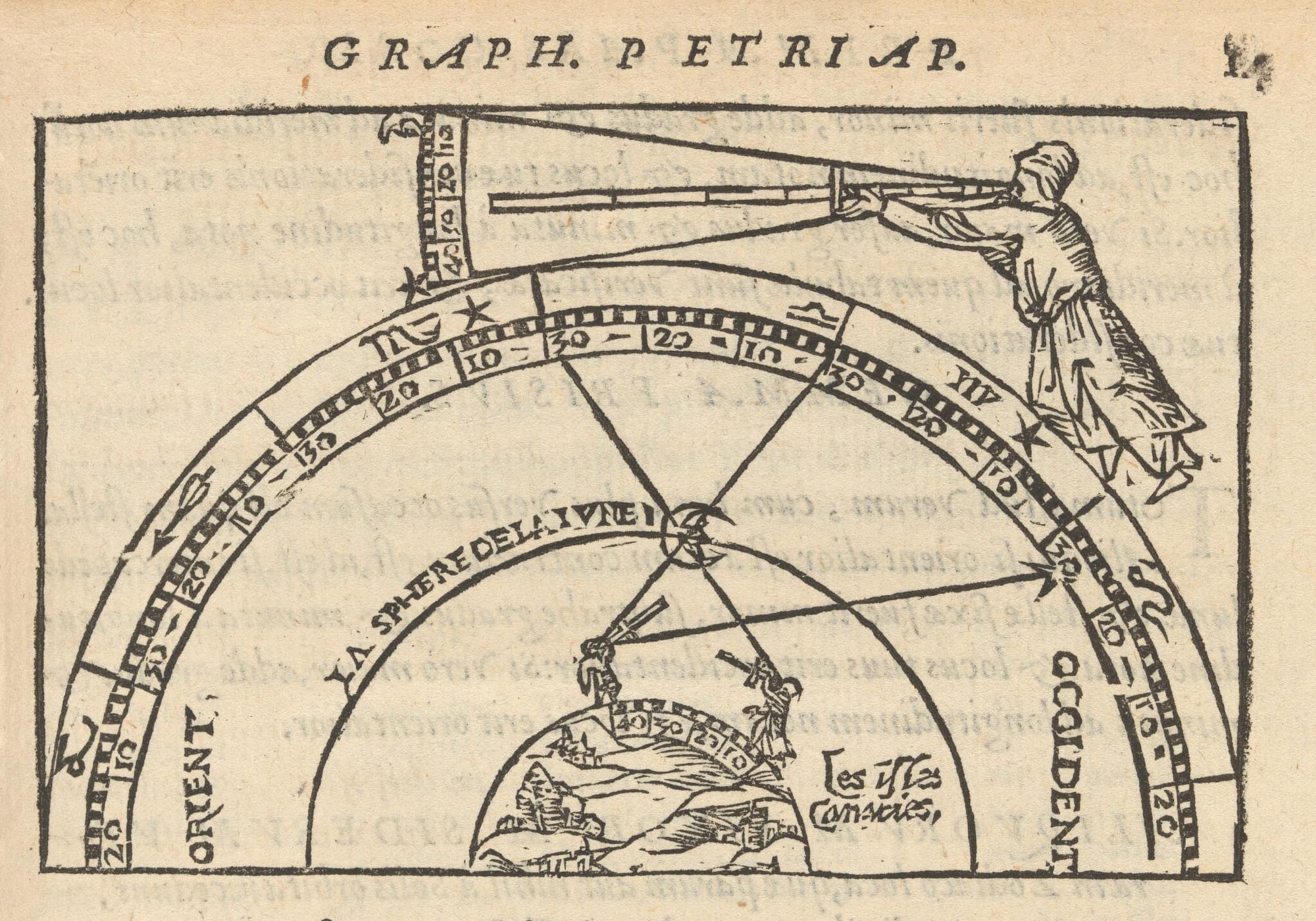
Nevil Maskelyne, the Astronomer Royal who would become Harrison's principal institutional antagonist, built his career on the lunar distance method. He published his Nautical Almanac in 1767 to make it practically accessible, and he believed in it with the conviction of a man whose professional identity depended on being right.
The horological solution was conceptually elegant: carry a reliable clock, set to the time of a known meridian, and compare it to local solar time wherever you are. But a reliable clock, in the middle of the eighteenth century, did not yet exist in the form that maritime conditions demanded. Changes in temperature altered the elasticity of springs and the dimensions of metal components. The violent and complex motions of a ship at sea affected every oscillating system in ways that bench testing could not completely replicate. Humidity attacked lubricating oils.
The forces involved in keeping a constant rate under these conditions pushed against the physical limits of what clockmaking craft had achieved. Both Britain and France recognised the problem formally in the same year. The British Parliament passed its Longitude Act in 1714, creating the Board of Longitude and granting a prize of twenty thousand pounds, a sum worth millions in contemporary terms, for any method of determining longitude at sea to within thirty miles on a voyage to the West Indies.
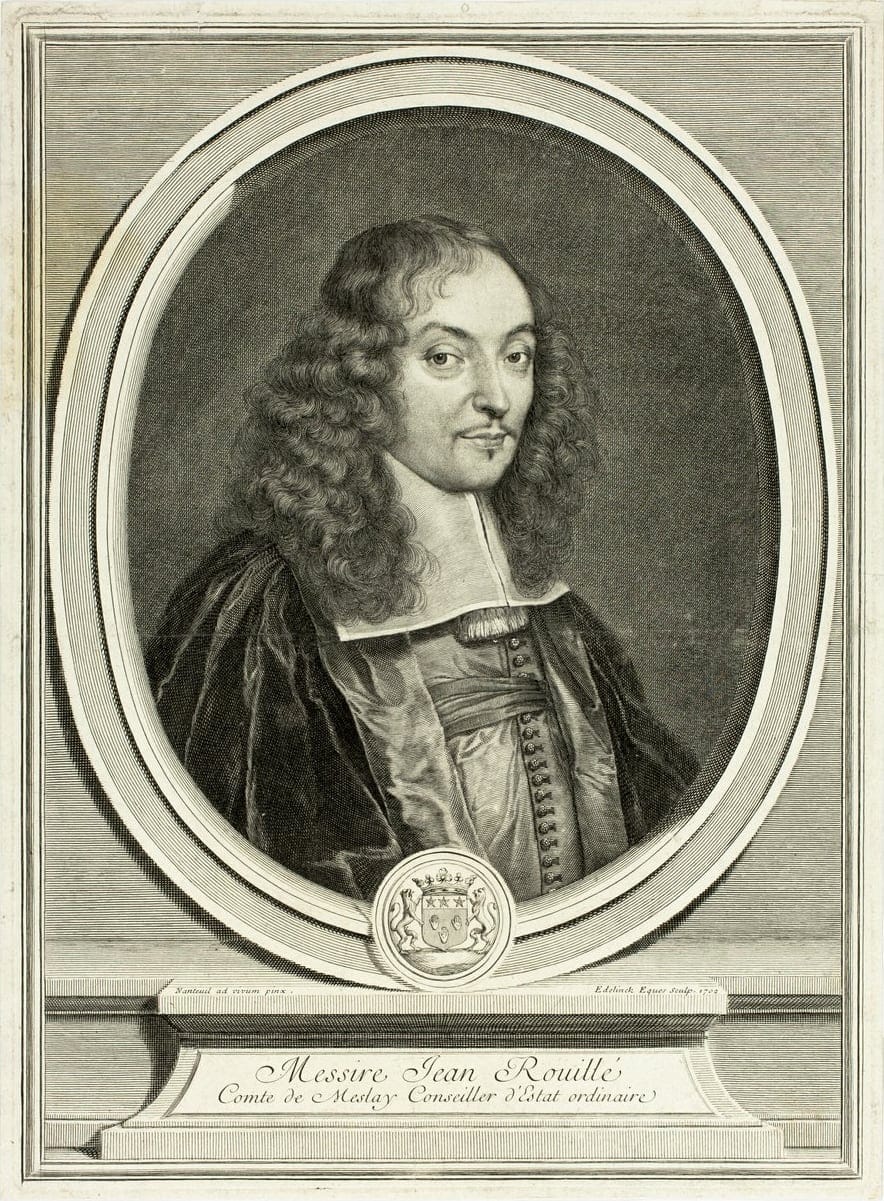
That same year, a Parisian count named Jean-Baptiste Rouillé de Meslay died and left 125,000 livres in his will to the Académie royale des sciences to fund prizes for significant problems in maritime science, specifically the measurement of time at sea. The Meslay prize operated biennially, the interest on the bequest distributed in alternate cycles, with the possibility of combining unclaimed prizes into a prix double of doubled value.
The first prize was awarded in 1720, after Meslay's son mounted a four-year legal challenge to his father's will, describing the goal of measuring longitude as an impossible chimaera and the bequest as extravagant. The Academy won the case. The prize endured. The two institutions reflected two different Enlightenment philosophies of how scientific problems should be solved.
The Board of Longitude was a government body created by parliamentary statute, funded from public revenue, and empowered to disburse a single grand prize on the satisfaction of particular conditions. It was, in theory, a mechanism for rewarding achievement. In practice, it became a mechanism for questioning, delaying, and qualifying achievement in ways that protected existing hierarchies of scientific authority.
The Meslay prize was a private endowment administered by an academy of scientists that awarded periodic rewards for particular contributions. It had less money and prestige, but also less politics. What the French system lacked, what it could not provide by its very nature, was a ship.
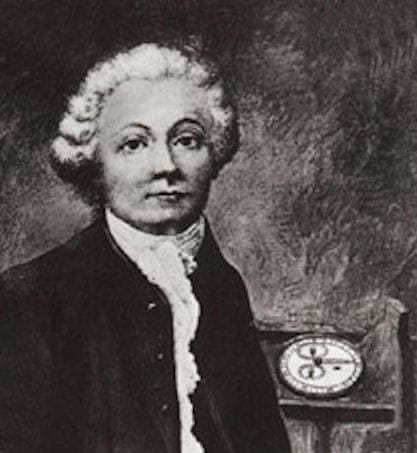
Pierre Le Roy was born in 1717, the eldest son of Julien Le Roy, the most admired French clockmaker of the early eighteenth century. Where his father had concentrated upon refining the pendulum clock and the pocket watch, Pierre turned his attention almost entirely to the particular demands of marine horology.
He was a theorist as much as a craftsman, someone who asked structural questions about why timekeepers behaved as they did rather than simply trying to make them behave better by incremental refinement. This orientation would prove decisive. By the mid-1760s, he had developed three innovations that, taken together, represented a coherent and original theory of what a marine timekeeper should be. The first was the detached escapement.
In a conventional watch, the escapement, the mechanism that controls the release of energy from the mainspring to the gear train, is in continuous contact with the balance wheel, the oscillating element that governs the rate. Every variation in the force of the mainspring, every irregularity in the oil, every thermal expansion of a component transmits itself directly to the timekeeping.
Le Roy's pivoted detent escapement broke this continuous contact. It allowed the balance wheel to swing freely through the great majority of its arc, touching the escapement only for the brief instant required to receive an impulse. The rest of the time, the oscillator was, in the most literal sense, isolated from the mechanism. The purity of the oscillation was preserved against contamination by everything surrounding it.
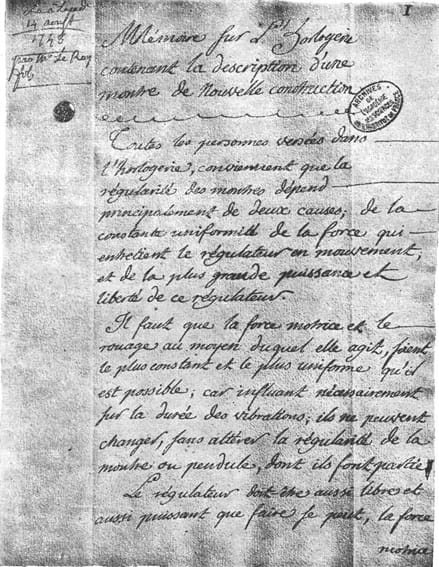
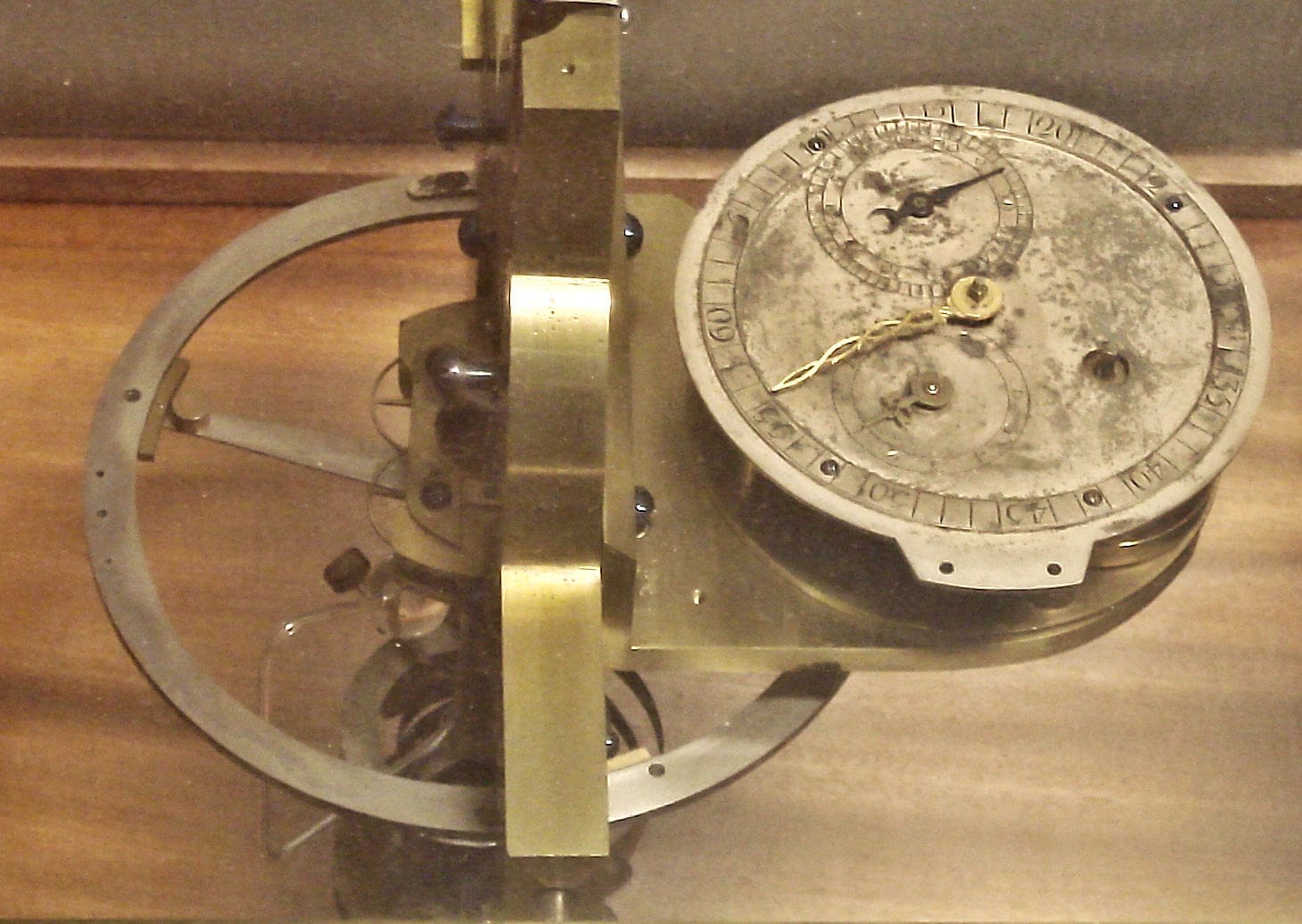
Le Roy had invented this principle as early as 1748. It would become the gold standard for precision mechanical timekeeping and remains so today. The second innovation was the isochronous balance spring. Le Roy determined that a spiral spring, when adjusted to a precise length and configuration, would oscillate at the same frequency regardless of amplitude, that is, regardless of whether the swing was wide or narrow. This isochronism meant that as the mainspring unwound over the course of a day, delivering progressively less force to the balance, the rate remained constant. The clock did not slow as it ran down.
The third was the temperature-compensated balance. Steel springs lose elasticity as temperature rises; the balance wheel expands, increasing its moment of inertia and slowing its oscillation. Le Roy addressed both effects simultaneously via a bimetallic balance wheel using brass and steel components arranged so that, as heat increased, small weights shifted toward the wheel's centre, reducing its effective diameter and counteracting the spring's softening. The watch corrected itself.
These three principles together constituted a philosophy of design. Where Harrison had pursued the longitude problem through mechanical mastery, H4 was a watch of astonishing complexity, operating at high frequency with an intricate system of remontoires to equalise the mainspring's force, virtually impossible to replicate and extremely difficult to repair at sea, Le Roy pursued it through what he called a more philosophique approach. Isolate the oscillator from external interference. Make the oscillator inherently stable against the conditions it will encounter. Then the gear train, the mainspring, the wheels and pinions, need only be serviceable rather than perfect.
Harrison proved that a clock could work at sea. Le Roy proposed a design that anyone could eventually build, repair, and manufacture in quantity. The distinction, which seemed purely technical at the time, would determine the subsequent history of marine navigation.
That distinction, which appeared technical in the 1760s, became decisive in the 1780s and 1790s. Harrison’s H4 was a triumph of genius, but it was not easily reproducible. Le Roy’s architecture was. The marine chronometer that would steer fleets and merchant ships for the next century followed the French logic of isolation, compensation, and simplicity, not the mechanical density of H4.
By 1766, Le Roy had integrated these three principles into what his contemporaries called a chef-d'oeuvre, a masterpiece, and had presented it to Louis XV on the fifth of August of that year. The Academy was impressed. And then, because no one had yet organised a means of testing it at sea, nothing happened.
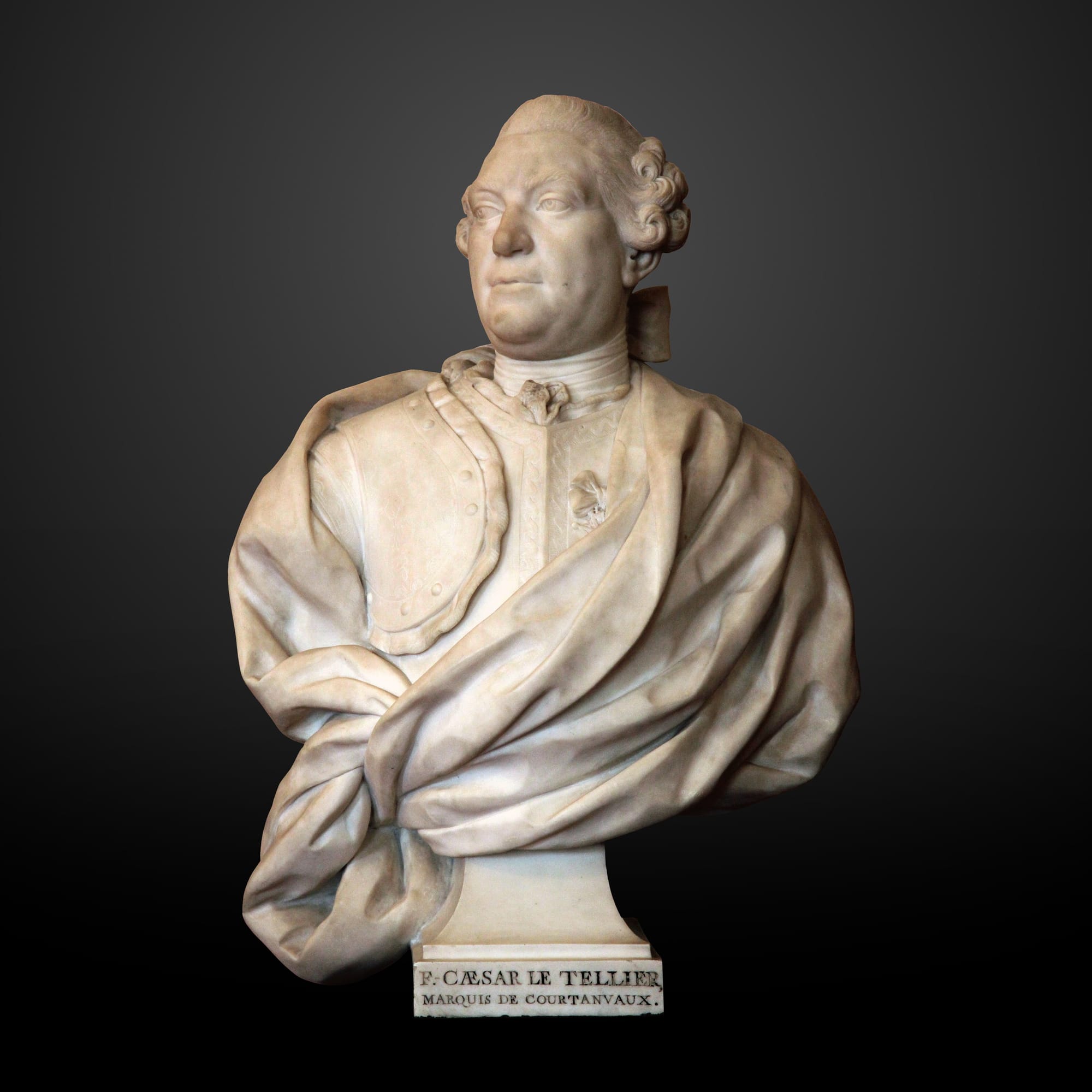
Into this vacuum stepped François-César Le Tellier, Marquis de Courtanvaux.
To understand what Courtanvaux did, it helps to understand what he was not. He was not a professional scientist, though he pursued chemistry, astronomy, natural history, and mechanics with genuine seriousness. He was not a naval officer, though he would learn seamanship competently enough to replace the pilot of his own ship on occasion. He was not a watchmaker, though he understood precision mechanisms well enough that Condorcet, in the memorial address delivered to the Académie royale in April 1782, described him as someone who could intuit the workings of a machine from its description alone and almost always improve its execution when he commissioned the construction himself.
Courtanvaux was an aristocrat of the highest order, a grandson of Louvois, a Grandee of Spain, a Duke, who happened to find the court world of social obligation and pleasurable vanity entirely intolerable, and who had converted his estate at Colombes, outside Paris, into a working scientific centre with its own chemical laboratory and observatory.
When health had forced him out of military service in 1745, after campaigns in Bohemia and Bavaria, Courtanvaux faced what Condorcet describes with characteristic eighteenth-century acuity as the most formidable enemy of all: idleness and the ennui that follows it.
Science rescued him. He worked with the Rouelle brothers in chemistry, constructed and refined astronomical instruments, and corresponded with scientists across Europe. His election to the Académie royale des sciences, filling the seat of his deceased son, the younger Marquis de Montmirail, whose death had preceded him, placed him at the centre of the institution at precisely the moment it needed someone with both the means and the temperament to act.
When the Academy announced the 1767 Meslay prize for the measurement of time at sea, Courtanvaux saw the problem with immediate clarity. Le Roy had instruments. Ferdinand Berthoud, his rival, had instruments. The Academy had a prize. What no one had was a ship.
He would build one.
The proposal was unprecedented within the records of French scientific patronage. Courtanvaux would fund the construction of a corvette at Le Havre, equip it as a scientific vessel, hire a crew, engage two members of the Academy as scientific observers, and lead the expedition himself. He sought and received royal permission to designate the vessel a frégate royale, a royal frigate, allowing it to fly the white ensign of the French Navy, a status that would facilitate its reception in foreign ports and lend the enterprise an authority that a privately commissioned merchant vessel could never have claimed. What could have been the hobby of a wealthy eccentric became, through this royal designation, a national scientific mission.
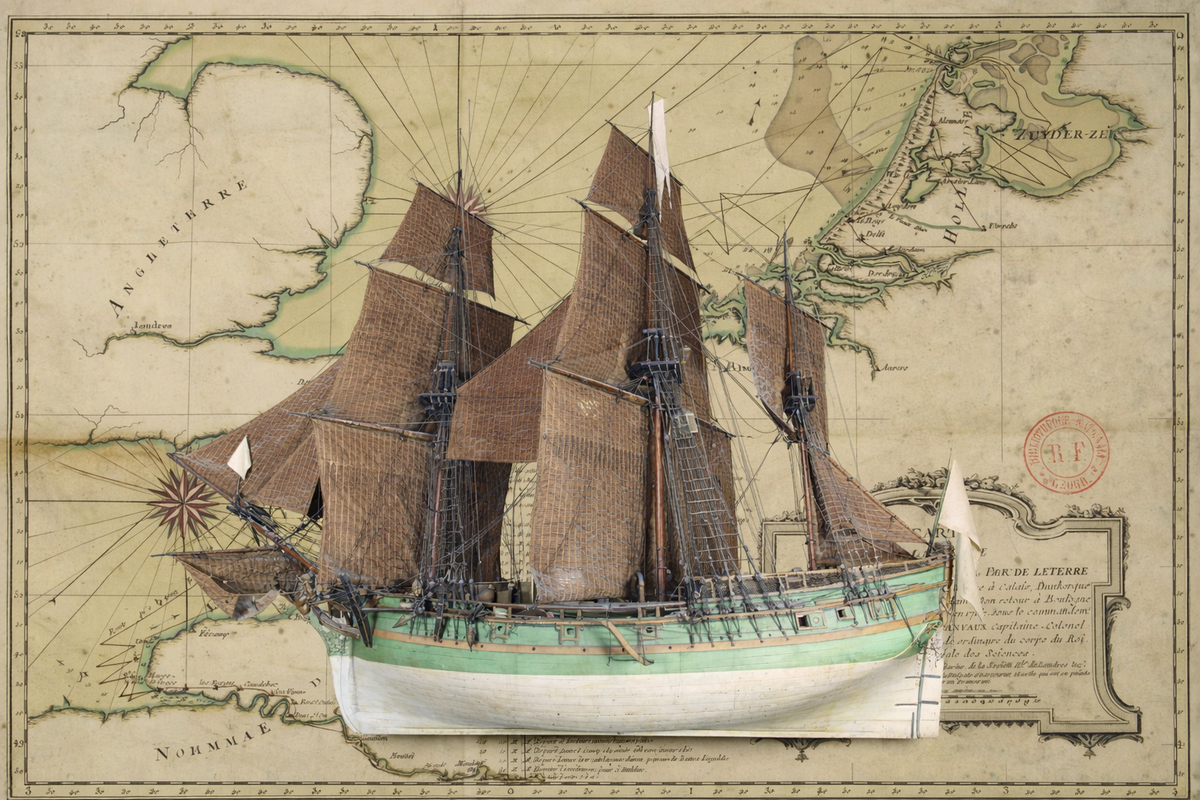
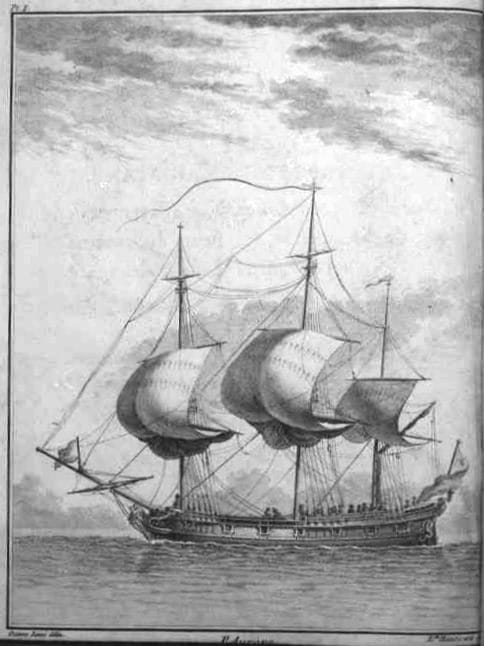
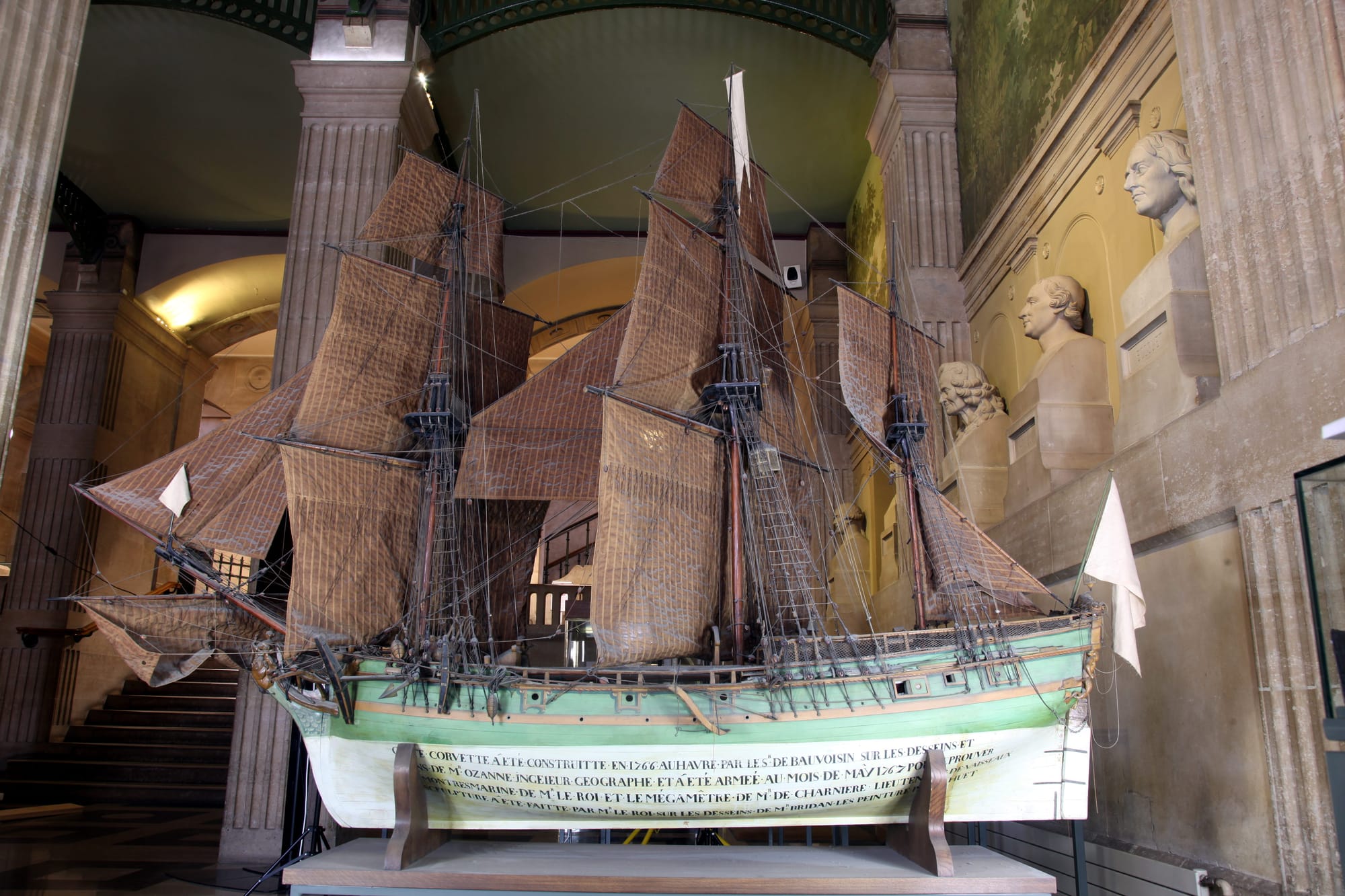
The ship was named the Aurore. She was designed by the naval architect Nicolas Ozanne and built at Le Havre by the constructor Bonvoisin: a two-masted snow-rigged corvette of 130 French tons, 21.6 metres long, 5.9 metres in the beam, armed with six light guns, crewed by twenty-four to forty men, including the scientific party. Small enough to enter shallow coastal waters and port anchorages for land-based calibrations, manoeuvrable enough to manage the complex tidal estuaries of Flanders and the Netherlands, fitted internally with a stable laboratory for the chronometers and a working space for the astronomical instruments of Alexandre-Guy Pingré and Charles Messier. A 1:12 scale model, constructed by craftsmen who had served on the voyage, survives today in the Bibliothèque Sainte-Geneviève in Paris. It is the only physical remnant of the ship.
Pingré was a regular canon of Sainte-Geneviève, an astronomer of considerable standing, and the Academy's nominated witness to the trials, appointed, in the language of the published journal, to cooperate in the verification of the instruments de concert avec M. Messier, Astronome de la Marine. Messier was already famous for cataloguing the nebulae and star clusters that obstruct the search for comets; his marine chronometer work belongs to the largely unremembered practical dimension of a career remembered almost entirely for objects in deep space.
The captain, Mathieu Chopin, was a professional mariner. Courtanvaux's personal secretary, La Chapelle, completed the party.Le Roy arrived in Le Havre with his instruments enclosed in their carrying boxes. Two watches. One, the 1766 masterpiece; the other, a less-tested prototype. The formalities of installation were conducted with a level of precision that reflected exactly the stakes.
The ceremony of the keys deserves attention.
When Le Roy's watches were placed aboard the Aurore in their sealed boxes, the keys were distributed among three custodians. Le Roy retained one key. The commander, de Tronjoly, held a second. Pingré himself took charge of the third. No single person, not the maker, not the patron, not the Academy's representative, could open the boxes alone. Any access to the instruments required the simultaneous presence of all three custodians.
Far from a bureaucratic formality, this was a response to an entirely specific historical situation. In England, the Board of Longitude had invested years using procedural mechanisms, demands for further testing, requirements for technical disclosure, and delays in payment, that Harrison and his supporters believed were designed to prevent rather than evaluate his success.
When the Board finally compelled him to submit H4 to a ten-month examination at Greenwich in 1766 and 1767, the examination was conducted under the supervision of Maskelyne, who had simultaneously published the first Nautical Almanac as a working tool for the competing lunar distance method. The conflict of interest was institutional, structural, and apparently invisible to everyone charged with resolving it. Harrison's published technical principles, released as the legal condition of his partial payment, allowed other makers to study and eventually copy the mechanisms he had spent thirty years developing, before he had received what he considered adequate compensation.
In this context, the division of keys aboard the Aurore represents a mature understanding of what institutional integrity required. It protected Le Roy from any accusation that he had adjusted his instruments between observations. It protected the Academy from any suggestion that its scientific witnesses had been complicit in manipulation. It placed the instruments themselves beyond the reach of any single authority for the duration of the trial. The sealed box, the divided key, the witnessed observation, these were not exclusively scientific protocols. They were a translation of hard-learned English experience into French institutional design.
Courtanvaux's own published journal situates the French enterprise explicitly in relation to Harrison. In terms that reflect his thorough familiarity with the English situation, he notes that Harrison's watch had been scrupulously examined at the Royal Observatory of Greenwich over ten consecutive months, and had been found slightly too sensitive to changes in temperature. Harrison had provided a description of his watch's mechanism.
And while Harrison was working in England, Courtanvaux writes, several French Artistes, artisans, in the elevated eighteenth-century sense, were consecrating their working nights to the same object. Pierre Le Roy. Ferdinand Berthoud. They did not despair of equalling and surpassing even Harrison.
The word même — even — does a great deal of work in that sentence. It acknowledges Harrison's achievement as a benchmark while positioning the French effort not as imitation but as independent competition. So the Aurore was not built to copy Harrison's work, but to prove something different.
The Aurore was officially commissioned on 19 April 1767 with the appointment of Captain Chopin. She put to sea on the morning of 14 May before a crowd of officials and townspeople at Le Havre, for first trials.
A week later, she came back to port.
On 21 May, attempting the first leg of the voyage toward Calais, the ship ran into a severe gale and was forced to retreat. During the enforced wait at Le Havre, Pierre Le Roy discovered that one of his two watches had been damaged in transit. The journey from Paris to Le Havre, by road, in a coach, over indifferent surfaces, had subjected the instruments to precisely the kind of violent motion that the sea trials were designed to assess.
Montre A, the 1766 masterpiece, appeared to have suffered. M. Leroy attribuoit cette accélération à un accident arrivé à la montre sur le chemin de Paris au Havre. Le Roy attributed the watch's subsequent irregular behaviour to an accident that had occurred on the road from Paris to Le Havre. Montre B, the least tested prototype, was more severely damaged and was not initially included in the trials.
Working with whatever tools he could find in Le Havre, a port, not a watchmaker's workshop, Le Roy attempted repairs. It was exactly the kind of field condition for which his design philosophy had been developed: the detached escapement and the compensated balance were meant to be maintainable by a competent maker without a fully equipped workshop. Whether the repairs on Montre B were ultimately successful would become one of the trial's central questions.
At the same moment, on the English side of the Channel, Harrison was in the middle of his ten-month ordeal at Greenwich. The examination of H4 under Maskelyne had begun in July 1766 and would continue until May 1767. Every day of the Aurore's storm-delayed departure, Harrison's watch was being observed and recorded under institutional conditions that its maker believed were designed to find fault rather than confirm performance.
The Board had already determined that H4 was sensitive to temperature, a finding Harrison disputed, and was preparing to publish his mechanical principles as the condition of partial payment. He had begun work on H5 that year, a fifth watch, partly to produce an instrument of undeniable quality and partly, one suspects, because he was the kind of man who could not stop building.
Two clockmakers. Two nations. Two testing regimes. The same summer.
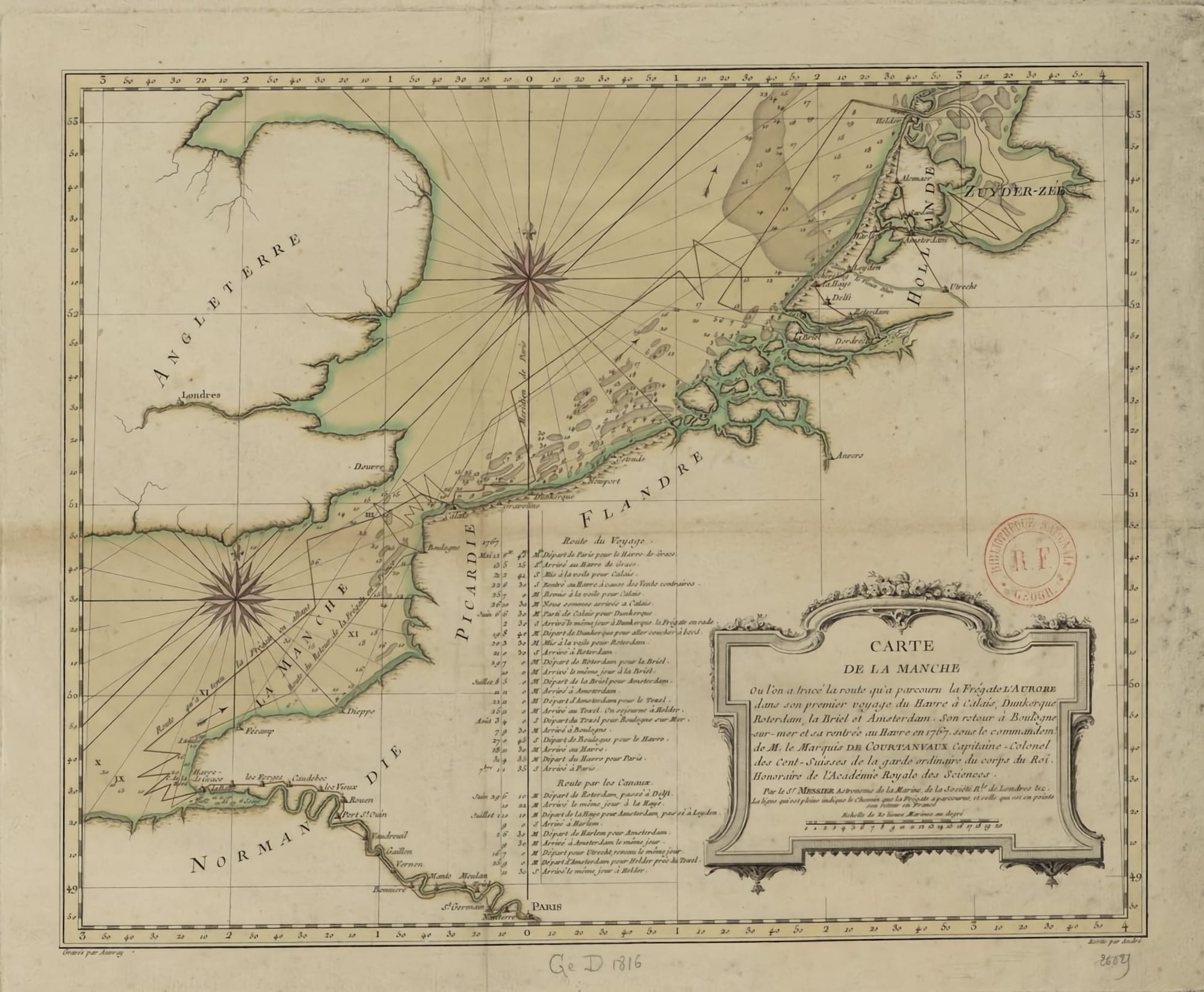
The Aurore finally put to sea again on 6 June 1767. She reached Dunkirk that evening, narrowly avoiding another storm. Pingré and Messier went ashore and established a temporary observatory to determine the port's precise latitude and local time by astronomical observation. This stop-and-start methodology was fundamental to the trial's design: the watches remained running aboard ship while the astronomers on shore established the ground truth against which the instruments' readings would be checked. Comparing the watch's indicated time with the locally observed solar time at each port call yielded the accumulated rate error over the intervening period. Dunkirk to Rotterdam to Amsterdam, each port a calibration point, the cumulative error building or diminishing with every leg.
The voyage to Rotterdam was slow. Unfavourable winds trapped the ship in the estuary of the Meuse for nearly a week. On the night of 6 July, an attempt to seize a brief change in wind nearly ended catastrophically: a sailor fell overboard in the dark and was pulled back only at the last moment, and the Aurore collided with a Dutch merchantman in the confusion. Science and the sea had always been in this kind of negotiation with each other, but the negotiation was never purely theoretical.
The critical moment of the first expedition arrived at Brielle on 5 July. Le Roy had completed his field repairs on Montre B. He handed the watch to Pingré, who had been travelling independently by land. Although Le Roy remained hesitant about officially entering the repaired instrument in the competition, it had not been calibrated with the same rigour as Montre A before departure, Pingré accepted custody. The watch began its trial late, under improvised conditions, repaired in the field by its maker. These were not the circumstances anyone would have designed.
The scientific party reunited in Amsterdam on 11 July. The Dutch capital received the expedition as a scientific and social event of significance; Courtanvaux engaged in what the journal calls 'touristic endeavours', visiting collections and dignitaries, while the astronomers took their measurements, and the watches continued their accumulation of time.
The ship moved to Texel, was delayed again by foul weather, and put to sea on 3 August. On the night of 4 August, at sea, the party observed an aurora borealis. Pingré recorded it. The northern lights over the North Sea, the watches ticking below decks, sealed in their boxes, their keys distributed among three men, it is one of those moments where the human scale of historical science becomes suddenly vivid.
The Aurore returned to Le Havre on 28 August 1767. The trial had lasted fifty-two days of outbound passage.
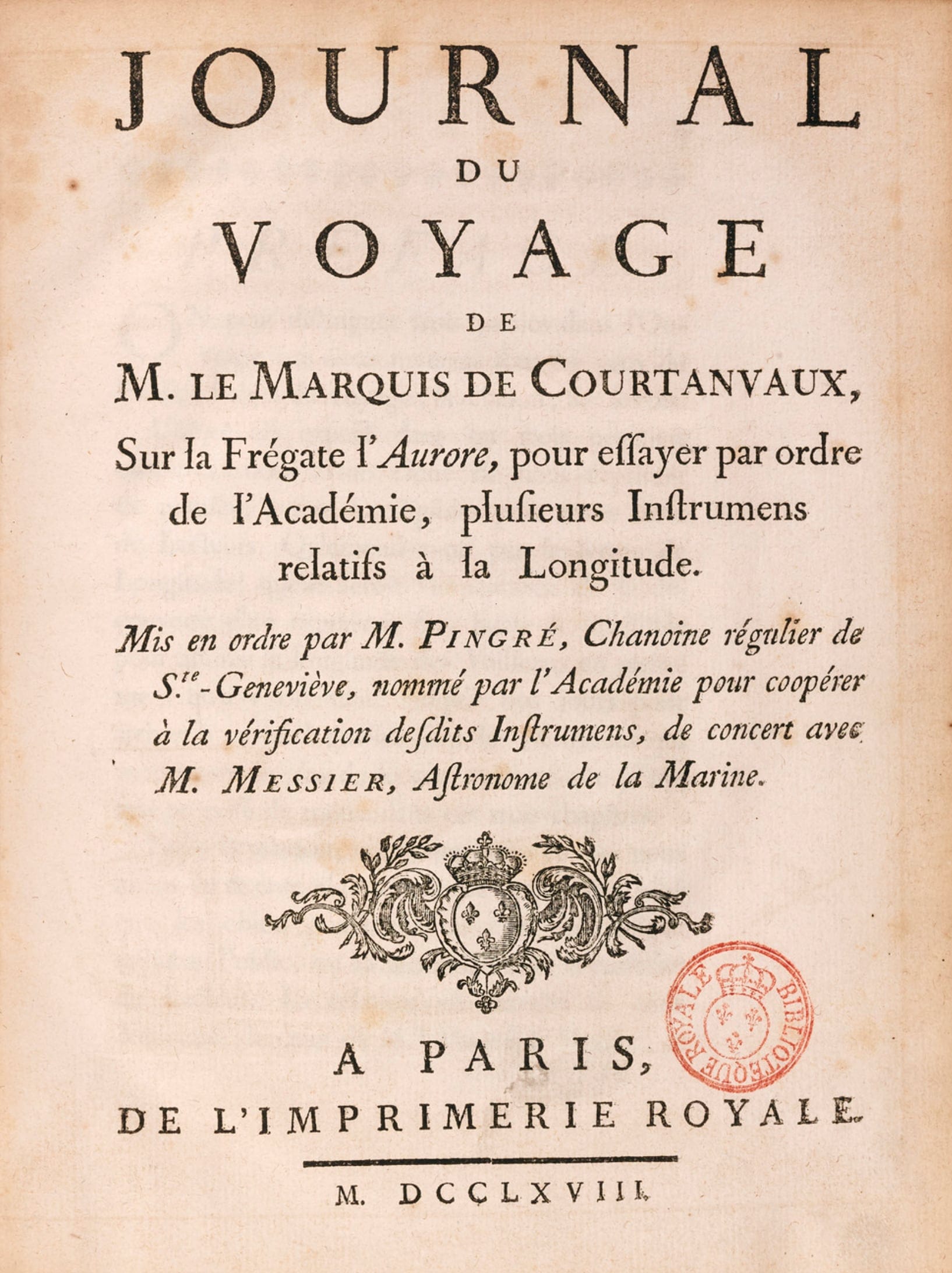
The results were analysed against the astronomical data gathered at each port. Montre A, the 1766 masterpiece, damaged on the road, repaired under pressure, had accumulated an error of four minutes and forty-one seconds over fifty-eight days, produced by the watch's daily rate accelerating from twenty-seven and a half seconds per day at Le Havre to nearly thirty-seven by Amsterdam.
Courtanvaux was precise about the implications. Chapter XIV of his published journal states that the watch's motion was not uniform from Le Havre to Amsterdam, showing successive degrees of acceleration. He calculated the resulting longitude error directly. The number he records, erreur en cinquante-huit jours de 4' 41'', was not a figure to be proud of. If Montre A had been blindly trusted, a navigator would have accumulated an error of just over one degree of longitude, roughly sixty nautical miles at mid-latitudes. Ships had been lost on errors far smaller.
But Courtanvaux does not conceal the irregularities, and he does not abandon the analysis. He weighs which watch is at fault, considers whether the source of the discrepancies lies in one instrument rather than the other, and concludes that the acceleration in Montre A traces to the road accident before the voyage began. This analytical honesty is itself significant. The trial was not designed to produce a triumph. It was designed to produce data.
Montre B related a different story.
The repaired prototype, handed to Pingré at Brielle after weeks of inactivity and field repair, had behaved with exceptional consistency. Le mouvement de la seconde montre a été bien plus uniforme que celui de la première. Over the outbound voyage, its accumulated error had been only fifty-one seconds of time, equivalent to less than four leagues of positional error even at the equator. More extraordinary still, in the later phases of the voyage, the watch had been wrong by only 15.5 seconds. A watch that had arrived at its trial damaged, had been repaired under improvised conditions by its maker in a foreign port, and had been handed to its custodian weeks late, had demonstrated a performance that put it within touching distance of the most celebrated timekeeper in the world.
Harrison had proved that a clock could survive at sea. Courtanvaux's journal, in its careful comparative examination, proved something equally important: that Le Roy's design principles were producing consistent results even under the worst conceivable pre-trial conditions. Montre A's failure was the failure of a damaged instrument, not a failed design. Montre B's success was the success of the design, not the luck of a surviving instrument.
The Academy was satisfied with what it had seen. But it was not yet prepared to award the prize. The data was compelling; a second voyage, more ambitious in scope, would be required for institutional confirmation.
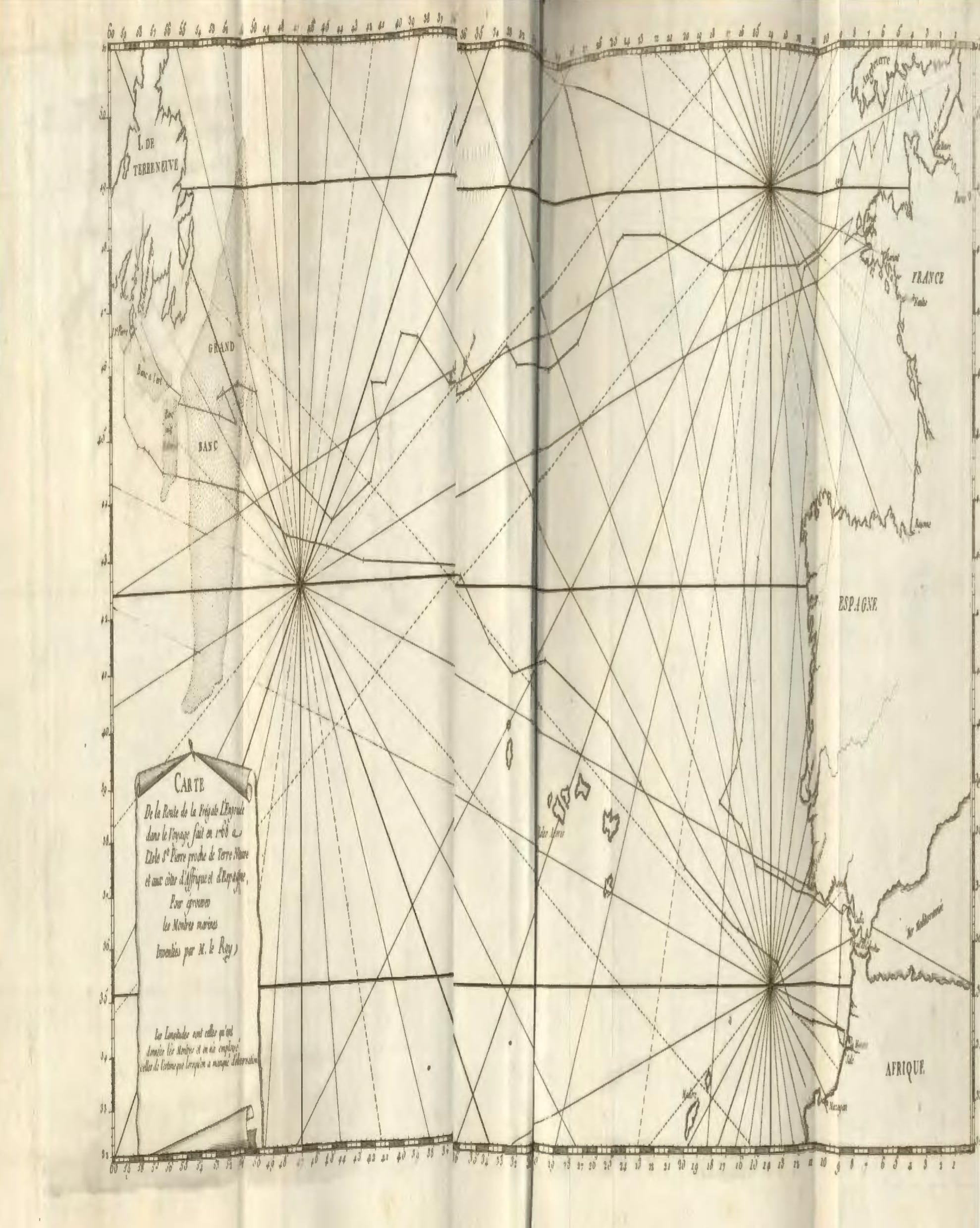
The second voyage was of an entirely different character. Where the Aurore expedition had been a private initiative, aristocratic patronage, experimental proof , a marquis's personal answer to an institutional problem, the 1768 commission came by royal order. The King's authority replaced Courtanvaux's cheque. Jean-Dominique Cassini, Cassini fils, the fourth generation of the dynasty of astronomers who had directed the Paris Observatory, commanded the expedition in place of the marquis. The institution had taken over from the patron.
The watches were the same. The scrutiny was considerably more intense.
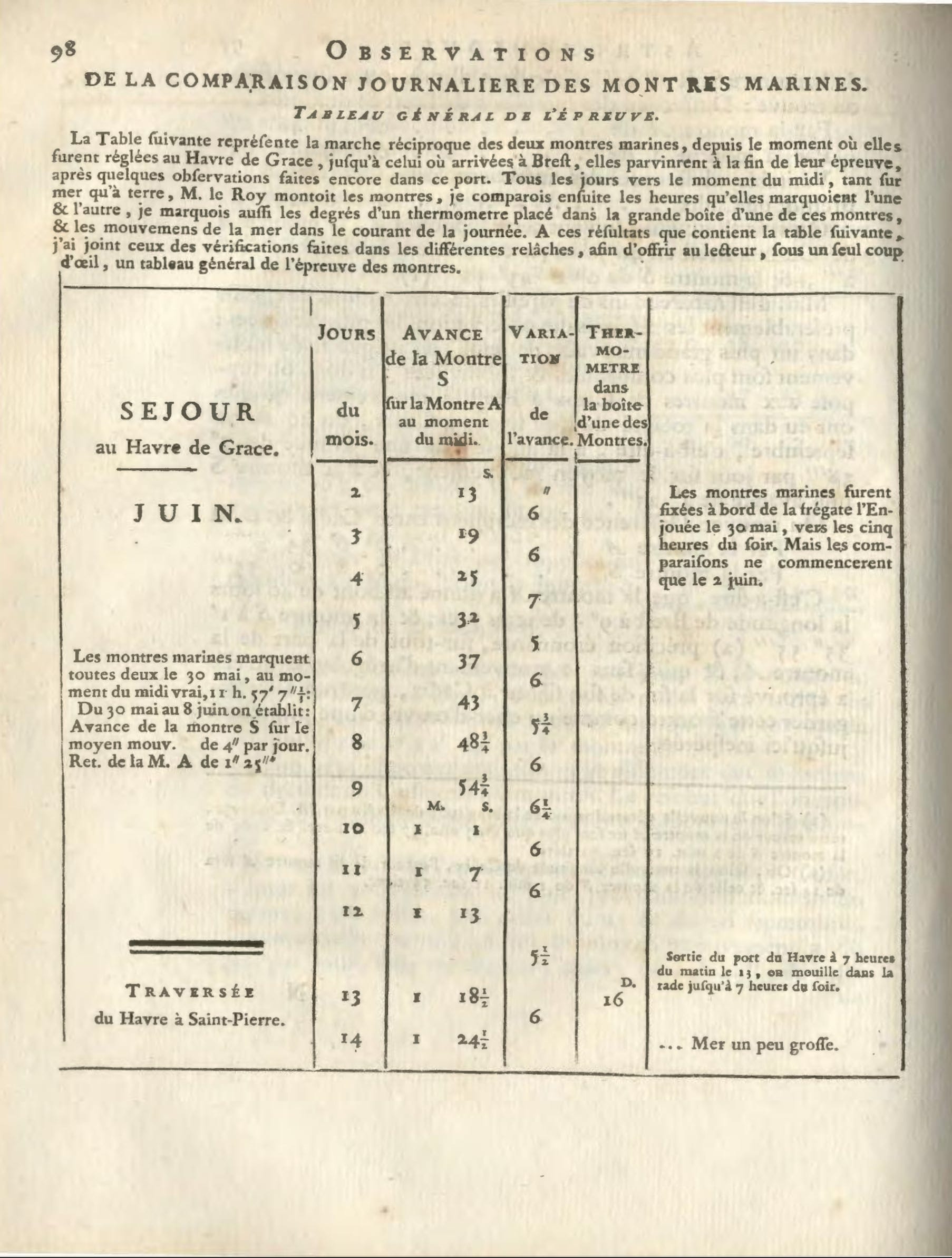
Le Roy's two instruments were regulated at Le Havre on 30 May, both set to within 1.5 seconds of mean time. The precise initial state was recorded in the formal procès-verbal. The exact setting operation was documented: Pour mettre les montres marines sur l'heure du temps moyen, au midi vrai... That methodology had been refined since 1767. What had been an experimental procedure aboard the Aurore was now a standardised protocol. Quantified deviation from mean time. Defined mean daily motion. The language of science had replaced the language of adventure.
The sealing of the boxes deserves the same attention it received in 1767. Le Roy proposed, and Cassini accepted, that the watch boxes be sealed with wax so that no one could access the interiors without the seal's rupture being immediately visible. De façon que l'on ne pût toucher à l'intérieur sans que la rupture du cachet n'en avertît aussitôt. After everything that had happened to Harrison in England, after the compelled disclosures and the disputed principles and the ten months of examination by a man who needed him to fail, Le Roy understood that the instruments' integrity had to be placed beyond procedural question.
The route of the 1768 voyage extended the Aurore's Channel and North Sea itinerary into genuinely oceanic conditions. Cassini crossed the Atlantic to Saint-Pierre-et-Miquelon, the small French islands off the coast of Newfoundland, before heading south to the African coast, then returning via Spain and Portugal. It was, compared to the Aurore's three and a half months in familiar waters, something close to a circumnavigation of the North Atlantic. The watches would face the full range of maritime conditions: oceanic swells, tropical heat, North Atlantic fog, and the temperature differential between northern Canada and the African coast.
During the Atlantic crossing toward Saint-Pierre, between 10 and 19 July, one of the watches showed irregular behaviour. The sea, Cassini notes, had been relatively calm throughout, il y eut toujours assez belle mer et peu d'agitation. What the crossing had provided instead was fog. Les brumes les plus affreuses, the most frightful fogs. Cassini's interpretive conclusion was careful and specific: Je crois donc pouvoir attribuer à la seule montre S le désaccord… et pouvoir en rejeter la cause sur l'humidité des brumes, et non sur les mouvements d'agitation de la mer. He attributed the discordance to the humidity of the fog rather than to the motion of the ship. Moisture, not movement.
This is an extraordinarily precise analytical step. The Greenwich examination of H4 concluded that Harrison's watch was slightly too sensitive to temperature changes. The 1768 French trial now isolated humidity as a separate variable, separating it from temperature and mechanical agitation. The experimental design had advanced from proof-of-concept to causal investigation. Where Greenwich had identified environmental sensitivity, the Atlantic voyage dissected it. What Maskelyne's Greenwich observations had identified as a general susceptibility to environmental conditions, Cassini's Atlantic crossing was beginning to anatomise.
Arrival at Saint-Pierre confirmed the discordance. The transatlantic verification against the island's known longitude provided the first verification of the watches' accumulated error over an ocean passage. The result was incorporated into the running comparison that Cassini maintained throughout, his daily comparison of the two watches against each other and against celestial observations, recording temperature, humidity, sea state, and any unusual event in a systematic journal. J'eus soin de tenir un journal exact des différentes circonstances de la température de l'air et des mouvements du vaisseau. The care with which he distinguished environmental causes was exactly the method that subsequent chronometer development would require.
The return voyage confirmed the results at multiple meridians. At Cádiz and then at Brest, Cassini checked the watches against the known longitudes of both ports, two return measurements, two confirmations, a triangulation. The institutional requirement was being met with institutional rigour.
The published report recapitulates the voyage with quiet thoroughness. The initial rates are restated, the daily comparison method reviewed, the anomalies accounted for. The accumulated error across the full voyage is calculated and set down: Montre A retarded at a daily rate of one second twenty-five; Montre S advanced at four seconds per day. Both figures subject to known environmental factors, both within the range of navigational utility, both reproducible under the stated conditions.
And then, after all of it, the voyage from Le Havre, the Atlantic crossing, the fogs off Newfoundland, the heat of the African coast, Cádiz, Brest, the daily journal, the sealed boxes, the wax, a single statement.
FIN de l'épreuve; les montres sont remises entre les mains de M. le Roy.
End of the trial. The watches are returned to the hands of Monsieur Le Roy.
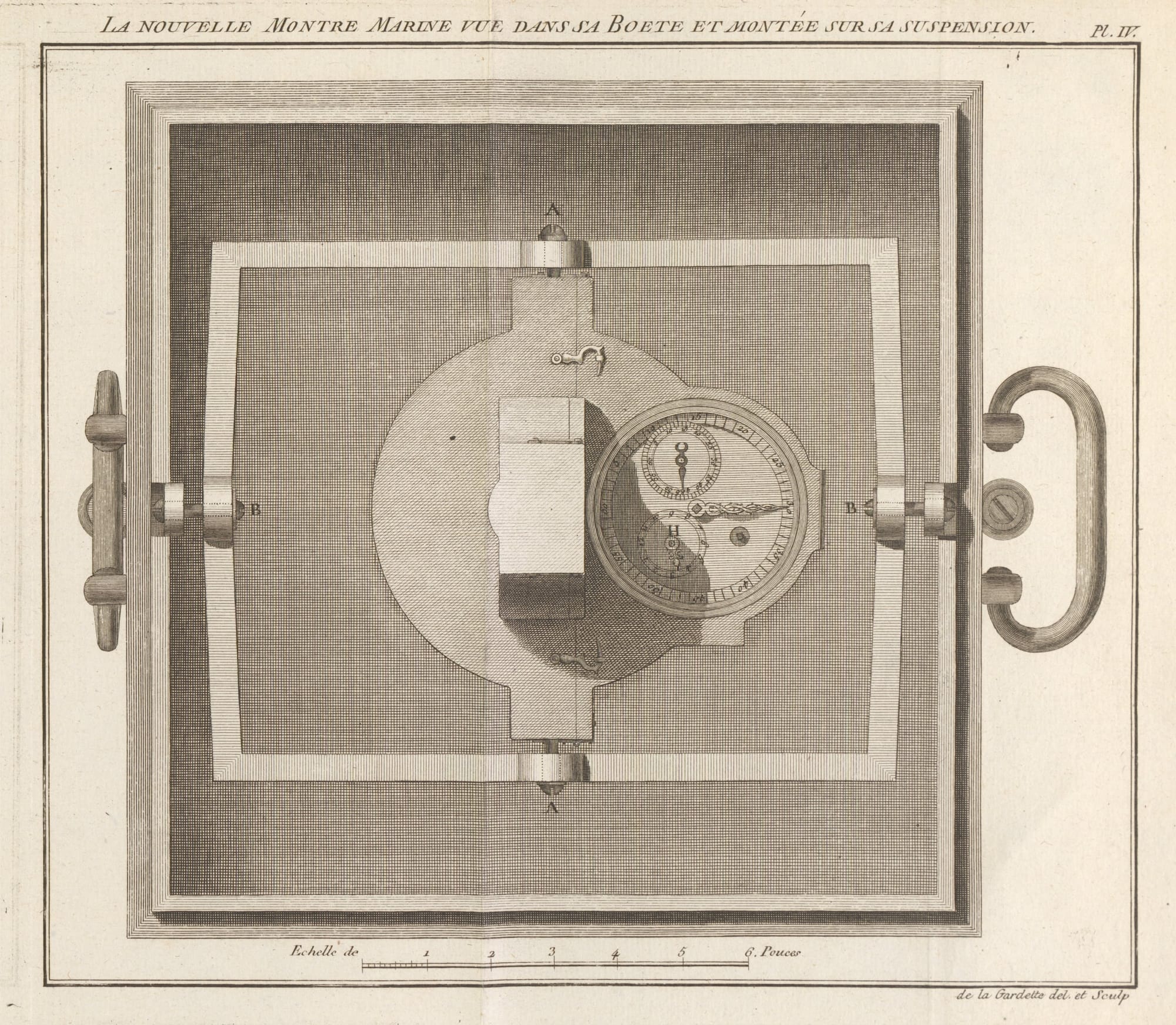
The Académie royale des sciences awarded Pierre Le Roy the combined 1767-1769 prix double, the doubled Meslay prize, in 1769. The citation praised both the inventive genius of his design and the proven performance of his instruments across two voyages. The published volume containing Cassini's voyage report, bound together with Le Roy's own Mémoire sur la meilleure manière de mesurer le temps en mer appeared in 1770, bearing on its title page the designation that the memoir had won the double prize at the Academy's judgment. Le Roy's title on the same title page: Horloger du Roi, Clockmaker to the King.
Not Horloger de la Marine. Not Clockmaker to the Navy.
That title, with its associated pension and state patronage, went to Ferdinand Berthoud in 1770.
Berthoud was a Swiss-born maker of immense technical skill, deep political intelligence, and a gift for institutional navigation that Le Roy entirely lacked. He had devoted years studying Harrison's work and had visited London in 1763 and 1766 specifically to inspect H4. Harrison refused to show him the mechanism, but Berthoud managed to extract significant details from Thomas Mudge, a member of the English disclosure panel who was himself a watchmaker of distinction and had his own complicated relationship with the Board of Longitude. Berthoud returned to Paris and produced his own marine clocks, tested during voyages of the Enjouée and the Isis, competent instruments though not, by the judgment of subsequent history, as theoretically rigorous as Le Roy's. His political skill, however, was precisely what Le Roy lacked. The man who won the scientific prize did not receive the state appointment. The man who received the state appointment had not won the scientific prize. Berthoud became the state. Le Roy became the theory. One secured institutional continuity; the other secured technical posterity.
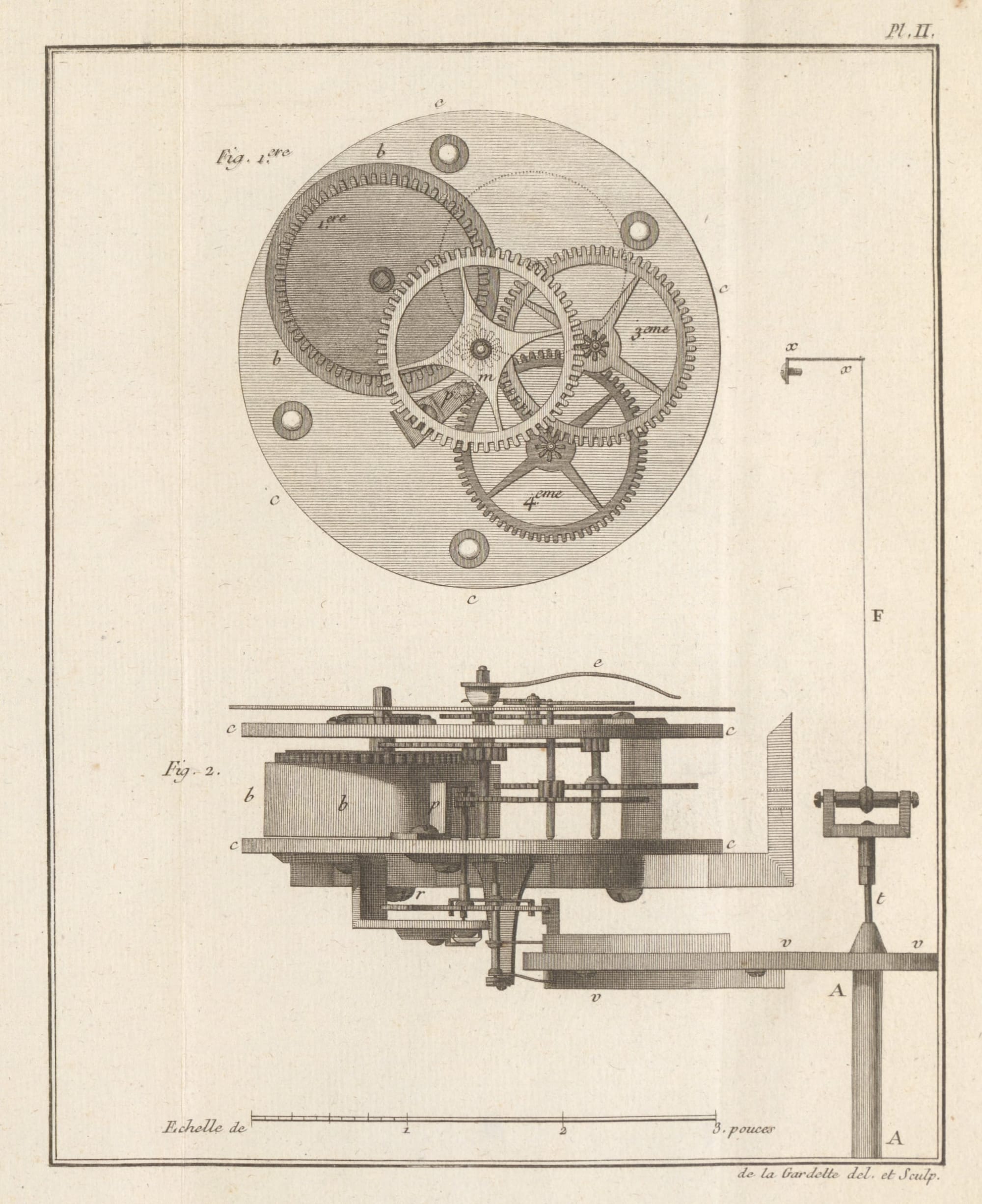
Le Roy retired from active horological competition. He continued to work, to improve his ideas, to write on the theory of precision timekeeping, but the great institutional contest of his career was over, its outcome at once a vindication and a disappointment.
Across the Channel, Harrison's story was reaching its own bitter resolution. The Board of Longitude, despite everything, had refused to accept that H4 met the conditions of the Longitude Act. The partial payments Harrison had received through the 1760s, each one conditional, qualified, contingent on further disclosure or further testing, fell far short of the twenty-thousand-pound prize. In 1772, aged seventy-nine, Harrison published a pamphlet addressed directly to the public: The Case of Mr John Harrison. Far from a scientific document, it was a complaint. The following year, he appealed to George III, who tested H5 at Kew over ten weeks and declared it accurate enough to navigate by. Parliament then voted Harrison a payment of £8,750, not the full prize, which the Board never formally awarded, but enough, at the age of eighty, to settle what could be settled.
Harrison died in 1776, on his eighty-third birthday, having spent more than forty years of his life directly engaged with the longitude problem. The money he received bore no relationship to the prize he had been promised or the value of what he had demonstrated. The institutional system had overwhelmed him and then, at the last moment, relented just enough to avoid the full dishonour of having let him die unpaid.
The English system rewarded demonstration; the French system rewarded design.
The subsequent history of the marine chronometer is a story of Le Roy's principles, propagated through English hands.
John Arnold, who had trained in London and was producing precision pocket watches of his own design by the 1760s, became aware of Le Roy's detached escapement and adapted it into the spring detent, a modification that made the mechanism more robust without sacrificing its isolation principle. Thomas Earnshaw, working in competition with Arnold through the 1780s and 1790s, refined the detent escapement into the form that became the worldwide standard: simpler, more reliable, and more easily manufactured than anything Harrison had produced. Both men drew on the intellectual architecture that Le Roy had built. Neither was shy about the debt, at least in a technical sense; the priority dispute between Arnold and Earnshaw consumed considerable energy and produced considerable litigation, but neither man disputed the essential French origin of the escapement principle they were competing to claim as their own improvement.
By the early nineteenth century, the marine chronometer, produced in quantity by English firms, sold to navies and merchant fleets across the world, and carried on every significant voyage of exploration and survey from Cook's second voyage onward, was, functionally, Le Roy's design perfected by English craftsmanship. The detached escapement. The compensated balance. The isochronous spring. Three innovations from the workshops of Paris, proven at sea on a privately funded French corvette in 1767 and confirmed by royal commission on the Atlantic in 1768, now manufacturing under English names at the standard of production Le Roy had always argued was possible. Harrison's practical impact, particularly through Cook's voyages, remains undeniable. But the chronometer that became standard was not H4.
Harrison's name became the popular story because it is the more dramatic story: the solitary craftsman against the hostile institution, the long fight, the ultimate vindication through royal intervention. It has the shape of a morality tale, and, in its essentials, it is true. But the marine chronometer that guided ships through the nineteenth century was not H4. It was an instrument designed according to principles that Le Roy established and two French voyages had proved. The English made it. The French invented it.
The Aurore was purchased by the French Royal Navy in 1769. She was struck from the naval lists in 1775. What remains is the scale model at the Bibliothèque Sainte-Geneviève, the model Courtanvaux commissioned, built by craftsmen who had served on the voyage, preserved through the Revolution that destroyed so much else of aristocratic France. It stands today in the library that was once the Abbey of the regular canons of Sainte-Geneviève, where Alexandre-Guy Pingré served, catalogued, and wrote. It is a gem of eighteenth-century naval craftsmanship, a ship within a library, carrying no sail and no cargo, going nowhere.
It carries everything.
Condorcet, delivering Courtanvaux's memorial address to the Academy on 10 April 1782, described the voyage of the Aurore as one of the fullest and happiest periods of the marquis's life, the time of its preparation, its execution, the rendering of its account. A man who had been bored by power and unmoved by vanity had found, in the practical organisation of a scientific expedition and the occasional replacement of a pilot at sea, something that satisfied him in a way that nothing else had. Cel Art si vaste, Condorcet calls the art of navigation, that art so vast, and perhaps the one among all arts that does the most honour to the human mind.
He was not wrong about that. What he could not have said, in 1782, was how the story would continue to be told — or rather, how much of it would not be told at all. The instrument that came back from the Atlantic in 1768, sealed in its wax-stopped box, its keys distributed among men who had crossed the ocean to keep them honest, carrying time from Le Havre to Saint-Pierre to Cádiz to Brest without losing more than could be accounted for by the most frightful fogs — that instrument, and the principles it embodied, would pilot the world for two centuries under other names.
There is, in all of it, both the injustice of history and its strange persistence. The work endures. The credit migrates. The sealed box keeps time. The names change.
The Journal du Voyage de M. le Marquis de Courtanvaux, sur la Frégate l'Aurore, pour essayer par ordre de l'Académie plusieurs Instrumens relatifs à la Longitude — compiled by Pingré and published by the Imprimerie Royale in 1768 — and the Voyage fait par ordre du Roi en 1768, pour éprouver les montres marines inventées par M. le Roy, by Cassini fils, published in Paris in 1770 with Le Roy's prize memoir, are the primary documentary sources for the trials described in this essay. Condorcet's Éloge de M. le Marquis de Courtanvaux, delivered before the Académie royale des sciences on 10 April 1782, provides the biographical foundation for the portrait of the marquis. A 1:12 scale model of the Aurore is preserved at the Bibliothèque Sainte-Geneviève, Paris; more documentation of the ship and her scientific mission is maintained at the digital archive voyage-aurore.bsg.univ-paris3.fr.