Meet Me Under the Clock

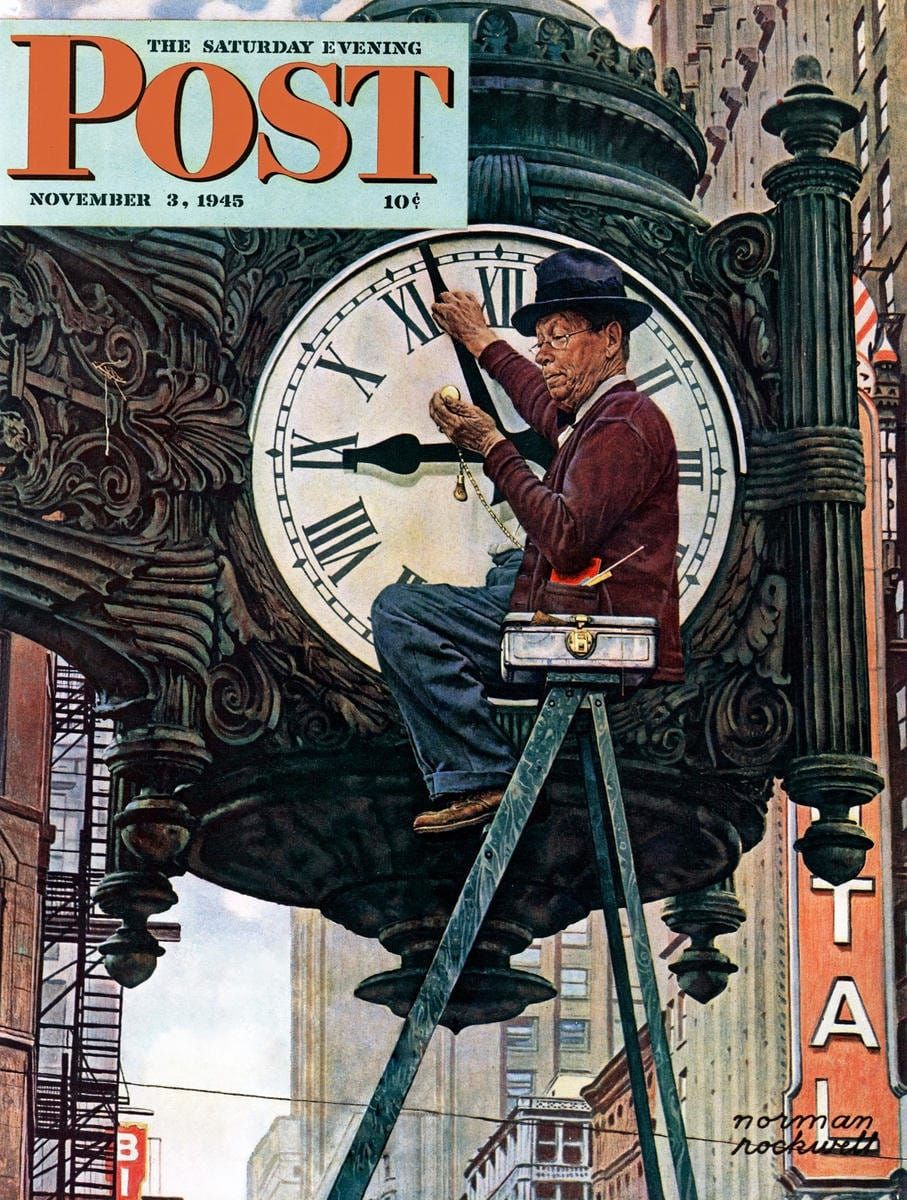
On the cover of the Saturday Evening Post for November 3, 1945, Norman Rockwell painted an elderly man setting a clock. The man is on a ladder, peering at a pocket watch held in one hand, using the other to move the hour hand of a great street clock, the kind that projects from a building's corner, horizontal to the pavement, readable from both directions on a busy street. It is a quiet painting. The repairman is concentrated, careful, slightly comic in his dotage. Chicagoans recognised the clock at once: it was the one at the corner of State and Washington, outside Marshall Field and Company. The painting ran nationwide, was widely reproduced, and, over the following decades, became one of the images most associated with the store and its landmark corner.
The engineers at Marshall Field and Company did not enjoy it.
Their objection was specific. The clock Rockwell painted was not set by a pocket watch. It was not set by hand at all, except under the most unusual circumstances. Since 1913, the store's master clock had received twice-daily radio corrections from Arlington, Virginia, where the Naval Observatory's high-power transmitter NAA broadcast time signals derived from astronomical observation. Those corrections fed a master clock, which sent hourly electrical impulses through the building's wiring to synchronise hundreds of subsidiary dials across nine acres of retail floor. The exterior clocks, the great bronze ones, seven and a half tons each, faces forty-six inches in diameter, were part of this network. To depict a man on a ladder, pocket watch in hand, was to depict a level of mechanical fallibility that Field's engineers found, by the accounts that survive, offensive.
Rockwell's model was a real Chicago watch repairman named David E. Hoxie, documented in Carlene Stephens's Marking Modern Times. Whether Hoxie had ever professionally serviced the Marshall Field clocks is not established in any of the sources examined here. What is clear is that Rockwell chose him for what he represented: the person responsible for the clock, the one who makes sure the city knows what time it is. That image was precisely what the store's engineers had designed their system to make unnecessary. The disagreement between the painting and the system behind it is not a small one. It is a question about what a public clock is for.
Notes on the Window
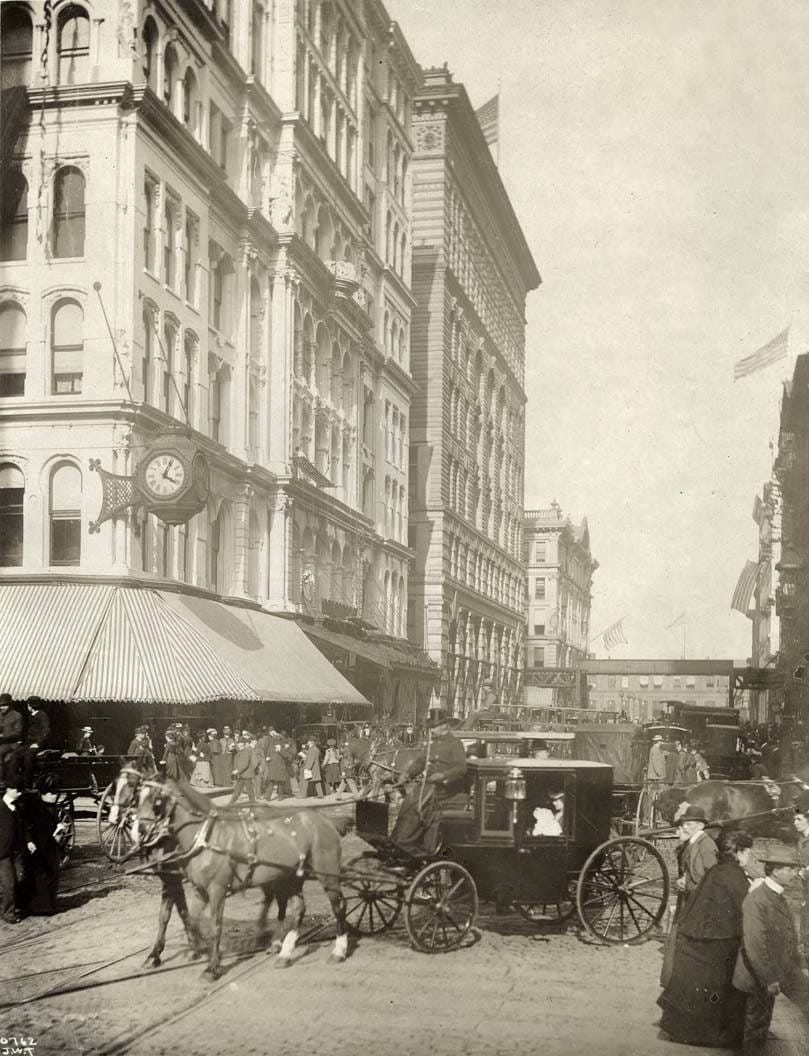
The first clock Marshall Field installed at State and Washington was not bronze and was not 7.5 tons. On November 26, 1897, a five-hundred-pound iron clock went up on the old Singer Building at the corner of State and Washington. Field did not install it for civic beautification, or at least that was not the primary impulse. He installed it because people were using his store windows as a message board.
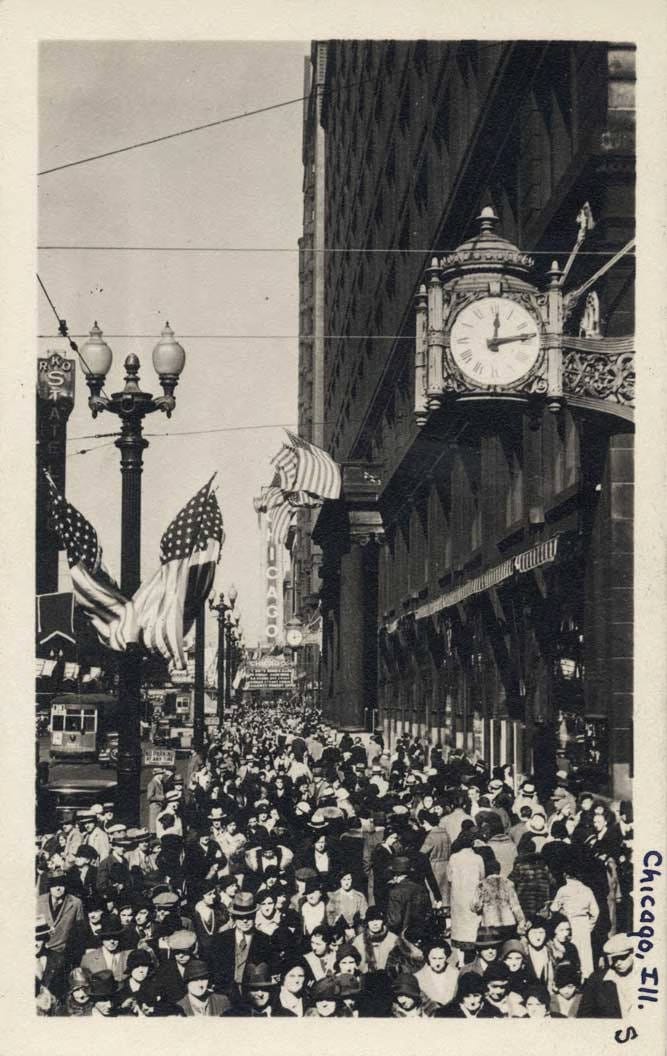
Chicagoans who arranged to meet friends downtown had no reliable shared landmark and no reliable shared time. When they missed each other, they left notes: scraps placed in window corners, whatever communicated that I was here, I'll be back. The store windows at State and Washington were apparently a preferred site for this practice. Field noticed it and installed a clock. The phrase that followed — meet me under the clock — became a fixture of Chicago social geography, the kind of phrase that passes so thoroughly into ordinary use that its origin becomes invisible. Above all, the clock was a place.
The Building and its Architects
The clock's transformation from a five-hundred-pound iron fixture to a matched pair of seven-and-a-half-ton bronze monuments was inseparable from the transformation of the building itself. The Marshall Field and Company building on State Street was not built at once; it accumulated between 1892 and 1914, under Daniel Burnham's firm, in stages that reflected both Field's expanding ambitions and the aesthetic movement, civic, almost ideological, that Burnham had helped crystallise at the 1893 World's Columbian Exposition.
The Field building's granite piers and Corinthian columns were claims about what Chicago was and intended to become. The Classical Revival vocabulary was a declaration; this building belonged to a city that intended to be taken seriously. Contemporaries called it a Temple of Commerce, and the phrase was intended both architecturally and commercially.
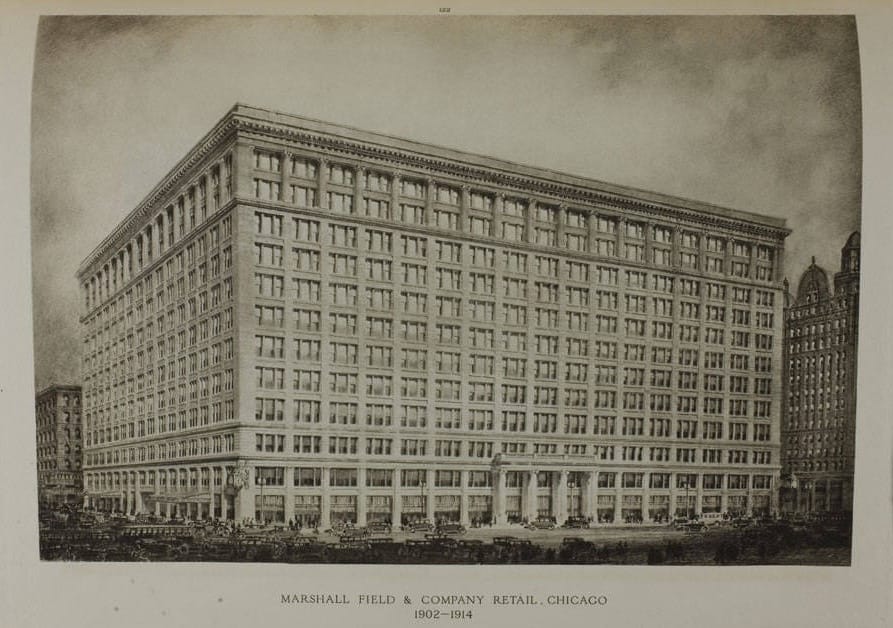
Two members of Burnham's firm were principally responsible for the building. Pierce Anderson, formally William Peirce Anderson, held an unusual combination of credentials: an electrical engineering degree from Harvard and an architecture degree from the École des Beaux-Arts. Burnham had recognised Anderson's technical capacity and personally urged him toward Paris. The dual training was rare among architects of the era, and it mattered here. The Marshall Field building required more than stone and steel; it required a complex electrical network, including the horological network that this story is about. Anderson is credited with the State Street facade and, specifically, the design of the corner clocks. His engineering background ensured that the clocks were structurally integrated into the building's steel and granite frame, part of the building, not additions to it. A persistent attribution in Chicago popular history gives the clocks to Louis Comfort Tiffany, whose Favrile glass dome is the building's other great set piece; there is no documentary evidence for it.
Ernest Graham, Burnham's most trusted protégé, managed construction and execution. He had come up through bricklaying and apprenticeship in Grand Rapids, and his practicality anchored Burnham's ambitions in the material world. He oversaw the multi-stage construction across more than two decades, and after Burnham's death in 1912, reorganised the firm as Graham, Anderson, Probst & White. The clocks, as they stand, are the product of two firm identities and two generations of construction. Burnham's vision carried through to completion by the men who succeeded him.
The Evolution of the Clocks: 1897 to 1907
The iron clock at Washington Street stood for seven years before the building's northward expansion made its inadequacy visible. In 1904, as construction extended toward Randolph Street, a second clock was installed at the new corner: a bronze clock, cast to a scale commensurate with the new facade, weighing seven and a half tons. The disparity between it and the 1897 iron clock at Washington must have been striking from the pavement. In 1907, when the final section of the building was complete, the iron clock was replaced with a bronze counterpart in line with the Randolph Street installation. The two clocks that exist today are not the product of a single design decision but of a decade of architectural development toward symmetry.
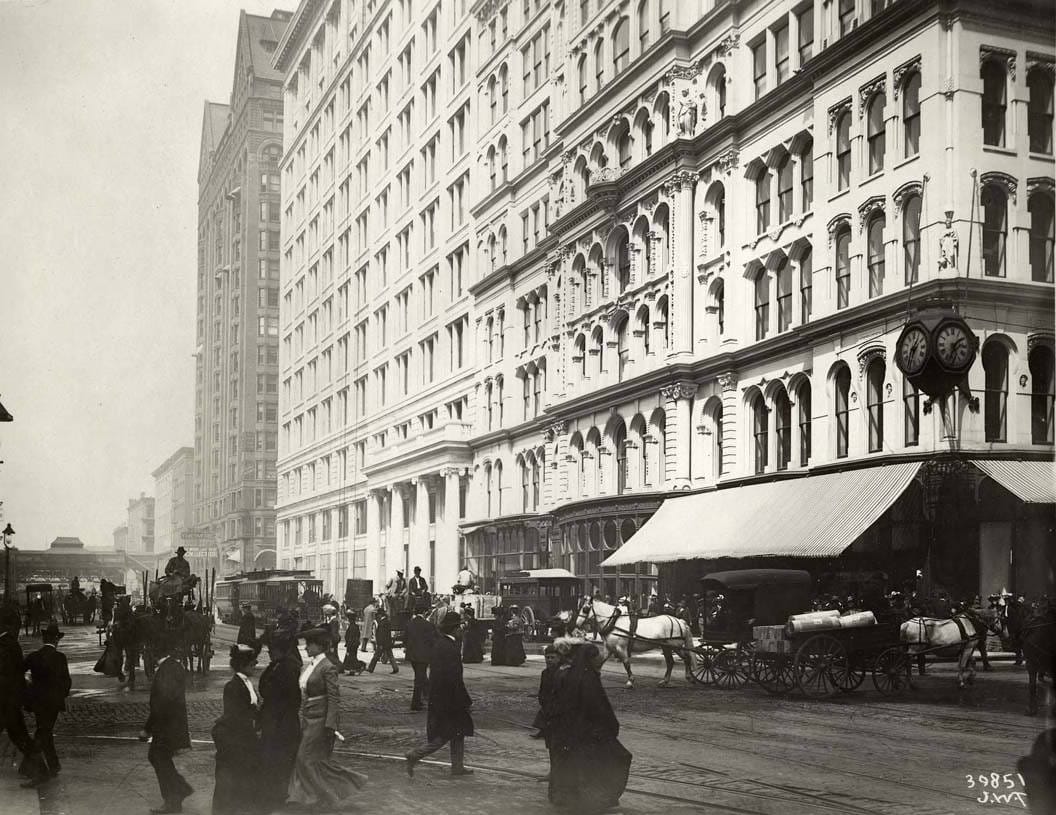
Multiple technical specifications survive from period sources. Each clock face measures forty-six inches in diameter. The hour hand runs twenty and a half inches; the minute hand, twenty-seven. Both hands are made of wood, a detail that surprises people who expect bronze or steel, given the scale of the housing. The choice was functional. The electromechanical movement driving the hands required a torque load that would allow it to move precisely and without strain. Wood is light enough to satisfy that requirement and rigid enough to resist the wind conditions on State Street. A metal hand of the same length would have added mass without improving accuracy.
The Hanberg Dispute
In September 1907, just as the Washington Street installation was being prepared, Chicago's Commissioner of Public Works, John Hanberg, intervened. He classified the Marshall Field clocks, along with those of Spaulding and Company and others, as 'projecting signs' in violation of city ordinances and ordered their removal within five days.
The dispute turned on the definition. Hanberg's position was that the clocks were a corporate advertisement in physical form. Field's representatives argued they were public infrastructure: essential timekeeping for citizens who did not carry personal watches, which in 1907 represented a substantial proportion of the urban population. After several weeks of negotiation, Hanberg rescinded the decree on September 25, 1907, on one condition: the clocks would remain permanently free of advertising features and corporate logos. Both clocks stand today without a Marshall Field name, without a Macy's name, without any corporate marking at all. The street got what Field's lawyers argued it deserved. The clocks belong to the street, which is precisely what Field's people argued in 1907, and precisely the concession they were required to make it true.
The Self-Winding Clock Company and the Style 'F' Movement
The mechanical intelligence behind the clocks came from New York. The Self Winding Clock Company, founded by Chester Henry Pond and operating between 1886 and 1970, supplied the movements and, more fundamentally, the engineering philosophy that enabled the installation. The company's central innovation was the elimination of manual winding. This sounds modest until you understand the specific problem it solved.
Traditional clock movements store energy in a mainspring wound by hand, typically once a week. As the spring runs down, it delivers less torque, and that declining force produces a declining rate that accumulates into error a competent repairman could measure but not eliminate. The SWCC's solution was to rewind the spring electrically every hour, keeping the torque delivered to the escapement effectively constant throughout operation. The effect is comparable to that of a remontoir d'égalité, though where a true remontoir interposes a separate equalising spring between the power source and the escapement, the SWCC achieved the same constancy by rewinding the mainspring itself at short intervals.
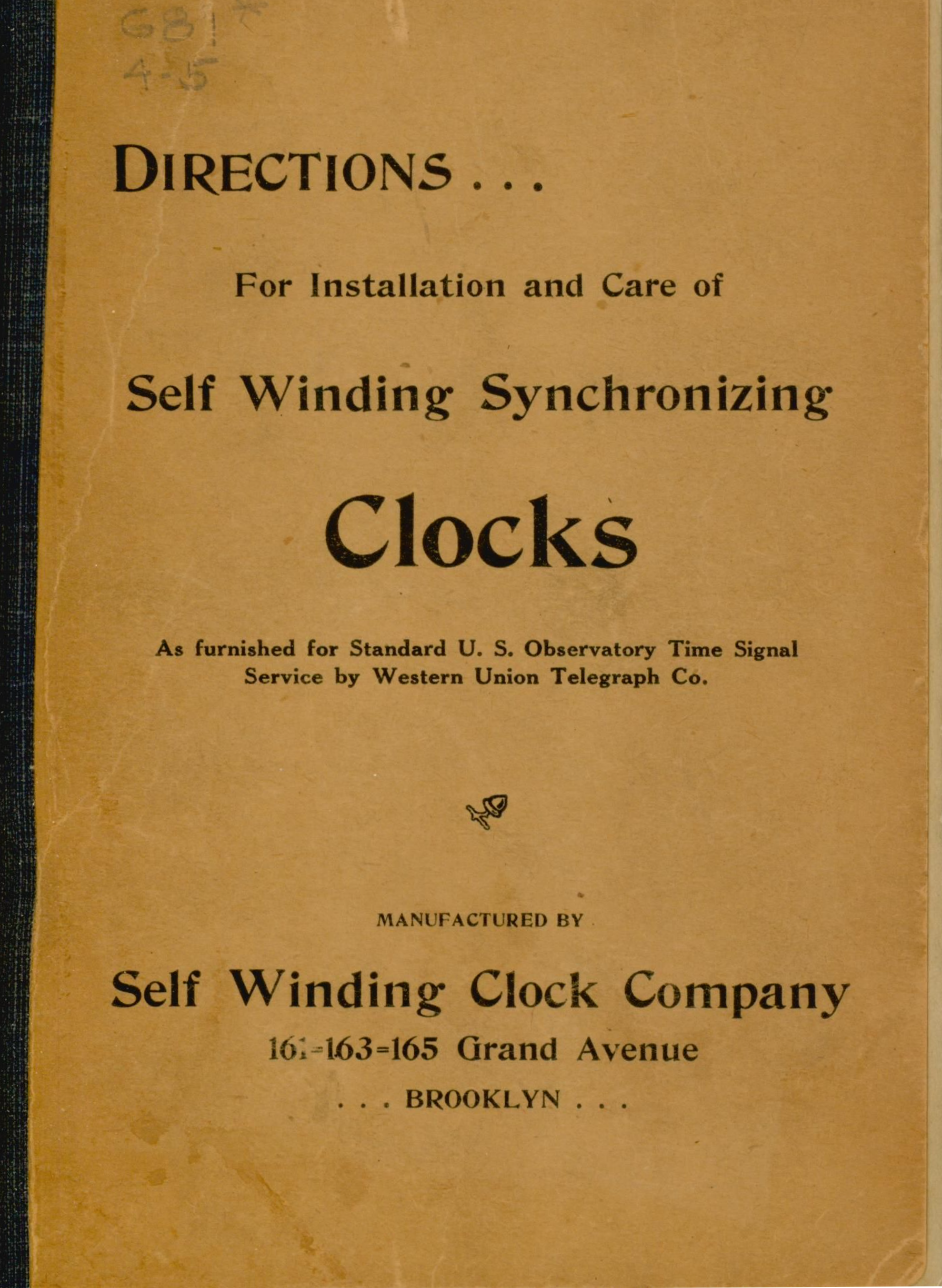
The movement used in the Marshall Field exterior clocks was the Style 'F', also known as the Vibrator movement. Its operation is mechanically uncomplicated to describe. As the centre arbour completes its hourly revolution, a pin engages the winding contact sector, completing the electrical circuit. Current from the building's battery supply energises a pair of coils, which attract a vibrating armature. The armature oscillates (the SWCC's own documentation compares it to the hammer of an ordinary electric bell), driving a pawl against the ratchet wheel, which turns the winding gear and stores energy in the mainspring. When the spring reaches full tension, a knockaway piece disengages the sector, breaking the circuit and ending the winding cycle. The clock then runs on the spring until the hourly sequence repeats.
The movement uses a recoil anchor escapement, with a pallet, crutch wire, and escape wheel, working in the standard configuration shown in the company's own engineering drawings. What the Style 'F' achieves, mechanically, is an isochronal condition, constant torque delivered to the escapement, that a manually wound clock cannot sustain across a week-long run-down. Because the spring was rewound every hour rather than once a week, the torque delivered to the escapement remained effectively constant, and with it the rate. The combination of frequent electrical rewinding and a well-regulated escapement gave the Field clocks a degree of beat-to-beat consistency that no manually wound street clock of the period could have approached.
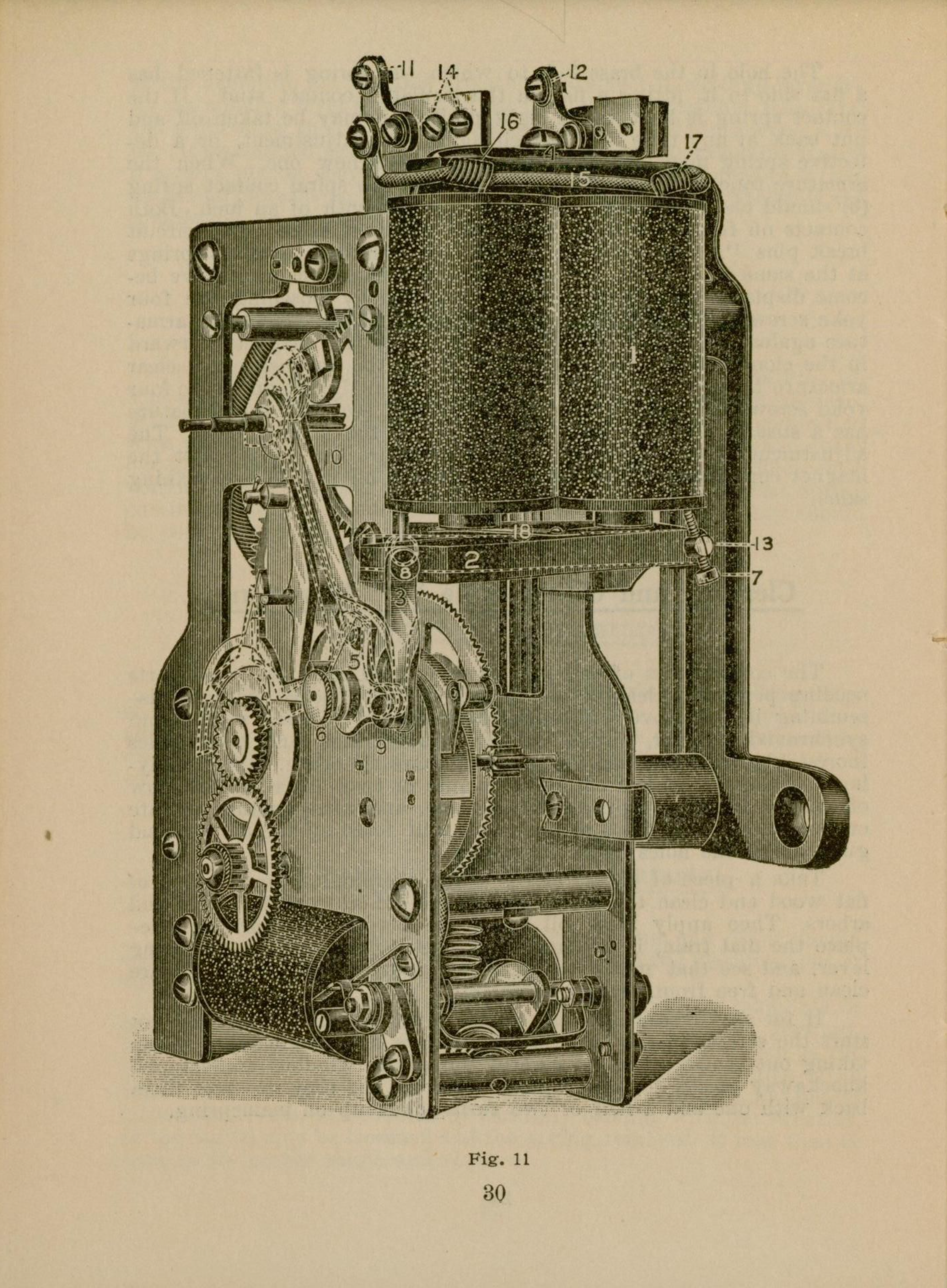
The SWCC operated through Western Union's Time Service Department, whose repairmen were responsible for installing and servicing the movements across the network. The Field installation was one node in a national infrastructure of synchronised public time, maintained by the Western Union Time Service Department's dedicated corps of clock repairmen.
The Master Clock and the Arlington Signal
The exterior clocks were the most visible component of a larger system. Inside the building, a master clock governed hundreds of subsidiary dials, one per department, across nine acres of retail floor. Every hour, the master clock sent an electrical impulse through the building's wiring. Each slave clock carried a synchroniser attachment: coils and levers that, when energised, physically corrected the hands to the top of the hour. A clock that had drifted 30 seconds over the previous 60 minutes was physically moved to 12:00, 1:00, or 2:00. The entire building operated on the same second.
The master clock's own accuracy was maintained by a higher authority. From 1913, it received twice-daily radio corrections from NAA, the Naval Observatory's high-power transmitter in Arlington, Virginia. The NAA signal was among the most precise public time signals available in the United States, derived from astronomical recordings and specifically established to provide institutions with access to Observatory time. The Marshall Field system included a latch mechanism that opened approximately fifty seconds before the hour and closed fifty seconds after, preventing the incoming signal from disturbing the hands mid-movement. Within that window, any accumulated drift was corrected.
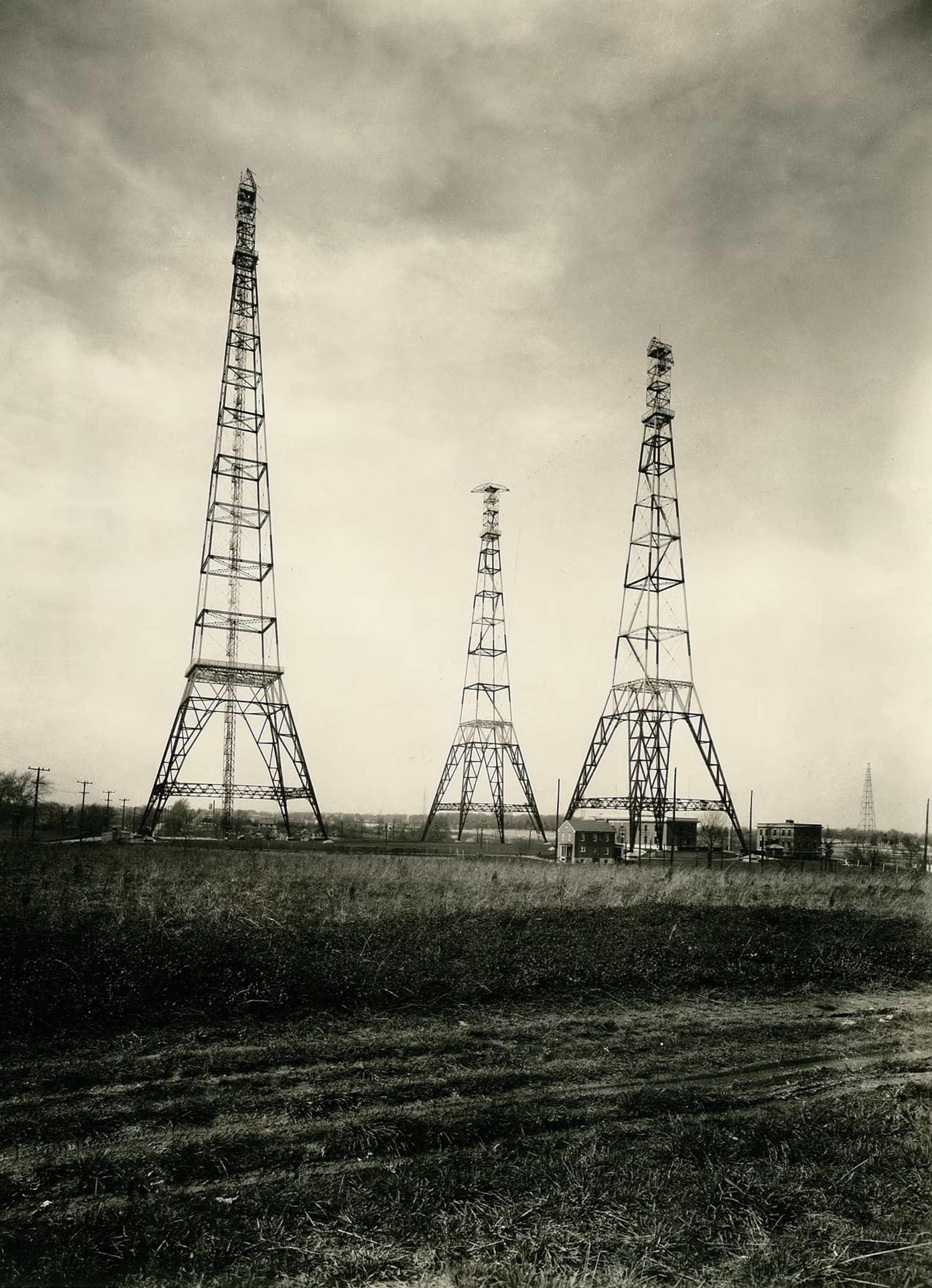
The claim that Marshall Field's clocks provided Chicago with its standard time is present in contemporary marketing and has been repeated since. It was partly true and partly promotional. Other institutions received the same NAA signal. What was genuinely unusual was the scale of the internal network, a single building in which the master clock answered to a radio signal from Virginia, the slave clocks answered to the master, and the exterior clocks answered to all of it. The pocket watch Rockwell's repairman consulted was accurate, in the best cases, to perhaps thirty seconds a day. The Field system's accumulated error, between NAA corrections, was a small fraction of that.
What Rockwell Got Right
The engineers were correct that the painting misrepresented the clock's mechanism. Rockwell's repairman with his pocket watch was, technically, a fiction. The clock he depicted had not required that intervention since at least 1913, if it ever had.But Rockwell was not painting the mechanism.
The painting's subject is the relationship between a person and a public clock, the implicit assumption that someone, somewhere, is making sure it tells the right time. That idea holds even when, by 1945, the responsible party was a radio signal from Virginia. The clock still needed to be right. The city still needed it to be right. The man with the pocket watch is the human face of that requirement, and Rockwell understood that a human face was what it needed.
Rockwell's audience on that November 1945 cover did not know what a Style 'F' Vibrator movement was, and had no reason to. What they saw was the clock. What they understood, without needing to articulate it, was the claim the clock made on the street: this is the time, this is where you wait. The woman who left a note in Marshall Field's window in 1896 did not need to be accurate to the second. She needed a place fixed enough for her friend to find.
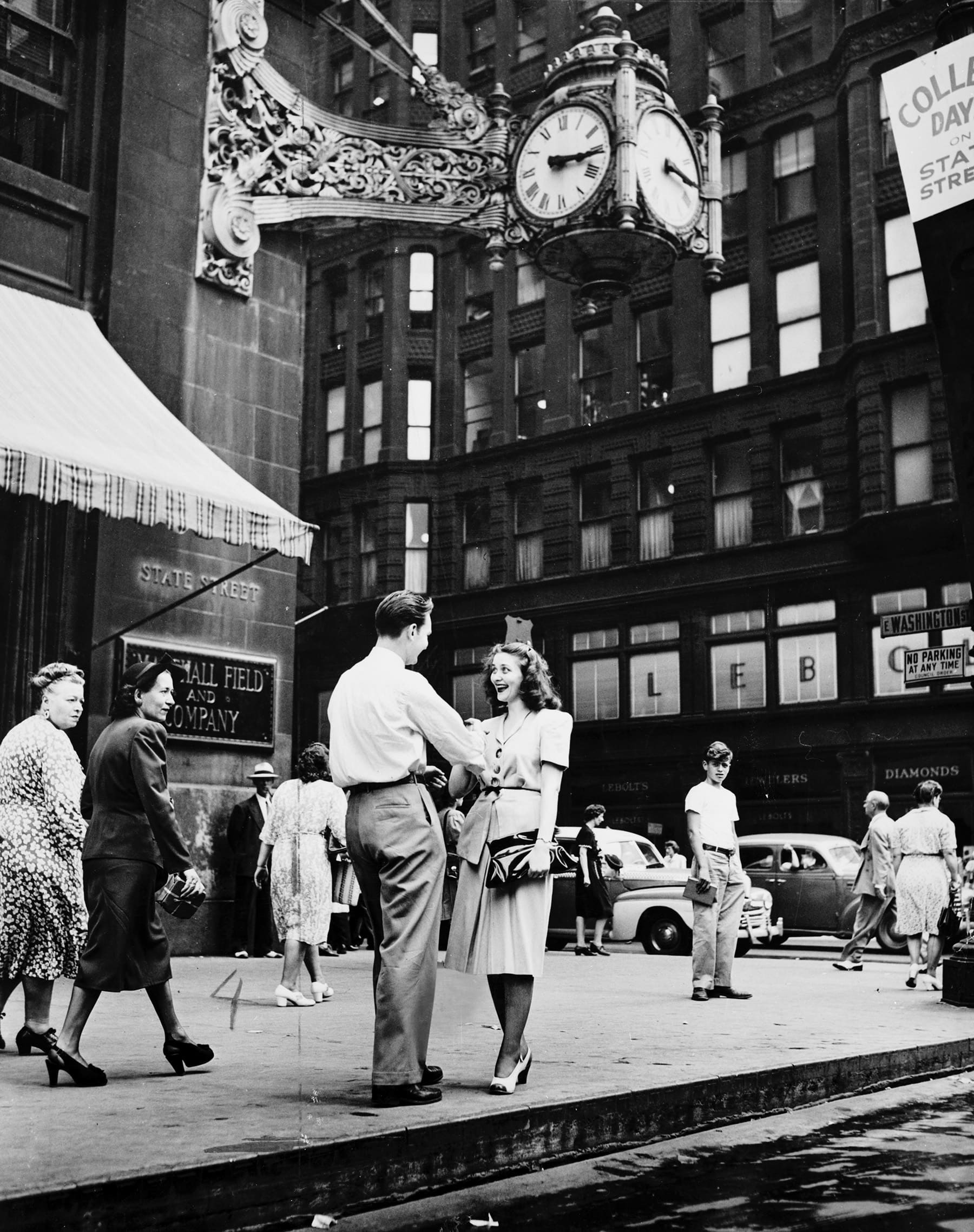
The engineers' objection to the painting was, in a precise sense, a category error. They had built an instrument. Rockwell had painted a landmark. By 1945, these were genuinely different objects, even though they occupied the same bronze housing at the corner of State and Washington.
The distinction Field made when he installed the first clock in 1897, before the SWCC, before the NAA signal and before the seven-and-a-half-ton bronze, was not a distinction between precision and imprecision. It was a distinction between private time and public time. The notes in the window were private arrangements; they failed because they had no common reference. The clock gave the street a shared present tense. It said: here is now, and we all agree on it.
That function does not require a recoil anchor escapement. It requires a clock that is conspicuous, stable, and trusted. The engineering that followed the 1897 iron clock was an elaboration of that function, not its origin.
Rockwell painted the origin.

I wish to thank Thomas Stocker, Librarian & Archivist at the NAWCC, for his generous assistance in locating and providing access to the Self Winding Clock Company primary documentation held in the NAWCC Library and Research Centre.
Sources: SWCC technical documentation — Directions for Installation and Care of Self Winding Synchronizing Clocks (c. 1900); Instructions for Installation and Maintenance of Self-Winding Synchronized Clocks, copyright 1923; Technical Information for Self Winding Clock Co., Model F, NAWCC Library and Research Center (issued May 1945) — reproduced by permission of the NAWCC. Carlene Stephens, Marking Modern Times (University of Chicago Press, 2012). Period coverage of the Hanberg dispute: Connecting the Windy City (September 25, 1907). Norman Rockwell, The Clock Mender, Saturday Evening Post, November 3, 1945. CHM architectural holdings: D.H. Burnham & Co., Marshall Field & Company south building, accession 1994.187 (pending consultation). William Peirce Anderson Collection, Ryerson and Burnham Archives, Art Institute of Chicago.