A lathe and some nails

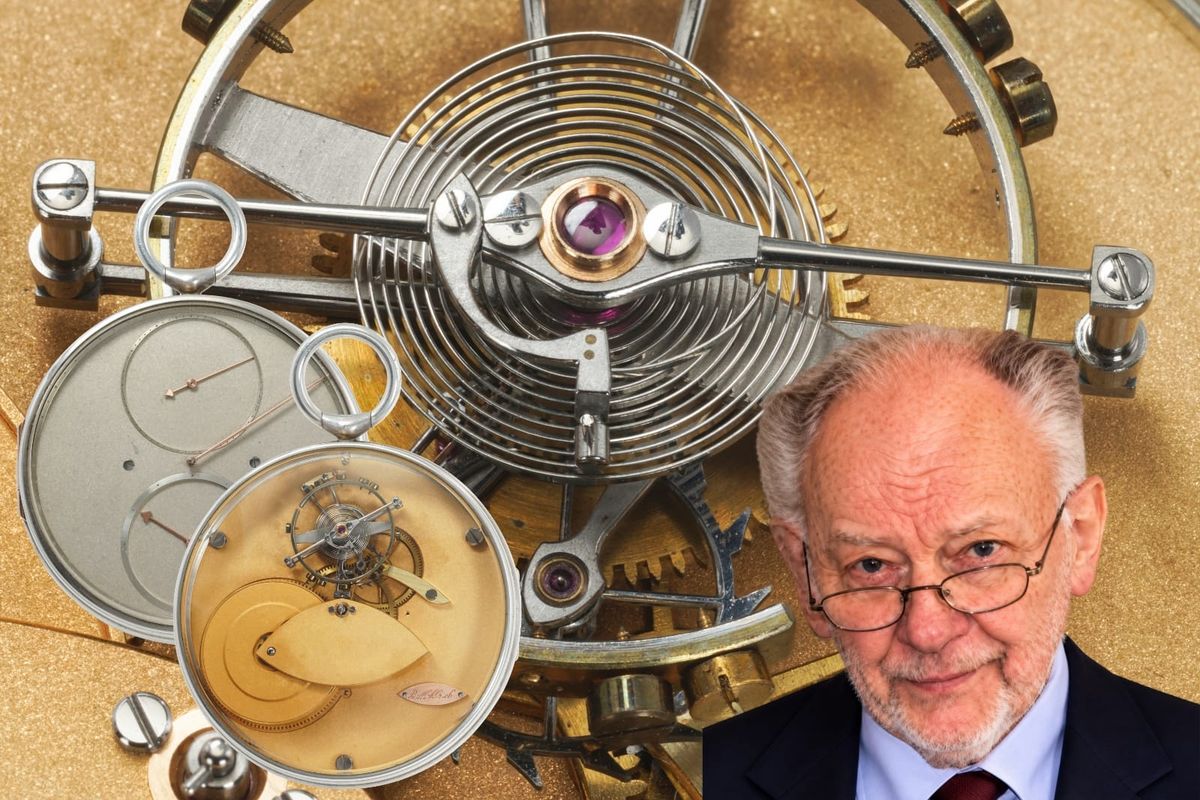
Richard Miklosch taught mathematics at a school near Aachen and made tourbillon pocket watches in the evenings. Most of the force of his first published article comes from his telling-off of the German trade press for describing his subject carelessly. "Es gibt keinen »Tourbillongang«", he wrote in Alte Uhren in the summer of 1978. "Man findet diesen Ausdruck fälschlich vor allem in Katalogen." There is no such thing as a tourbillon escapement; one finds the expression wrongly, above all in catalogues. A tourbillon is a carriage that turns, and inside it sits an escapement of some ordinary, named kind; for him, conflating the two was not a slip of language but a sign that the writer had never taken the thing apart. In his own watches that escapement was nearly always a detent, and a detent is built in one of two rival ways, as a spring detent or a pivoted one. The difference between the two is the argument he spent his writing life having. In November 2026, one of his watches appears in a Geneva saleroom, and the catalogue sides with him.
It names the escapement correctly: an Earnshaw detent, the spring kind, and Dr Crott, cataloguing his work, writes "Federchronometerhemmung", the same thing in German. He won that one. The catalogues get the man wrong now, and that is what he would have written to correct.
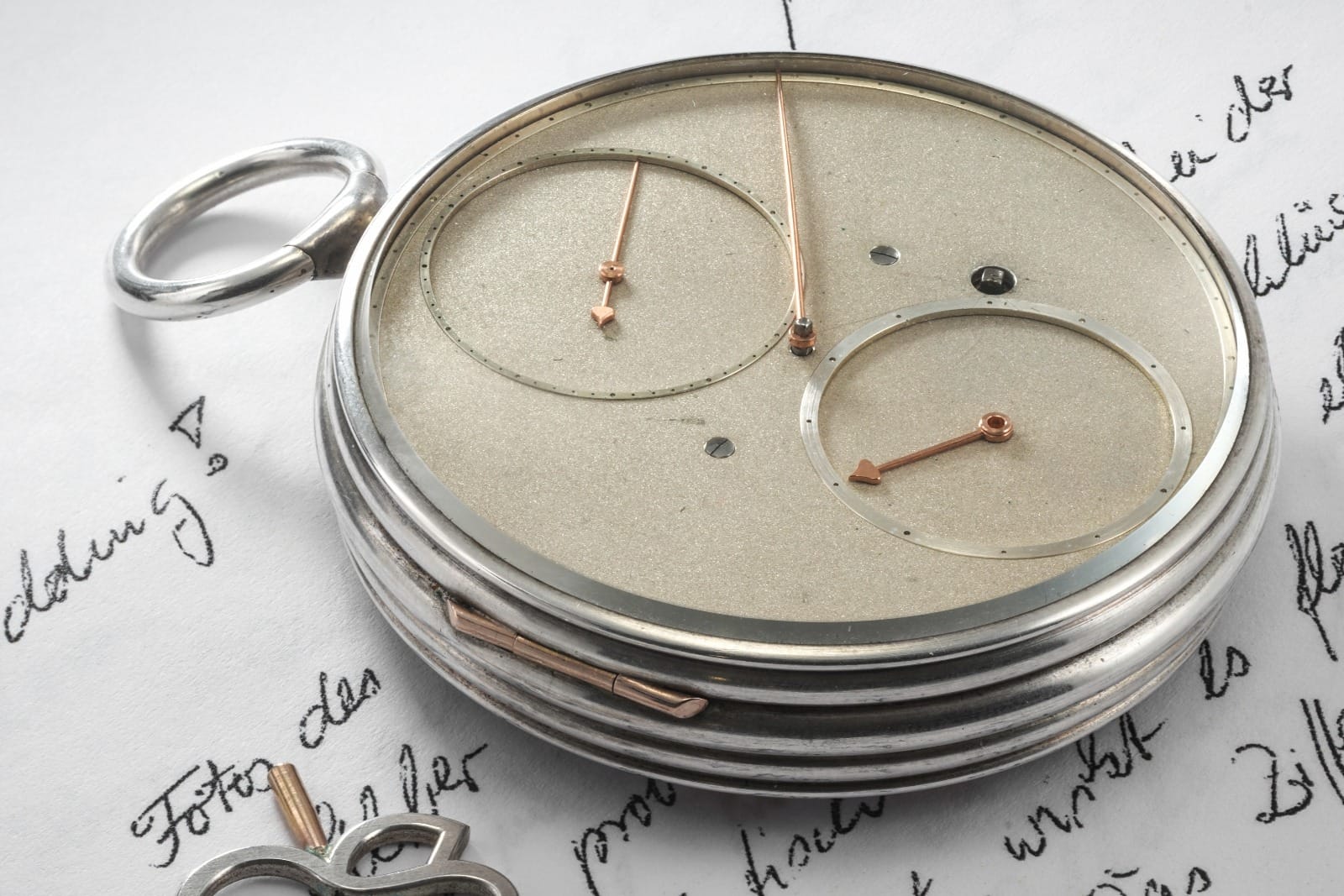
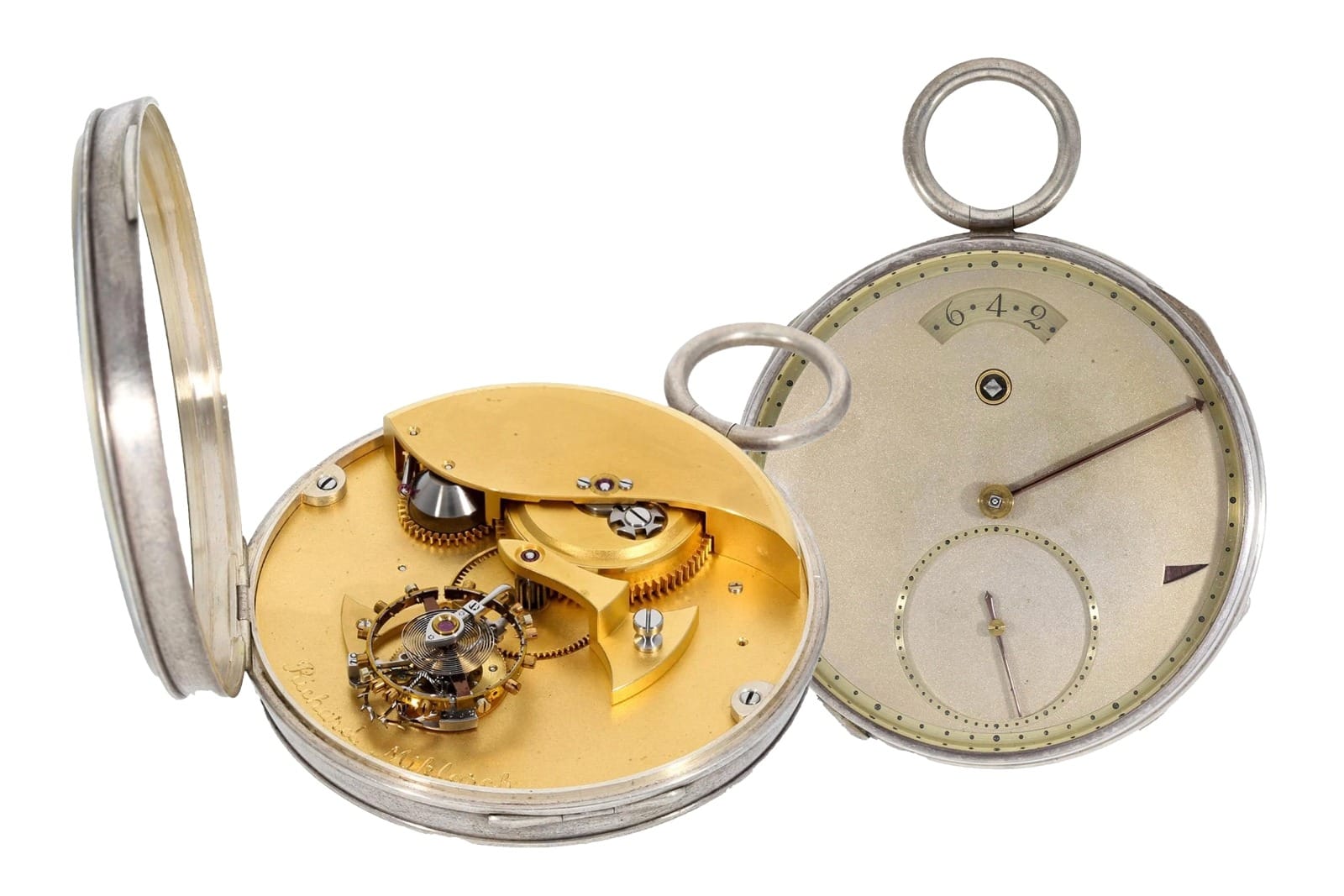
The Geneva watch, dial side, photographed on a copy of Miklosch´s handwritten draft letter, dated 15 July 2008, and sold with the watch. The regulator dial has no numerals or signature, and the winding and setting key lies beside it. Image: Phillips, Geneva Watch Auction XXIV, lot 61.
On 9 May this year, Cortrie in Hamburg sold one of his flying tourbillons at 900,000 euros hammer, about 1,089,000 with the premium, against a low estimate of just 20,000.
In November 2008, the Aachen auction house of Dr Crott offered a tourbillon pocket watch with a spring-detent escapement, made by a German “amateur” then 69, for an estimated 20,000 to 25,000 euros. The same watch comes up in Geneva on 7 and 8 November, with Phillips estimating it at 300,000 to 600,000 Swiss francs.
Herzogenrath
Born in 1939, Miklosch lived in Herzogenrath, a town on the Dutch border fifteen kilometres from Aachen, and taught mathematics and technology there for close to forty years. The watches were made in the evenings and the holidays. When Curtis Thomson, an American restorer of complicated watches, wrote to ask whether he might come and see the workshop, he got a warning rather than an invitation. "Yes, you may come visit me, but you do realise I make serious watches here, tourbillons with detent escapements, not watches that go ding dong. I don't make ding dong watches."
Thomson went anyway, in 2005, and spent five days there. The following January, he published the fullest account of Miklosch at the bench in International Watch, and the man in it isn't the figure the salerooms describe. He is didactic, certain, and funny about himself. When asked what a precision watch needs, he gave a list that pointedly left out the thing he is famous for: "A precision timepiece should have a spring detent, doesn't have to have a tourbillon, large balance, light balance, large barrel and an up-down indicator, nothing more." Twelve years earlier, he had told Susan Packer how he did it: "I make all of my watches with a lathe and some nails, you know."
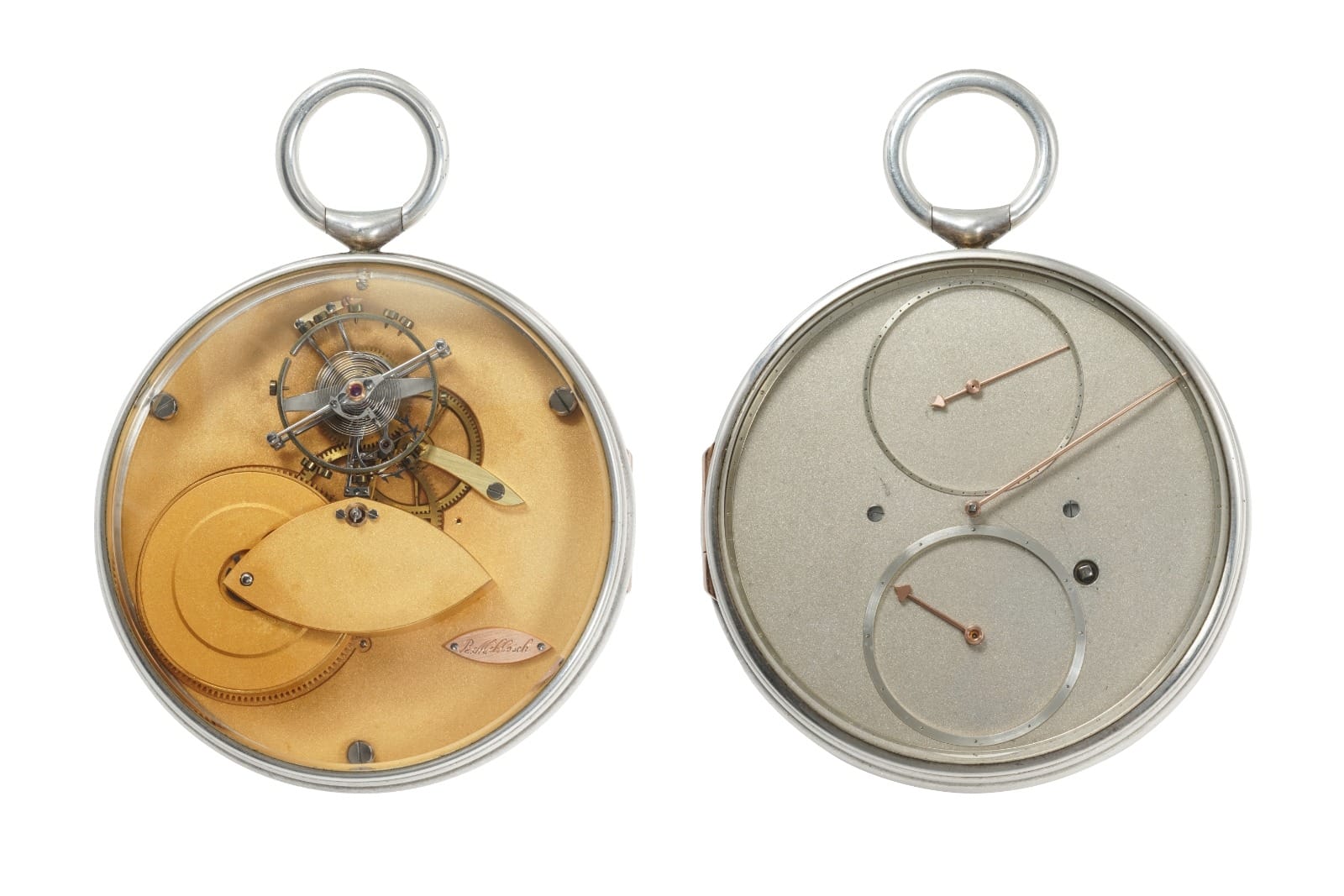
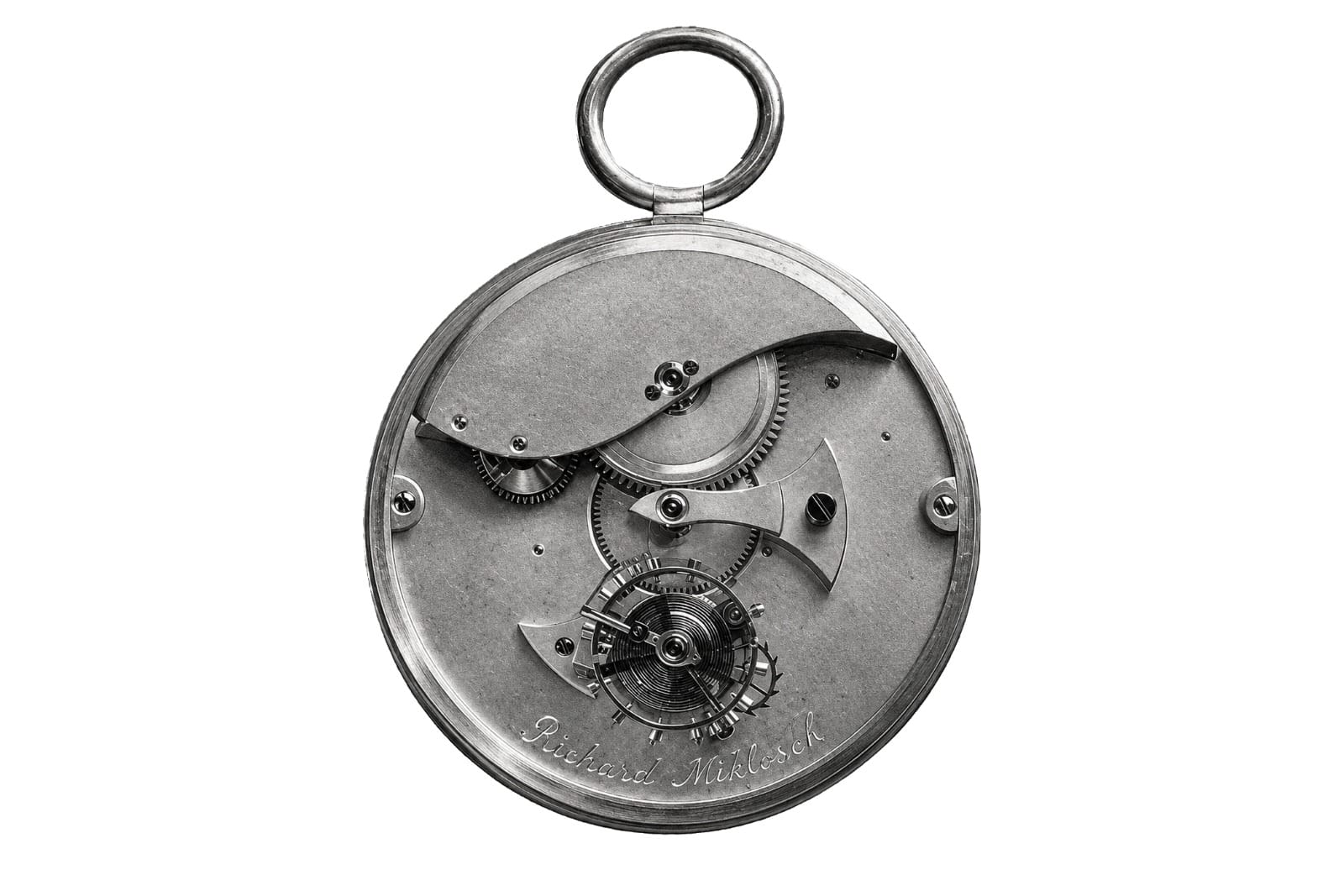
The Geneva watch, movement and dial side. Image: Phillips, Geneva Watch Auction XXIV, lot 61.
The house he was let into was fortified. Iron gates, security blinds on the windows, a spiral staircase gated and locked at each level, and a locked workshop door. Nobody got in or out without Miklosch's approval.
On technique, he was unsentimental to the point of rudeness. "There are no presents in techniques, you must do exercises." Thomson counted at least twenty part-finished watches and thirty tourbillon carriages in that workshop, a strange and rather moving inventory for a man in his mid-sixties working alone.
Two watchmakers in Aachen
Every saleroom biography calls him self-taught, and the word is doing a lot of work. It makes him a prodigy and saves anyone the trouble of asking who taught him, and three people have answered it, though not with the same answer.
The family had been expelled from Czechoslovakia in 1945, when he was a small child, and settled near Aachen. Susan Packer, writing in the NAWCC Bulletin in October 1993, who later became his pupil, names the two men who took him up as a boy: Mr Riese and Mr Lennartz, watch repairers in the city who, as she puts it, took a liking to the young Miklosch and helped to begin his education concerning watches. One of them went further, as Miklosch told her. "It turned out that Mr. Riese went hunting often, and when he did, I went to use his shop. He was very generous." He was somewhere between twelve and fourteen.
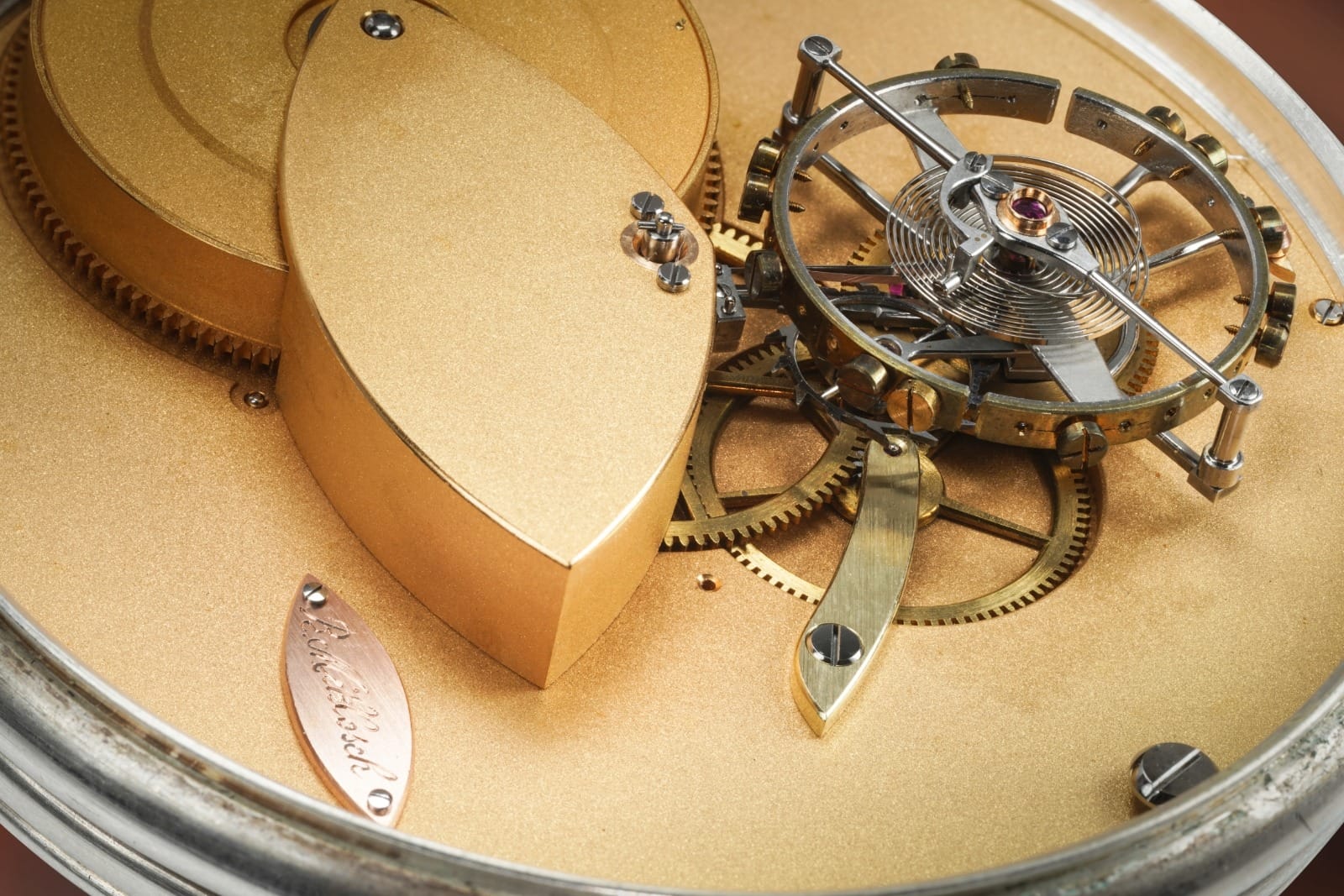
The Geneva watch, view of the tourbillon. Image: Phillips, Geneva Watch Auction XXIV, lot 61.
When Thomson arrived half a century later, he was told the same thing: two local watchmakers had been in Aachen, though by then neither was named. The third account comes from inside the house, and it is the most specific of the three. His widow, Barbara Miklosch, writing a postscript to his obituary in January 2015, says Lennartz trained as a young man at a Swiss watchmaking school, that Richard often watched him over his shoulder, and that he served an apprenticeship with him, which is where his lifelong regard for Swiss watchmaking came from. She calls Lennartz "sein erster und langjähriger Lehrmeister", his first and long-standing master.
The three do not name the same man. Packer's story is Riese's workshop, Barbara Miklosch's is Lennartz's bench, and Thomson was given the pair with no names attached to either. What they agree on is narrower than it looks: that before he was out of his teens he had the run of a professional workshop in Aachen, and that he was shown things there. They diverge on who showed him, and for how long. Whatever that amounts to, the word self-taught does not describe it.
The word survives among people who knew him. Kari Voutilainen, who spent a week at his bench, still calls him a self-taught German watchmaker. Thomson, who spent five days there, put it more precisely in his opening line: a maker of handmade watches; technically, he isn't a watchmaker. Packer, who asked him, wrote that he had no real apprenticeship and no formal education in watch repair. He had teachers.
Glashütte, by letter and by visit
The second education came from the other side of a closed border. Barbara Miklosch dates its beginning to after their 1968 marriage: Richard began to take a strong interest in Glashütte watchmaking, made contact by letter and visit, above all with Alfred Helwig and Gustav Gerstenberger, and regarded them both as models for his own work.
Thomson puts the crossings later. By his mid-thirties, Miklosch was ready for more serious work, and his parents bought him a watchmaker's lathe with attachments. He began what Thomson calls the dangerous trips into eastern Germany, where Gerstenberger trained him to make the detent escapement and time a watch. Thomson dates those trips to the mid-1970s, and Packer dates the Glashütte contact to about 1976, but neither can be right for Helwig, who died in May 1974. Only Barbara Miklosch's dating leaves room for Miklosch to have met both men.
Flying one-minute tourbillon with spring detent escapement, silver and glazed on both sides, its silvered regulator dial carrying a digital hour and a power reserve, 56.5 mm and about 135 grams. Lot 4223 at Cortrie, Hamburg, 9 May 2026. Image: Cortrie
Helwig had given the Glashütte school its flying tourbillon in the 1920s, and by then he was an old man. Gerstenberger, born in Breslau in 1886, was a régleur and chronometer maker who worked at Julius Assmann, then at IWC in Schaffhausen before the First World War, then on his own account, and still regulated chronometers for the state factory into his late eighties. He had never taken a master's certificate. Miklosch asked him why not, and the answer is the best sentence anyone in this story produced: "Bei uns war jede Uhr ein Meisterstück." With us every watch was a masterpiece.
Miklosch attests to what passed between them three times in print over eleven years, making it hard to read as a late, flattering reminiscence. In the Swiss journal Chronométrophilia, in 1993, he writes of "mein Lehrmeister Gustav Gerstenberger, Regleur in Glashütte", and in the same series calls himself, in an almost shy parenthesis, "ich bin sein letzter Schüler" (I am his last pupil). In a German magazine in 2004, a caption reads: "ganz im Sinne und Stile G. Gerstenbergers, meines Lehrmeisters". Writing about the old man in 1997, he set down the length of it: "Während der 13 Jahre, in denen mich Gustav Gerstenberger in der Chronometrie unterwies", during the thirteen years in which Gerstenberger instructed me in chronometry, he made under supervision a pocket chronometer with a mass balance, a cylindrical hairspring and a spring detent, as a journeyman's piece.
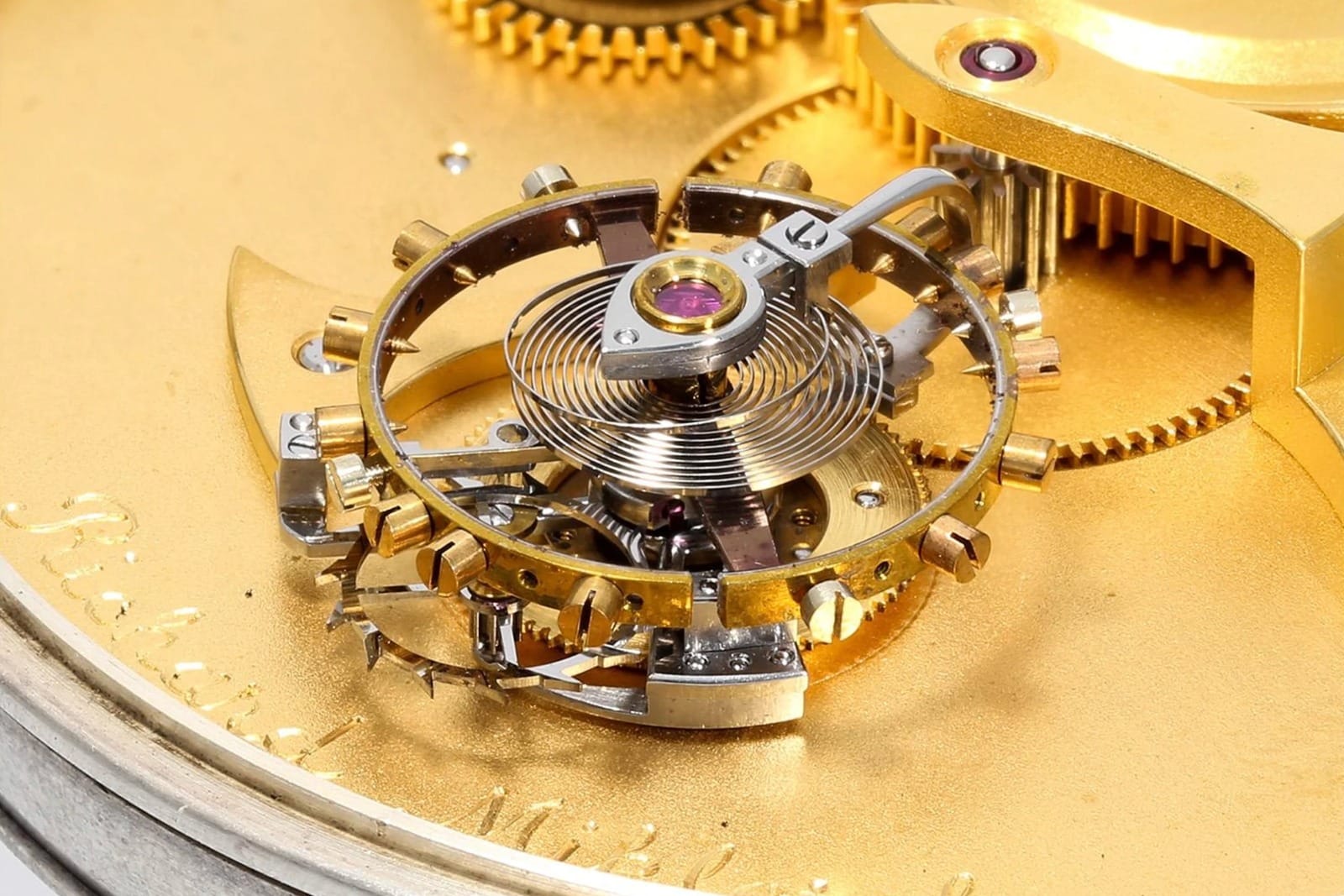
Flying one-minute tourbillon with spring detent escapement. Lot 4223 at Cortrie, Hamburg, 9 May 2026. Image: Cortrie
Thomson sets down how the teaching worked, which Miklosch never did. Gerstenberger handed him an ebauche. He took it home, worked on it, and came back a year later for approval; the exercise repeated. Gerstenberger became, in Thomson's careful phrase, Miklosch's teacher in effect.
Which thirteen years those were is not known and should not be guessed. Gerstenberger died in 1983 at ninety-seven and worked at his bench into his nineties, so the thirteen years could have ended at his death or well before. The documents can be read both ways.
To Packer, he put it in terms that have nothing to do with chronometry. "Mr. Gerstenberger had no children, and so he considered me to be as his son. His specialty was the detent escapement. He saw the first four watches I made, two pocket chronometers and two tourbillons. I knew him for thirteen years. He was perhaps the greatest watchmaker we ever had."
The summer of 1978
"Tourbillons, kritische Betrachtungen" ran in Alte Uhren in July 1978, six pages, and it is not the careful first appearance of a hobbyist. He goes after Breguet in it. Breguet, he says, for all the greatness and significance of his work, passed over the most elegant solution: a tourbillon with an Earnshaw spring detent, and calling that anything other than a fundamental error would be dishonest. He reports a joke they told at Glashütte about men who couldn't make a detent spring: they made a pivoted detent instead, and he notes in passing that a detent spring alone could serve as a master craftsman's test piece.
Then, describing the spring detent in action, he writes the sentence that tells you he had watched one for hours. "Einem Tiger gleich springt das Gangrad an", like a tiger the escape wheel springs away, and only by the movement of its spokes can one see that it turns at all, and at once it is caught, soft and delicate, a little yielding, by the detent spring. The register is wrong for a technical journal and exactly right for the thing being described.
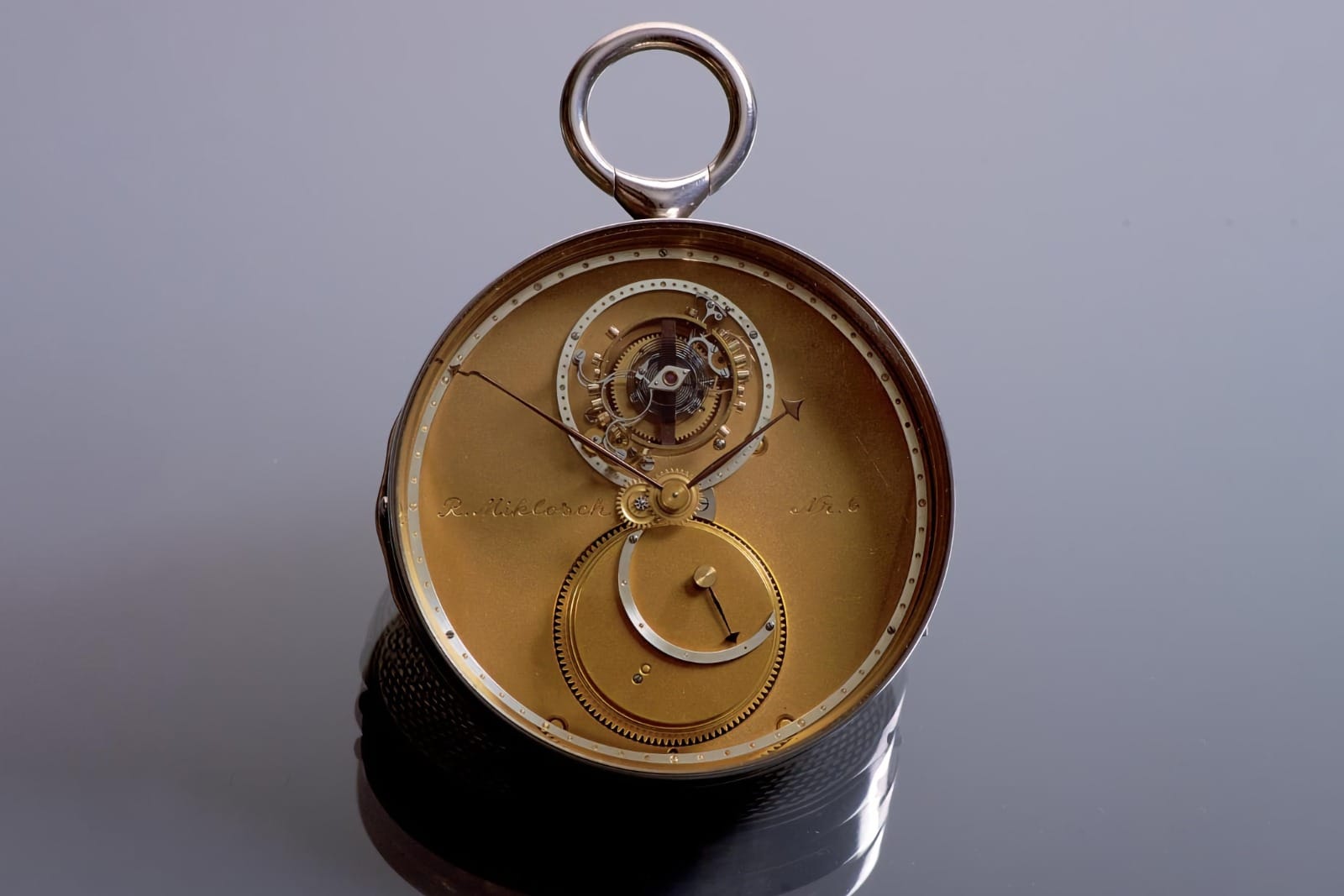
Tourbillon Nr. 6. A flying one-minute tourbillon of about 1980 with a spring-detent escapement and a retrograde power reserve carried on the dial side. Lot 476 at Auktionen Dr. H. Crott, Mannheim, 18 November 2006. Image: Auktionen Dr Crott.
At the end he states the standard he intends to be held to, and it is a standard about labour rather than results: whoever resolves to make a tourbillon, even today, should finish every single part as well as it can be finished, without regard to time or labour, as watches were made in Glashütte. Under Helwig's direction, he adds, there arose tourbillons by which the Lord God might let the sun turn.
Twenty-six years later he gave that last line away. Writing in 2004, he recalls asking Helwig what fascinated him most about the subject and reports the old man's answer: "When I get up in the morning and look at my tourbillon, I know what time it is; it is the watch by which the Lord God lets the sun turn." The phrase he had used as his own flourish in 1978 turns out, on his own later account, to have been Helwig's, said to him at some point before Helwig died in 1974. It is the closest thing he ever published to a transcript of those visits.
One-minute tourbillon with chronometer escapement by Richard Miklosch, about 1980. Image: Alte Uhren, Ebner Verlag.
The article worked in a way nobody had planned for. In the next issue, the editors reprinted a Helwig essay, saying no publication they had ever run had brought them so many telephone calls and letters of agreement. They described Miklosch, in the same breath, as one of the last great craftsmen. He was a man, they went on, who could say of himself that alongside George Daniels in London he still had the ability and the ingenious skill to build the most beautiful and probably the most difficult thing there is among pocket watches.
The comparison with George Daniels, by then England's best-known maker working entirely by hand, stuck, and it wasn't a one-off. The same magazine's book critic, reviewing Daniels's Watchmaking in 1982, described Daniels as a lonely maker of rare and occasionally strange single pieces, known to German enthusiasts alongside Richard Miklosch. In 1984, the same hand reviewed the Musée international d'horlogerie's own history of the mechanical watch, took exception to its claim that poising errors do not affect a tourbillon's rate, and reached for the two men as the authorities who would know: "Und was würden George Daniels und Richard Miklosch dazu sagen?" A trade magazine in the same year called the tourbillon an unusual hobby for a schoolteacher. It said that any watchmaker with even a rough idea of the difficulties stands before it in silent admiration.
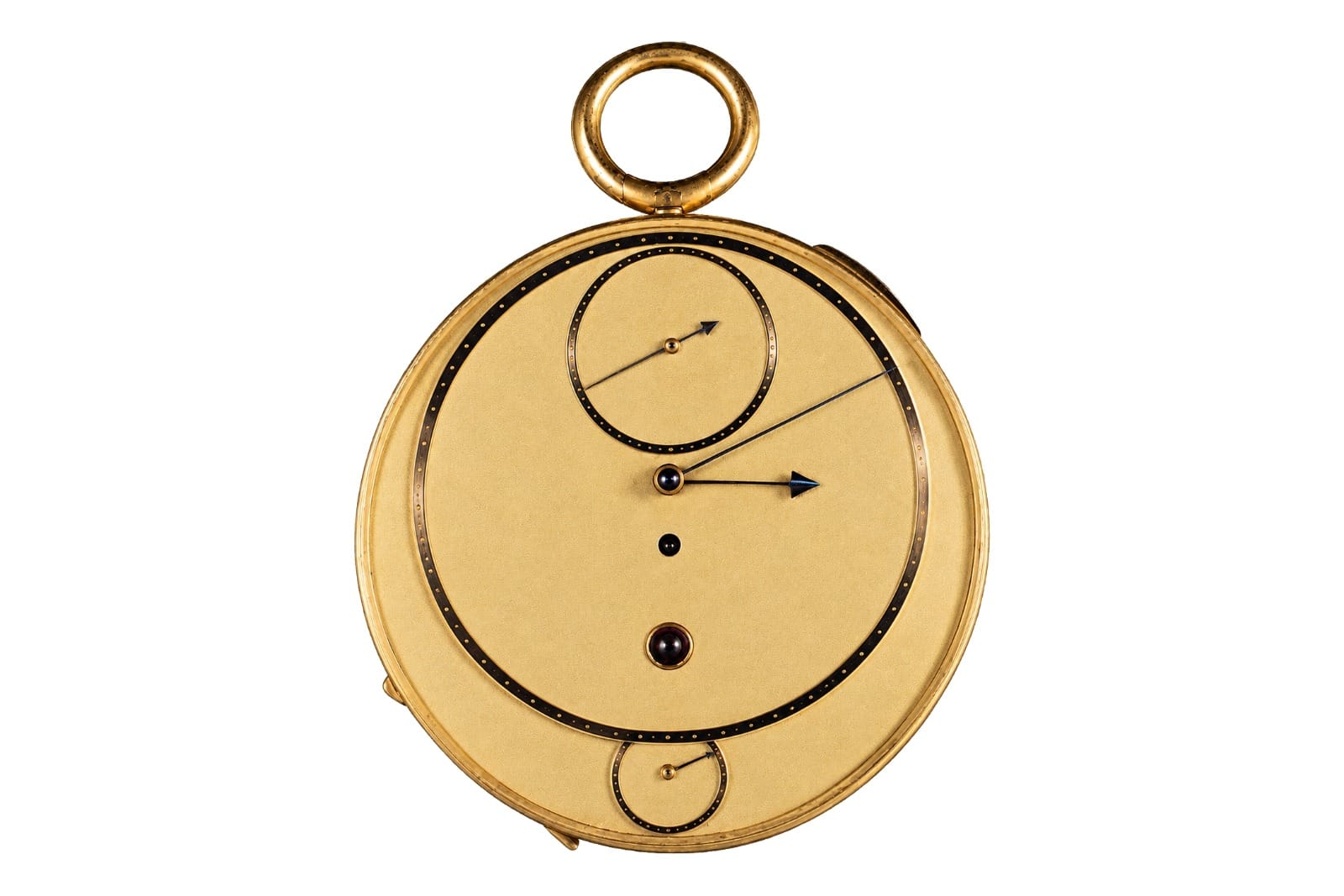
Deck chronometer with tourbillon and chronometer escapement by Richard Miklosch, about 1985. Image: Alte Uhren, Ebner Verlag.
He had also seen Daniels. Thomson lists it without ceremony: after Gerstenberger and Helwig died, Miklosch called on Philippe Dufour, Derek Pratt, and George Daniels, absorbing information as it came, and, by buying and studying watches by Pellaton, Bornand, and Charrue, he found new tutors and benchmarks for his standard of quality. The German press set him beside Daniels; he had gone to Daniels to learn.
Rate, not toys
The salerooms sell him as a tourbillon maker, and he was one, but the tourbillon was never the point. He put it to Thomson in one line: "The main reason to make a tourbillon is to achieve a fine and stable rate, not toys." The escapement was the thing he cared about, and he said why, in one passage that does the whole job:
Mein Lehrmeister Gustav Gerstenberger, Regleur in Glashütte, verwandte ausschliesslich den Federgang. Aus technischer Sicht bietet er wohl die grössten Vorteile. Die Wippenchronometer der klassischen französischen Periode dagegen bestechen durch ihre persönliche Note und ihren individuellen Charme. Für mich ist Gangleistung oberstes Gebot, und daher favorisiere ich den Federgang.
My master used the spring detent exclusively, he writes. Technically, it probably offers the greatest advantages. The pivoted-detent chronometers of the classical French period charm with their personal note and individual character, but for me performance is the highest commandment, so I favour the spring detent. The concession to the French is real, and the conclusion is clear. Read slowly; it is also a statement about inheritance rather than engineering, since the spring detent comes first because Gerstenberger used nothing else.
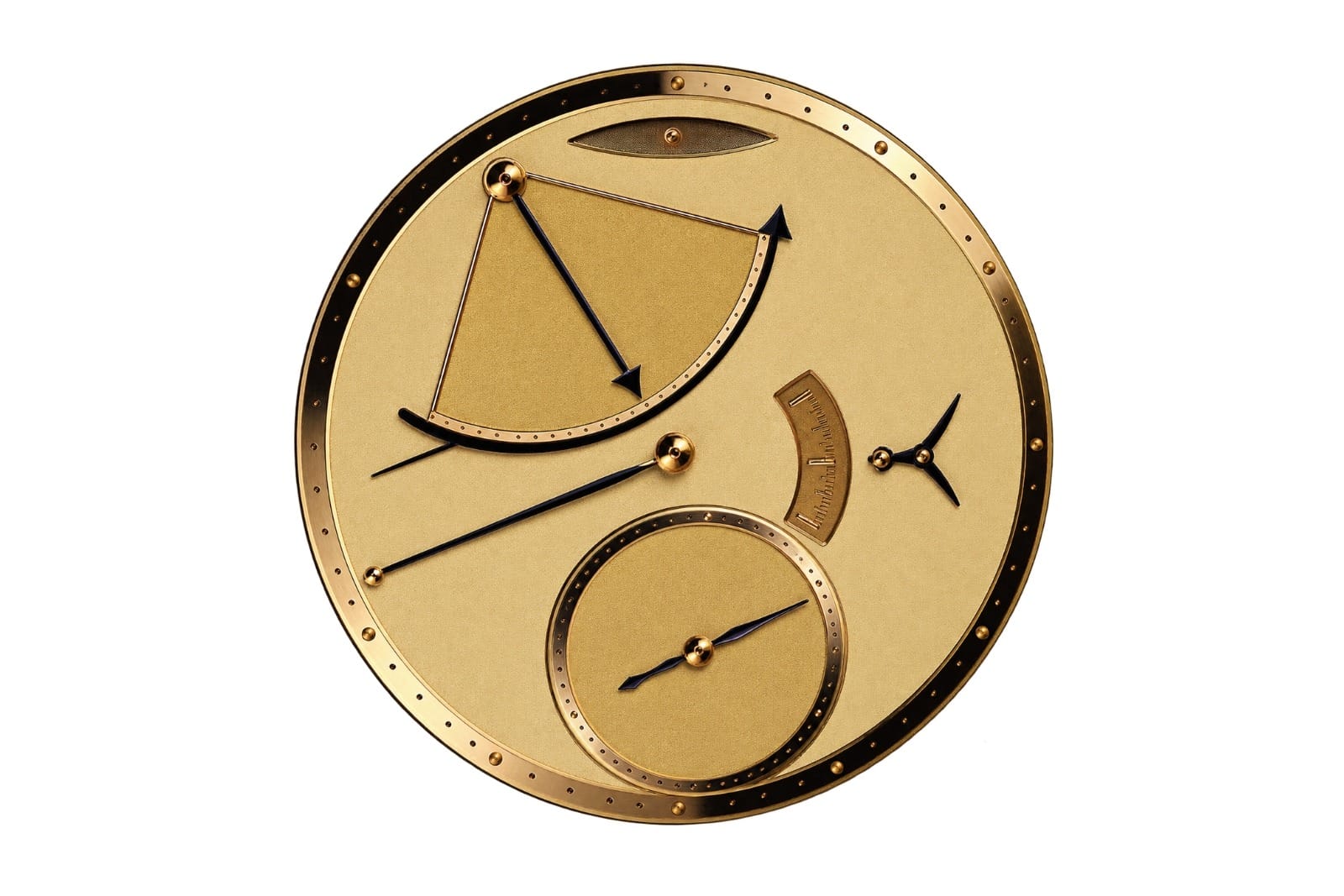
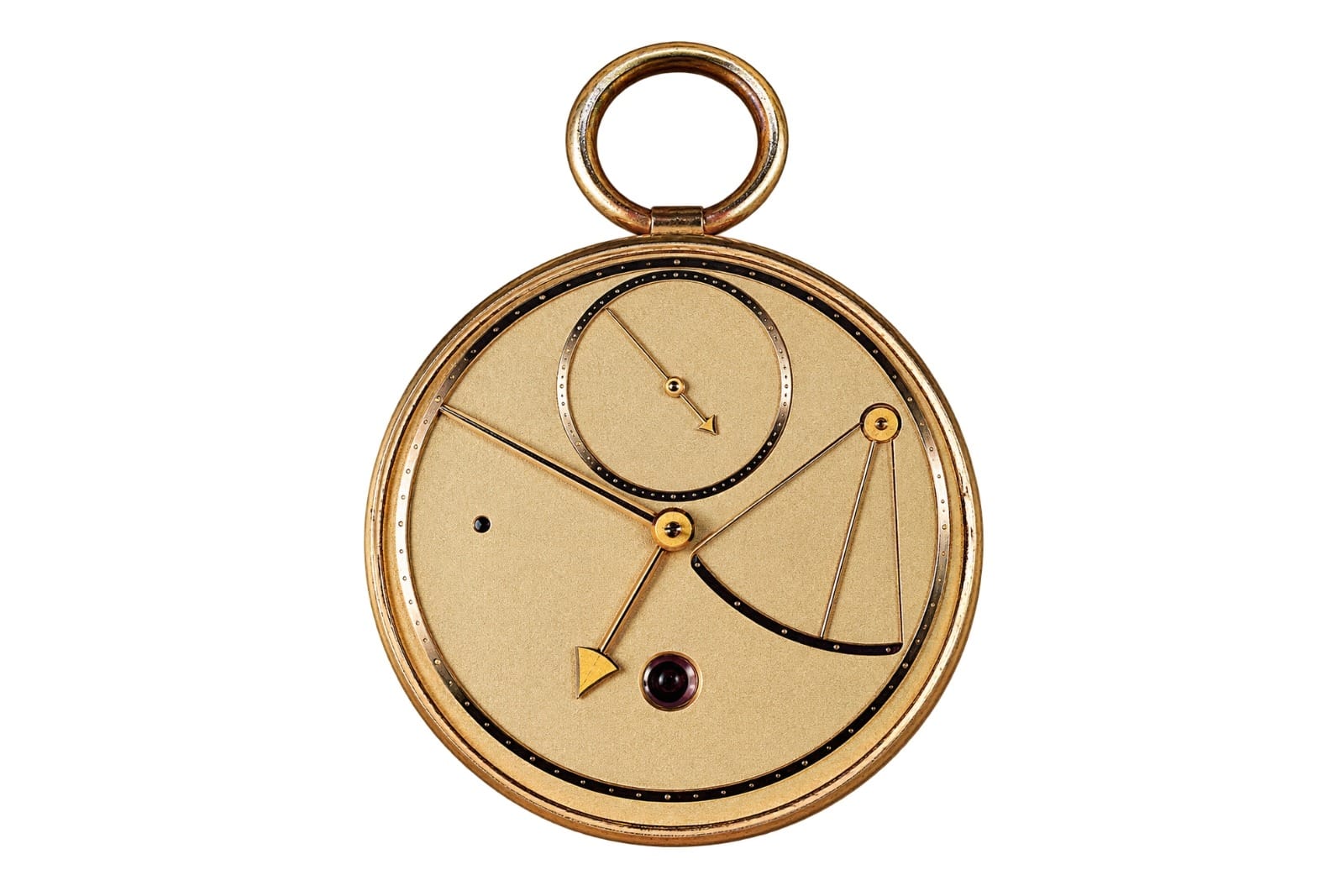
One of his own watches, dated 1978 and photographed from the dial side: a wandering hour, a large sector for the up-and-down work, a screw differential, and a one-minute tourbillon with chronometer escapement. His own caption reads "Arbeit des Autors, 1978". Image: Klassik Uhren 2/1998, p. 38, Ebner Verlag
The same hardness shows in small refusals. Pressed jewels, the ordinary industrial kind, were out of the question. Writing in Switzerland in 1993, he called the thought of knowing there were pressed jewels in a wholly hand-made watch unbearable to him. He rejected flying barrels because they're mounted only in the upper bridge, always a little unsteady, and need repair after several decades of running, which he says goes against his personal leaning toward security and stability. The objection is about what the watch will need in fifty years, which is a strange thing to weigh when the watch is a showpiece.
And he could be generous about the thing itself when he was not correcting somebody. He wrote in a note Osterhausen printed in 1999 that the tourbillon was, and remains, the supreme discipline of all chronometry and the greatest challenge to self-realisation. Dr Crott liked the line well enough to print it in the catalogue when the Geneva watch was first sold in 2008.
Thomson's article ends on the number, not the man. Miklosch told him his pocket chronometers ran to one second a day. "All is correct."
The escapement that does not exist
A man who tells a magazine in his first article that catalogues get things wrong will keep doing it, and he did, in the letters column, for the rest of his writing life.
The best documented exchange runs over two issues of Klassik Uhren in 2000. Herbert Neumüllers had written up a chronometer from the Technicum at La Chaux-de-Fonds from the early 1930s. He captioned a plate of its 65 mm movement as having a "Federhemmung mit kurzer Wippe", a spring escapement with a short pivoted detent. Miklosch replied in the next number that the thing described does not exist, that the combination is a contradiction in terms, and that he was not reasoning from the page. "Ich kenne die beschriebene Uhr und habe sie selbst in der Hand gehabt: Sie hat eine Grossmannsche Wippe!" I know the watch described and have had it in my own hands; it has a Grossmann pivoted detent.
He did not stop at the caption. He wrote that the article, as a whole, lacked technical substance and flattened into a stringing together of observatory results, dates, and conjectures. He called its author a self-appointed expert on Swiss school watches. It is not a kind letter.
What happened next is the better half of the story. In the very next issue, the one carrying Miklosch's own cover story on marine chronometers, Neumüllers answered a reader's question about a Ulysse Nardin power reserve by sending him to Miklosch: "Herr Miklosch hat es in dem instruktiven Aufsatz in KU 2/1998 ausführlich dokumentiert." Miklosch has documented it thoroughly in that instructive essay. Having been called a self-appointed expert in print, Neumüllers was now citing the man who called him one as the standard reference. Eleven years later, a third writer thanked them both in the same acknowledgement for help with the same 65 mm calibre they had quarrelled over.
The letters pages cut both ways. In 1997, a reader signed Dr Norbert Enders had attacked a portfolio of his work in the same magazine, also on technical grounds.
The Technicum watch is the one piece of this story that can still be settled. Neumüllers said it was on show at the Musée international d'horlogerie. If it is still in La Chaux-de-Fonds, somebody opening the case answers a question about the dead man's eye that no amount of reading will.
Six
Helmut Crott, who founded the Aachen house that sold his work and corresponded with him, put it plainly to me: Miklosch visibly numbered only the first six watches of his life in the movement, and nothing after that, which makes the exact sequence of everything later, in Crott's words, nearly impossible to establish.
An observation watch with chronometer escapement and one-minute tourbillon. To cut friction, a ruby rolls along a cone. Image: Klassik Uhren 2/1998, Ebner Verlag.
The Geneva watch is one of the later ones. Its movement bears his name on a rose-gold plaque and no number. Tourbillon Nr. 6 is a different watch, which Dr Crott and Cortrie both place in Theodor Beyer's private collection in Zurich, an attribution the Beyer museum will neither confirm nor deny.
Phillips has now published a list of fourteen: eleven tourbillons and three chronometers, each with a print source. Helmut Crott told me where the number comes from: every publication he knows of that reproduces a photograph of a Miklosch watch. Miklosch made more than that, he says, and he is preparing a Werkverzeichnis. So the fourteen counts pictures. Phillips's own essay repeats Thomson's 2005 finding of at least twenty watches and thirty tourbillon carriages in cigar boxes in that workshop. Fourteen is what survives in the literature, not what left the bench.
The sixteen silent years
The writing is countable, and it has a shape. He published in German magazines twice in 1978, once in 1980, and once in 1981, then nothing for sixteen years. He returned in 1997 with four pieces in a single year, wrote steadily through 2004, then stopped. He had not been silent everywhere, and the gap is only a German gap: the four Swiss papers fall in the middle of it, between 1991 and 1994. Dated watches fall right across that gap, including ones he dated 1982 and 1985, suggesting a man who wrote or made, but not both, at once.
He probably didn't end the second run himself. His last work was announced in six parts, and two appeared, and the 2004 annual index lists exactly those two. Klassik Uhren left the newsstand in mid-2005 and was cut from eighty-eight pages to fifty-two, and a magazine that size had less room for six-page technical essays. The Swiss papers ran in Chronométrophilia and included a serial on building a pocket chronometer after he saw a Dumas at a Geneva viewing in October 1992. Fifteen years into the work, he wrote there, making a new pocket chronometer was "fast ein lustvoller Spaziergang", almost a pleasurable stroll.
Twelve years after his last essay, and two years after his death, a German writer explaining a modern chain-and-fusee tourbillon to collectors sent them to the 1998 article for how the power reserve works. This is the second time the record shows his technical writing being used as a live authority, sixteen years after Neumüllers sent a reader to the same essay.
What became of it
He died on 30 August 2014, at seventy-five. The obituary ran in Klassik Uhren the following January, and Barbara Miklosch added a postscript. She wrote the paragraph about Lennartz and the Swiss school, and about the letters to Helwig and Gerstenberger. Then she wrote this: "Hoffen wir, dass seine umfangreiche Sammlung in gute Hände kommt und so sein Name der Nachwelt erhalten bleibt." Let us hope that his extensive collection comes into good hands, and that his name is kept for posterity.
Where it went is not known. Thomson's twenty-odd part-finished watches and thirty carriages, the tools, the notes, the photographs he took of other men's chronometers, and the papers that were still in another writer's hands three years after his death: none of it has a recorded destination.
What survives in print is a man who thought that making a watch was not primarily a technical act. He said it to Packer in 1993: "There is no other profession like watchmaking ... that one person can take some dead material ... a piece of brass or silver ... and give it life ... with his hands, with his mind, with his heart." His obituary printed it again twenty-two years later.
In the same conversation, he also said something less quotable and more exact about what he thought he was doing when he taught. "The student will always be like the teacher. The ways of the teacher become the ways of his student." He had been that student himself, twice, in a repair shop in Aachen and at a bench in Saxony, and he wrote down what he had been shown in two bursts a decade and a half apart.
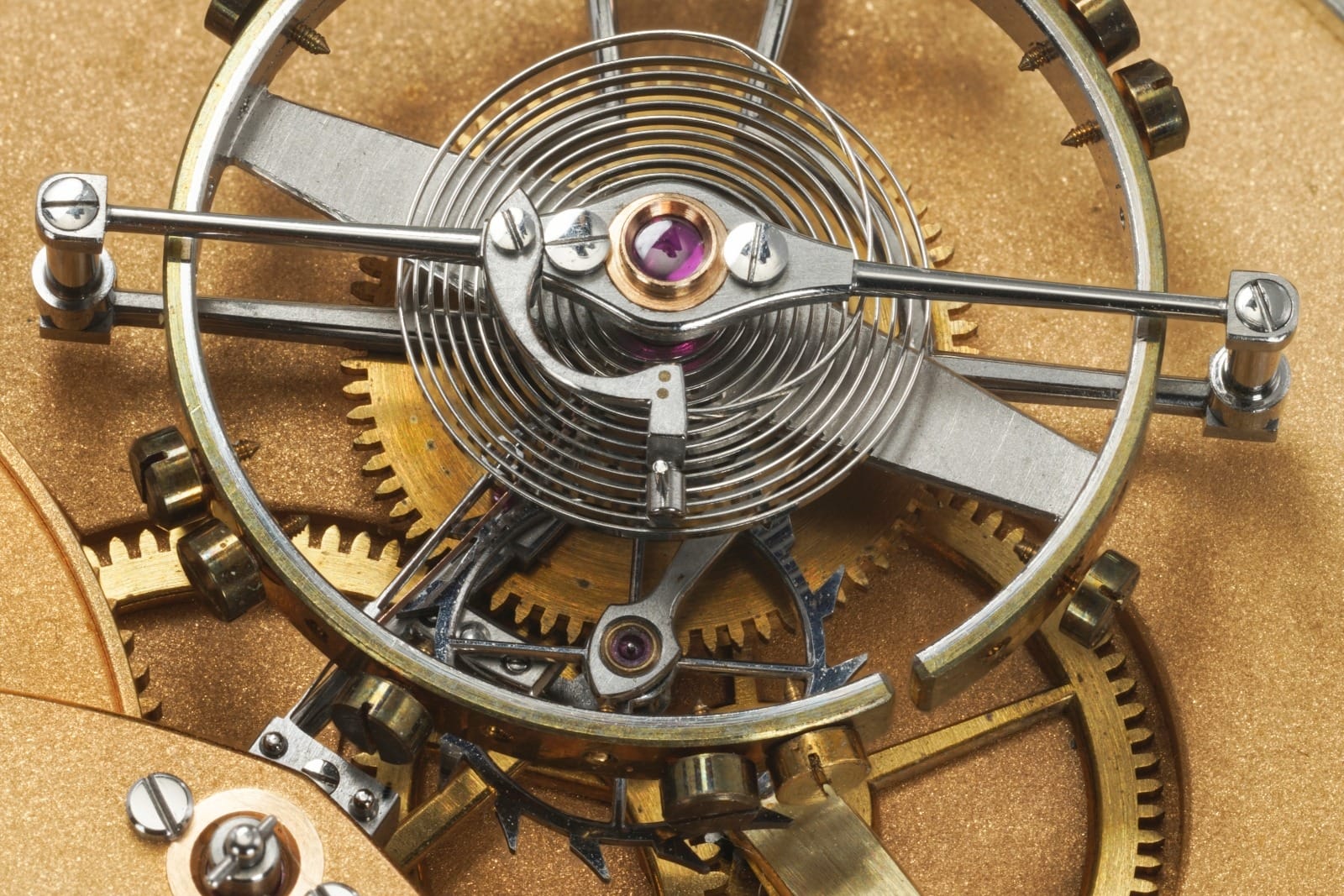
The Geneva watch, view of the tourbillon. Image: Phillips, Geneva Watch Auction XXIV, lot 61.
He went on teaching. Miklosch met Thomson off the train at Aachen and greeted him before he had said a word: "You must be my American pupil." Kari Voutilainen wrote to him by hand as a student, was invited, and spent a week watching him work, and says the enthusiasm ignited his ambition to make watches of his own.
The watch in Geneva carries no number. On Crott's account, that puts it after the six he counted, which the catalogue does not say, and he would have written to the cataloguer about it.
Thanks
Dr Helmut Crott, who founded the Aachen house that sold Miklosch’s work, answered questions in September 2026 about the numbering of the watches, the provenance of the Geneva watch, and the origin of the figure of fourteen.