Eight Pages to Brest

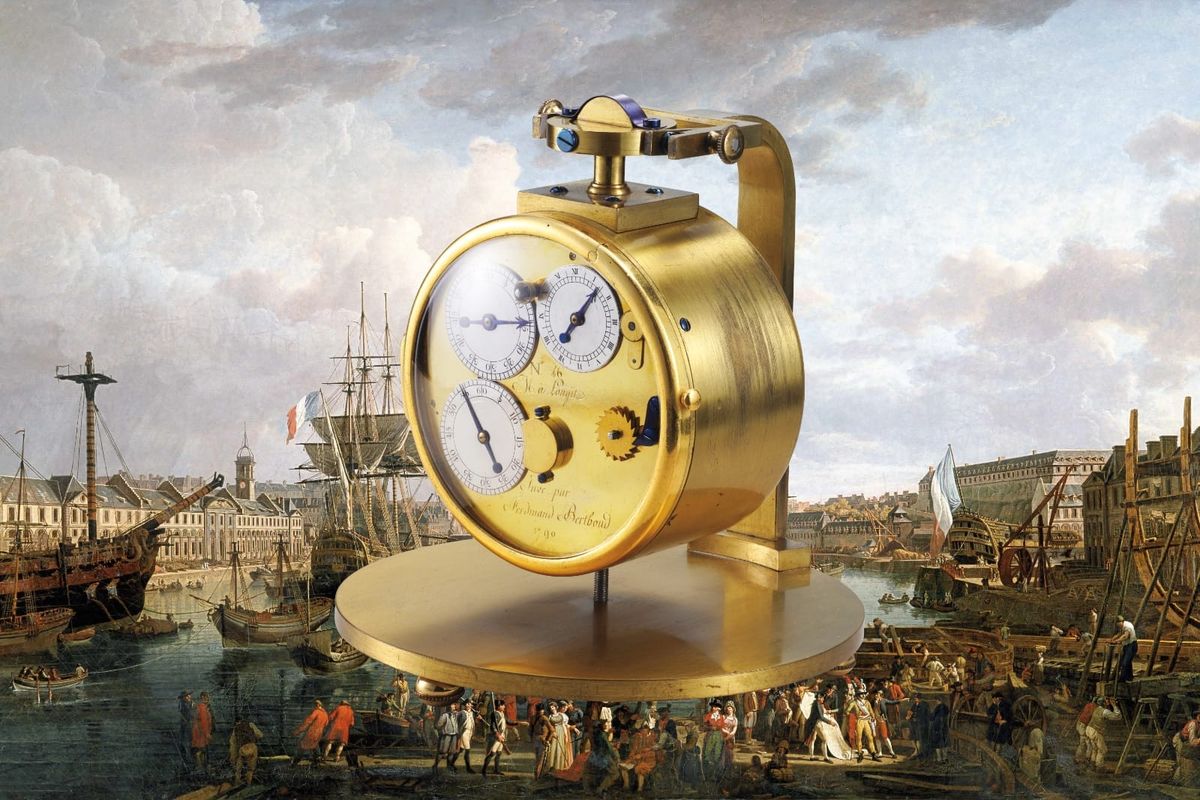
Vincent Martin and Berthoud’s longitude watch No. 46
Longitude watch No. 46 comes up at Phillips in Geneva on 7 and 8 November 2026. The watch says it was invented by Ferdinand Berthoud and says nothing at all about who made it. The man who made it was in Brest, working from what arrived by post.
The watch arrived by mail from Brest on Wednesday 13 October 1790. Berthoud's first note about it is that it arrived without accident, which, for him, was never a formality: he had been writing remedies for what the roads did to his machines since 1773 and billing the Marine for them since 1780. Six days later, he took it apart, writing in his journal:
« Je receus Mercredy cette montre qui est venue par le Courier sans accident. Je l'ai démontée ce matin pour faire graver les Cadrans & les platines. »
Taken apart, to have the dials and the plates engraved. The engraver cut five lines into the gilt of the plate that carries the dials, still perfectly readable:
N.º 46
M. à Longit.
Inve. par
Ferdinand Berthoud
1790
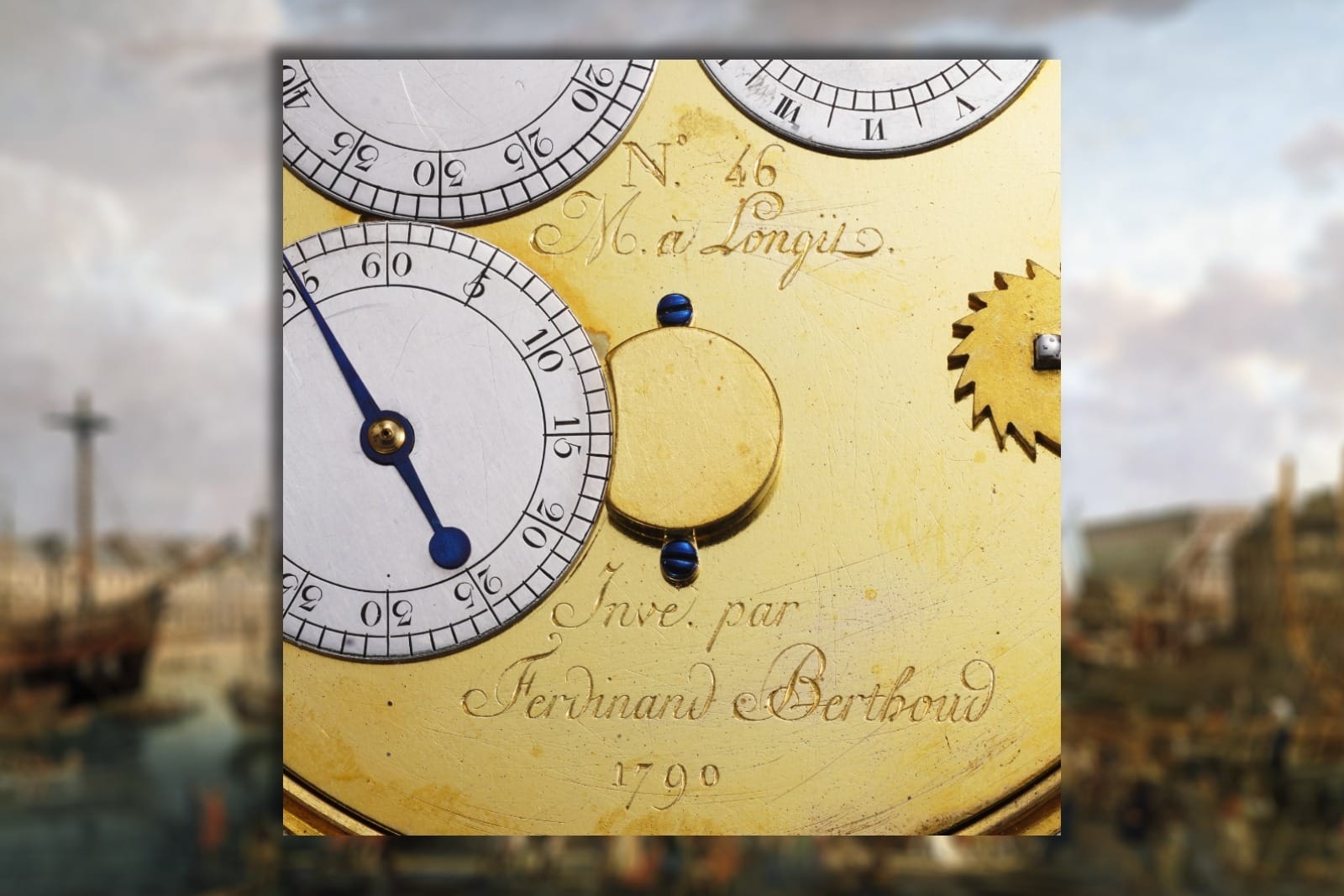
The plate carrying the dials, engraved in October 1790 while the watch lay in pieces on the bench in Paris. Invented by Ferdinand Berthoud. @ Phillips
Montre à Longitude, inventée par. A longitude watch, invented by. There is no second verb on that plate and no second name. The man Berthoud named in print as having executed it, and who put it on the Brest mail, was called Vincent Martin. On the plate carrying the dials of another watch Martin built at Brest the following year, the engraver cut two verbs and two names: constructed by Ferdinand Berthoud, executed by Vincent Martin.
A goldsmith's son, probably
In 1984, Catherine Cardinal, preparing the volume on Berthoud she wrote with Jean-Claude Sabrier, went to the Minutier central, where the papers of the Paris notaries are kept, and found an apprenticeship contract. Bound inside was an extract from the baptismal register of Saint-Barthélemy: Jacques Vincent, baptised on 23 January 1755, son of Germain Edme Martin, master goldsmith and jeweller, and of Louise Jouard, his wife, living on the place Dauphine. The boy entered Berthoud’s workshop in 1766 at age eleven for an eight-year term. Berthoud kept his own shop in the rue du Harlay, in the same parish, so the father placed the child a few minutes from his door.
That contract also settled an argument in the reference books. Baillie printed one, Vincent Martin, in 1951, at Brest, apprenticed to Ferdinand Berthoud. Tardy’s dictionary, published between 1971 and 1973, listed two men instead: a Jacques-Vincent, born in 1755, apprenticed to Berthoud in Paris in 1766 and at Brest in 1775, and a Vincent, Berthoud's pupil, appointed clockmaker to the Marine at Brest on 11 March 1786. Adolphe Chapiro joined the two back into one man in the ANCAHA bulletin of 1979, and held to the joint in 1986 and again in 2002. The contract confirms the name and birth year.
But it stops there, carrying the boy only to Berthoud’s door. Cardinal's 1984 volume makes the apprentice and the man at Brest one person, which the contract alone cannot do. Tardy’s Brest date of 1775 sits eleven years ahead of the royal order that actually sent Martin to the port, and no document found since places him there that early.
I wrote to Catherine Cardinal to ask how she tied the apprentice to the man at Brest, but she hasn't had occasion to look at Berthoud’s pupils since 1984, and the Berthoud file, like her other working dossiers, is no longer in her possession.
Berthoud’s journals, by contrast, give him no parents and no birthplace. He arrives in them already a workman.
The pivots will be made by Martin
The first time Martin appears in the papers, he has one of the smaller jobs. On 12 April 1780, Berthoud sat down and gave away the project for a large marine clock, N° XXIII, piece by piece: eight operations and seven men besides himself. The drums and the bezel to a founder-chaser, the plates and wheels to Rauch in the pendulum trade, the case to a cabinetmaker, Lieutaud, the axis and escapement piece to a maker of rough watch movements. Operation eight: « Les pivots seront fait par Martin. » The pivots will be made by Martin. And at the foot of the page, in the first person: « J'executerai moi meme les pignons [...] la Roüe de fusée &c & diligerai le tout. » I shall make the pinions and the fusee wheel myself, and direct the whole.
Berthoud's numbers run in one series across his marine clocks and his longitude watches, in Roman or Arabic as he pleases, and they are not a tally of what he had made. In November 1782 he wrote that thirty years of work had given him more than thirty-six longitude clocks « que j'ai executés », and the machine he numbered 36 is dated three years after that.
Berthoud writes only « Martin », with no forename, which is not quite a signature. Vincent is the strong candidate, since he had been in the shop since 1766, and the only other Martin in these papers, Jean Martin, Berthoud's gardener's son, was still a small child. Nine months later the flyleaf of the same journal carries two lines, the day figure written over a correction: « Le Jeudy 11 Janvier 1781 M. Martin a Commencé a travailler. Le Lundy 15 Janvier le Neveu Louis a Commencé a travailler. » Martin started on Thursday. Louis Berthoud, the nephew who would take over the business, started on Monday. The line gives no forename and does not say what was begun. If this is Vincent, in the shop since 1766, it marks a return or the start of a particular job.
Why somebody had to go to Brest
Berthoud's machines kept coming home. One reached him in February 1781 via Brest, brought back from Cádiz by Verdun de la Crenne, major general of d'Estaing's squadron, and hadn't been cleaned since January 1775. He disassembled it to check the pivots and holes beneath the dirt. Others fared worse. In November 1781, clock N° 19 had several essential parts broken on the road to Brest. Machines still went by road after there was a man at Brest, and in August 1788 one arrived in Paris « toute fracassée », brought in a box by a man called Hudry, its glass gone, its compensation broken, two roller pivots and the suspension spring with them, and he wrote « heureusement » that the escapement and the train had survived.
He had already proposed the remedy. On 25 July 1781 he ruled a heading across a page and wrote down a proposal:
« Pour faciliter L'usage des Horloges Marines il sera Necessaire d'établir a Brest un Artiste capable d'entretenir ces Machines. [...] La Seule difficulté qu'elles rencontrent c'est celle du transport par terre qui les expose a beaucoup d'accidens ainsi que je l'ai éprouvé plusieurs fois. [...] il faudroit établir dans chaque Port de Roi un Horloger en état d'entretenir ces Machines. On éviterait par là le renvoi des Horloges après chaque campagne [...] Et comme Brest est le Port où il se fait le plus d'armement il faudroit commencer par celui-là. »
Put a man in each of the King's ports to look after these machines, and you'll stop shipping them back and forth. Begin with Brest, « le Port ou il se fait le plus d'armement ».
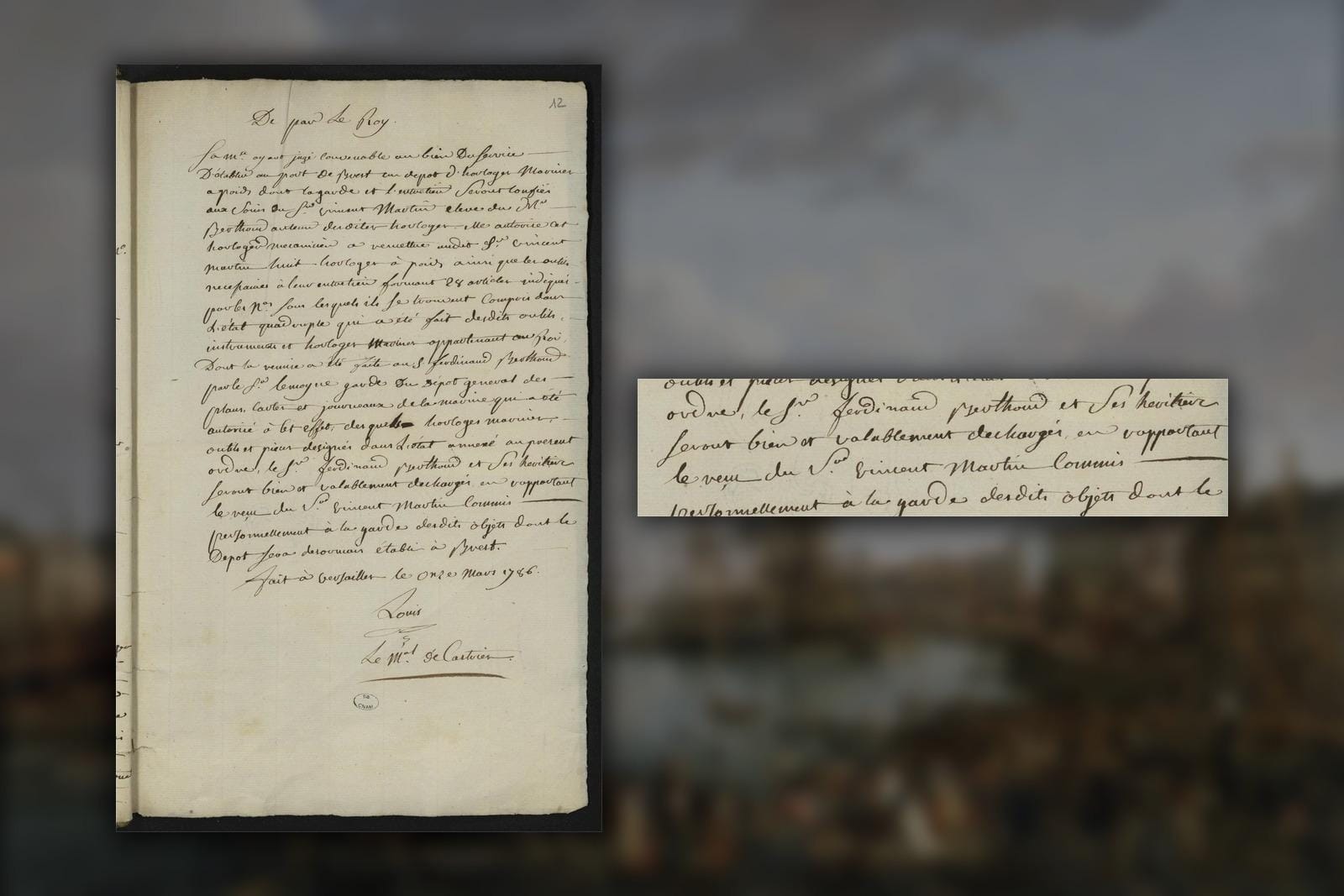
The order of 11 March 1786, signed at Versailles by the King and by the Maréchal de Castries, making eight weight-driven marine clocks and 28 articles of tools over to Vincent Martin at Brest. Berthoud is discharged of them only « en rapportant le reçu du S.r Vincent Martin Commis personnellement à la garde desdits objets », enlarged at the right. The clerk capitalises Commis. Conservatoire national des arts et métiers, Paris, Ms 16 (1), f. 12r. « Cnum - Conservatoire numérique des Arts et Métiers - https://cnum.cnam.fr »
The order came five years later. On 11 March 1786 it was signed by the King and by de Castries at the Marine: eight weight-driven marine clocks made over to Vincent Martin, with 28 articles of tools that the Crown had bought from Berthoud four years before and left in his use, and Berthoud discharged of the lot only « en rapportant le reçu du S.r Vincent Martin Commis personnellement à la garde desdits objets ». Personally charged with their custody. Martin signed the receipt on 9 April. What the appointment cost him is in a letter Berthoud wrote six years afterwards, pleading to keep him in it: it would be cruel, he told the Minister, for Martin « de perdre son etat après avoir fait le Sacrifice de celui qu'il avoit a Paris : après de très fortes depenses pour aller s'établir a Brest ». He had his own establishment in Paris. He gave it up, and paid to go. At the end of 1787 Berthoud sent an apprentice after him, at his own expense: a boy called Jean Martin, no relation, the son of his gardener.
A watch built from a letter
On 27 June 1789 Berthoud began a new design.
« Le 27 Juin 1789. Montre a Longitude Verticale. reduite au plus petit Volume d'après N° 36. Le Balancier 4 Vibrations par Seconde. Echappement Libre a detente & levee Selon ma derniere Construction [...] »
He reduced a longitude watch to the smallest possible volume, cut down from his small clock N° 36, its balance beating four times a second, with a free detent escapement in his latest arrangement. He was sixty-two, born in 1727. He would not build it himself. On 14 December he wrote down the arrangement:
« Je fais travailler en ce moment a deux Mouvements faits sur le Plan de N° 45. l'un est exécuté par M. Sanchez Pensionaire de S.M: Catholique & mon Eleve & l'autre par M. Martin Horloger de la Marine a Brest aussi mon Eleve. les deux Montres a Longitudes doivent être executes et terminées en entier par les Eleves autant pour les former que par l'impossibilité ou je suis a present de m'occuper long tems de Suitte & sur tout a des Machines aussi delicates. Mais il me reste un travail fort Important celui de les diriger et de donner a la Construction de ces Machines toute la perfection possible en employant les moyens les plus simples. »
Two movements on one plan, that of N° 45, and two pupils, each watch to be executed and finished entirely by the pupil, partly to train them and partly because he could no longer sit at delicate work for long. His important work was directing them. Cayetano Sánchez was a pensioner of the Spanish crown, picked by Admiral Mazarredo and sent from Madrid to Paris at twenty, contracted to work 10 months a year in the workshop at Groslay, the village near Paris where Berthoud spent all but two winter months. Martin was at the far end of France.
The same week Berthoud wrote down what the watch was for: in the pocket if need be, on a chimneypiece on its stand, and at sea on the same stand, carrying a gimbal, set in a box, or simply in a cupboard aboard ship. He put the price at 1,200 livres, the more easily if several could be made, and said he meant Martin to make them for merchant officers.
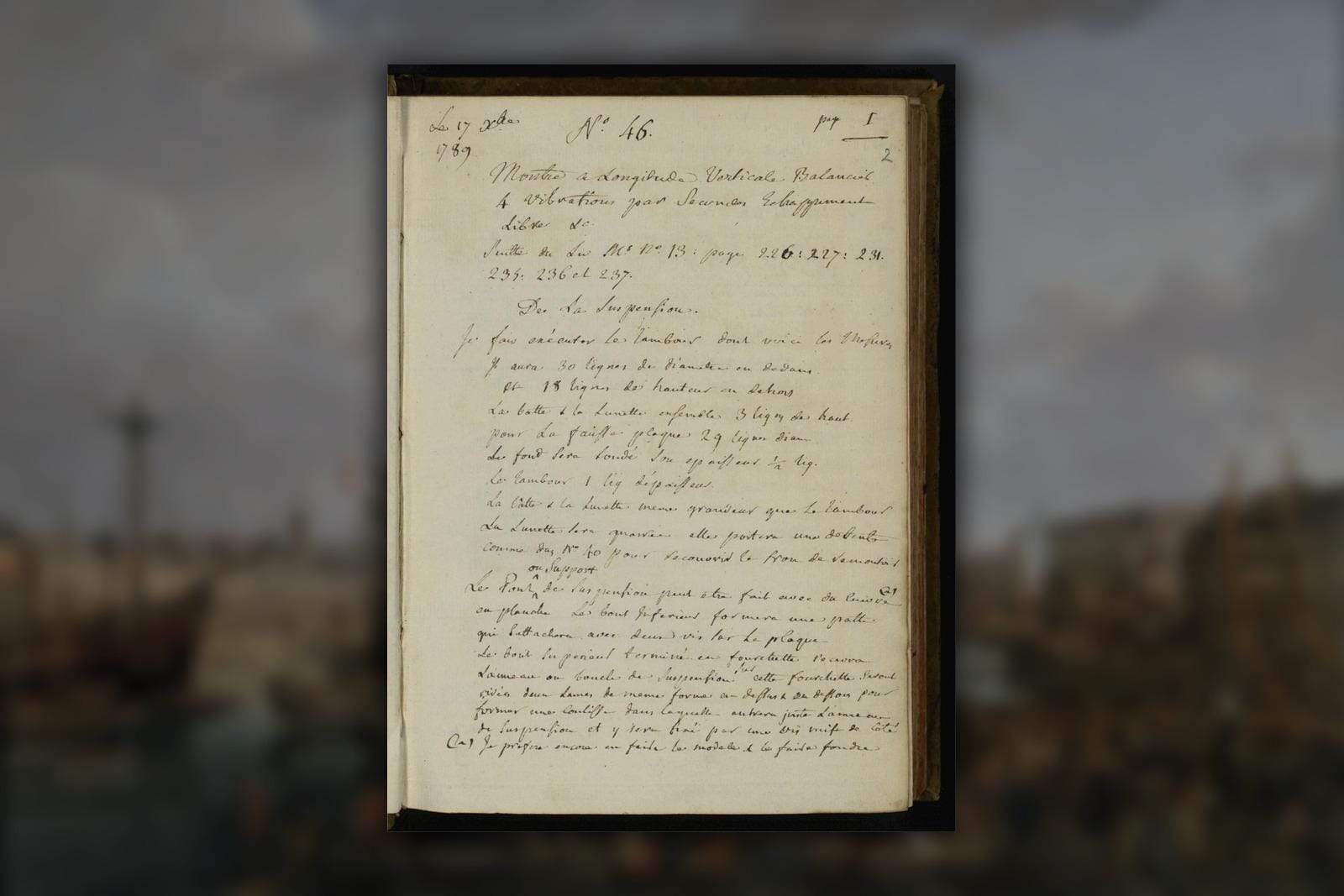
17 December 1789, the first leaf of the new design. De la suspension, with the drum 30 lignes across and 18 lignes high. Conservatoire national des arts et métiers, Paris, Ms 72. « Cnum - Conservatoire numérique des Arts et Métiers - https://cnum.cnam.fr »
Then he began posting it to him. On 17 December he opened a fresh journal and took the design through the gimbal, the spiral, the balance, the escapement, the train and the compensation. On the 21st, against the page, he wrote: « envoyé les Mesures ci a coté a M. Martin a Brest avec les detail[s] compris depuis la page 3 jusques a celle 10. » Eight pages of it were in the post four days after he opened the book.
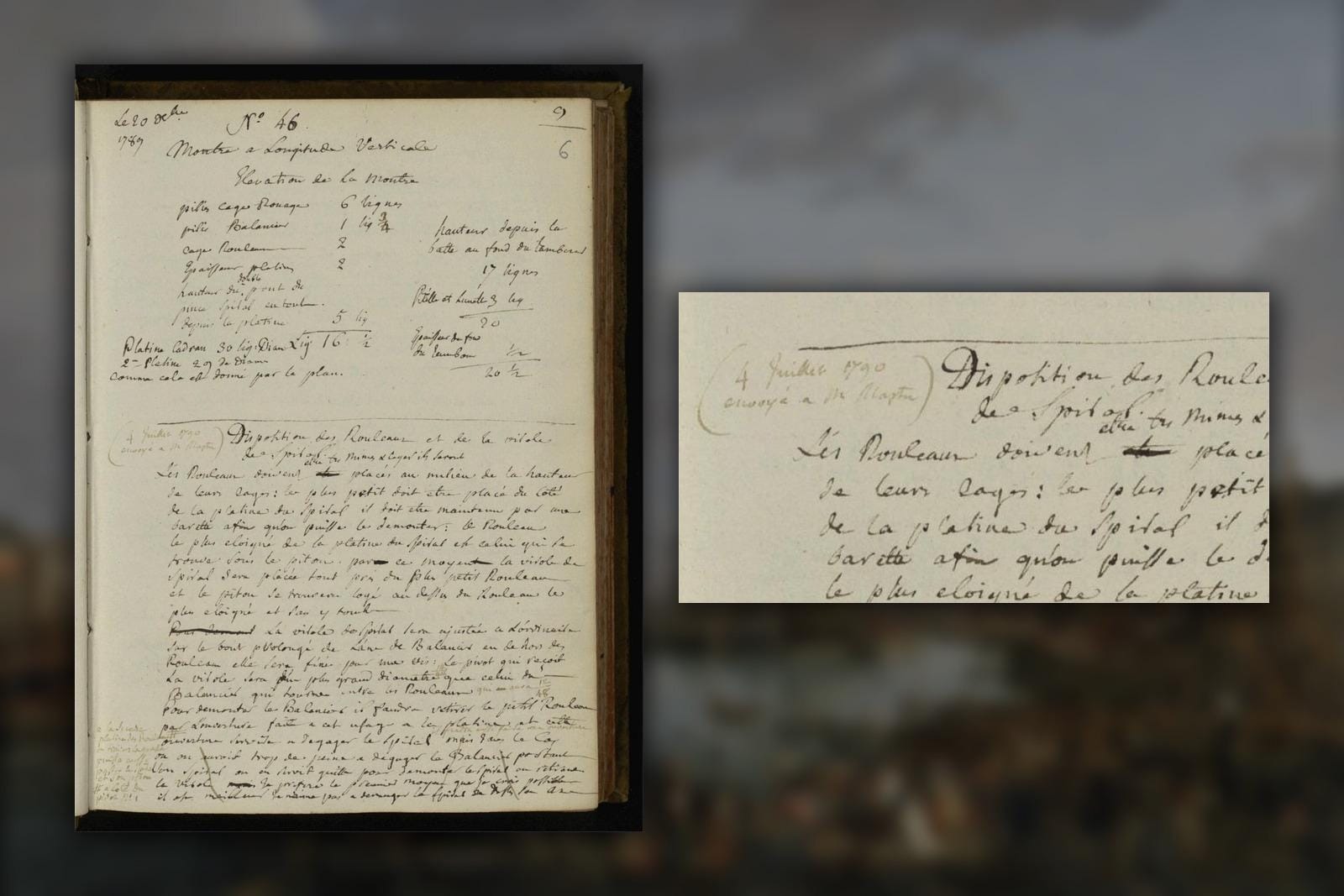
The elevation of the watch, drawn on 20 December 1789, with the pillar heights, the plate thicknesses and the diameters. In the margin, boxed in Berthoud's own hand and enlarged at the right: « 4 Juillet 1790 envoyé à M. Martin ». The drawing went to Brest. Conservatoire national des arts et métiers, Paris, Ms 72, f. 6r. « Cnum - Conservatoire numérique des Arts et Métiers - https://cnum.cnam.fr »
More went in the summer. On 1 July 1790 he copied a letter into the journal under a heading that names the arrangement outright:
« Montre a Longitude Verticale - laquelle je fais exécutée par M. Martin, a Brest dapré mon Plan N° 46. [...] »
Which I have M. Martin execute at Brest, after my plan N° 46, and the heading runs on, « Suitte de la page 7. 8. 9 et 10 »: by July 1790 « Plan N° 46 » meant the journal pages for No. 46 he had posted in December. The two numbers are not a muddle. In late June 1789, his plan N° 45 was the four-vibration design and his plan N° 46 was a six-vibration portable, and on 11 July 1789 he wrote the second off: « Je préférerai le Plan N° 45 dont le Balancier fait 4 Vibrations par Secondes à celui 46. Je ne ferai pas exécuter ce dernier. » The machine that came to carry the number 46 was built on the plan of N° 45, and the number was available because the design it first belonged to had been abandoned. The letter is in the second person, and the division of labour is physical: Paris sends the gimbal, the drum, and the case; Martin fits the movement inside them at Brest and sends the whole thing back when it is done. Five numbered clauses give him dimensions to a forty-eighth of a ligne, the Paris line being a little over two millimetres. On another page, dated the day before and headed N° 37, a small clock Martin had already made, Berthoud had ruled instruction 13 across the foot with a little drawing beside it:
« 13. Lorsque vous exécuterés une petite Horloge pareille a celle que j'ai Receüe vous ferés la Lame Composée plus etroite et a deux rangs de Rivets Seulement [...] Je vous en envoye un Modele [...] Les Rivets trop gros et l'intervale en longueur trop grand. »
Make the next one's compensation blade narrower, with only two rows of rivets. I am sending you a model. Your rivets are too big and too far apart.
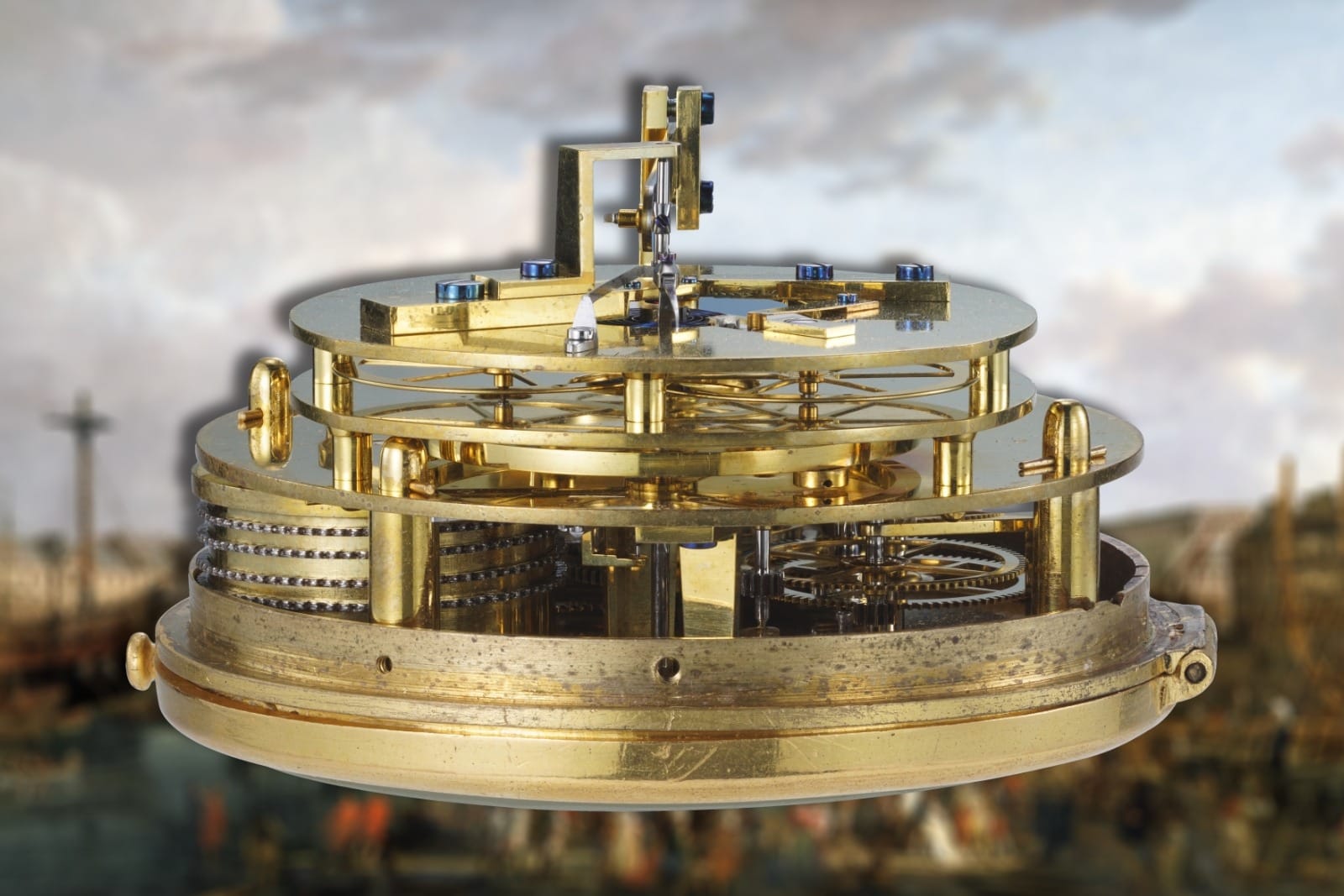
Four plates making three cages on plain cylindrical pillars, the gimbal trunnion lug with its pin at the edge, the fusee chain below. This is the architecture built at Brest from eight pages of dimensions sent by post.
That is how No. 46 was built. One man drawing at a table in Paris, another at a bench in a naval arsenal, with the Brest mail connecting both.
The two watches were not finished alike. On 4 September 1790, on the page headed with Sánchez's watch, N° 45, Berthoud wrote: « J'ai finis le mouvement et fait L'Échappement de cette Horloge elle marche depuis Dimanche. » He had finished the movement and made the escapement himself, and it had been running since Sunday. Eight months after promising that both pupils would execute and finish their watches entirely, he had built the more difficult part of one of them himself. No. 46 came in from Brest assembled.
Whose fault
The watch had been on the bench in pieces since the morning of 19 October 1790. Berthoud measured what had come out of the package. Over the next fortnight he learned about the parts that regulate a watch of this kind from two older clocks in his stove, N° 1 and N° XXX.
The trials began in the stove, the heated chamber he kept for temperature work. The run went from the 1st to the 3rd of November, the thermometer from nine degrees to 25 and back on a scale he does not name, the door thrown open to bring the cold on fast. No. 46 lay in pieces on the bench. One of the clocks in the stove, N° 1, a small spring clock in a drum, would not return to the rate it had held before it was heated, and he wrote that this proved the copper of its compensation blade was too weak. He had thinned that copper himself on 27 October.
On 4 November he accidentally found that it had nothing to do with the blade. He had lifted the movement of N° 1 out of its drum very carefully, to read the index on its stud, and put it back just as carefully without touching anything.
« Cependant j'ai observé qu'après avoir remis le Mouvement l'Horloge qui auparavant retardoit sensiblement s'est trouvée réglée [...] en un mot cela ne vient pas de la Lame Composée. La Cause de Cet effet vient du pince Spiral qui est trop pesant, ses pivots trop gros et le Ressort trop fort. »
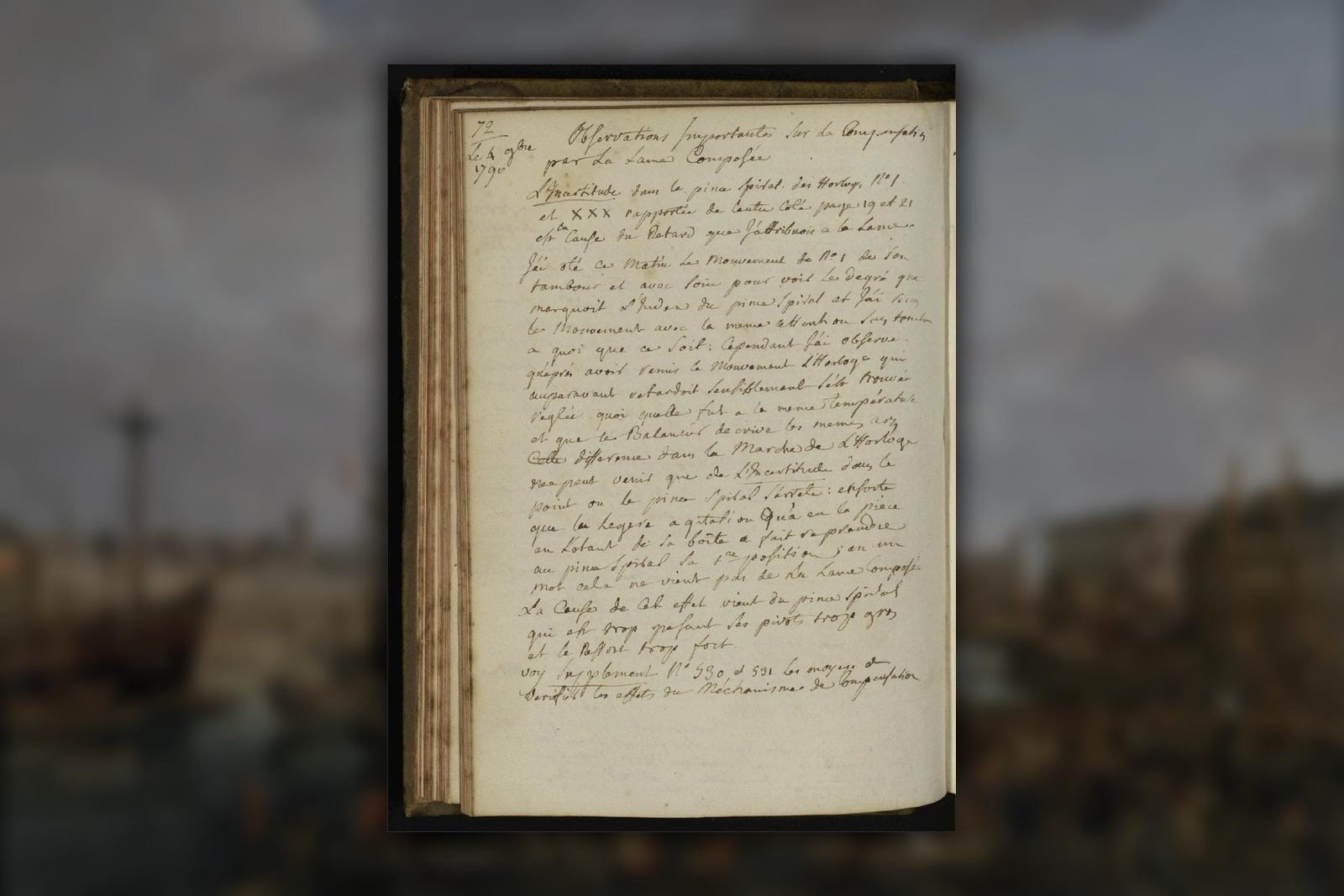
4 November 1790. He lifted the movement of N° 1 out of its drum to read the index on its stud, put it back without touching anything, and found the clock back on rate. The fault he had blamed on the compensation blade was the spiral stud: « en un mot cela ne vient pas de la Lame Composée ». Conservatoire national des arts et métiers, Paris, Ms 72, f. 37v. « Cnum - Conservatoire numérique des Arts et Métiers - https://cnum.cnam.fr »
The clock that had been losing was now keeping time. Moving it had let the stud settle back into place. In a word, it does not come from the compensation blade. The cause is the pince spiral, the spiral stud: the little pivoted arm that pinches the balance spring and so fixes its working length. Too heavy, its pivots too thick, its spring too strong. The next day he turned that into a rule. In a watch of this kind, the spiral stud must be as light as possible and carry no index at all, because an index cannot read to that precision, and its weight does harm. No. 46 is a watch of that kind, with a composed blade and a spiral stud.
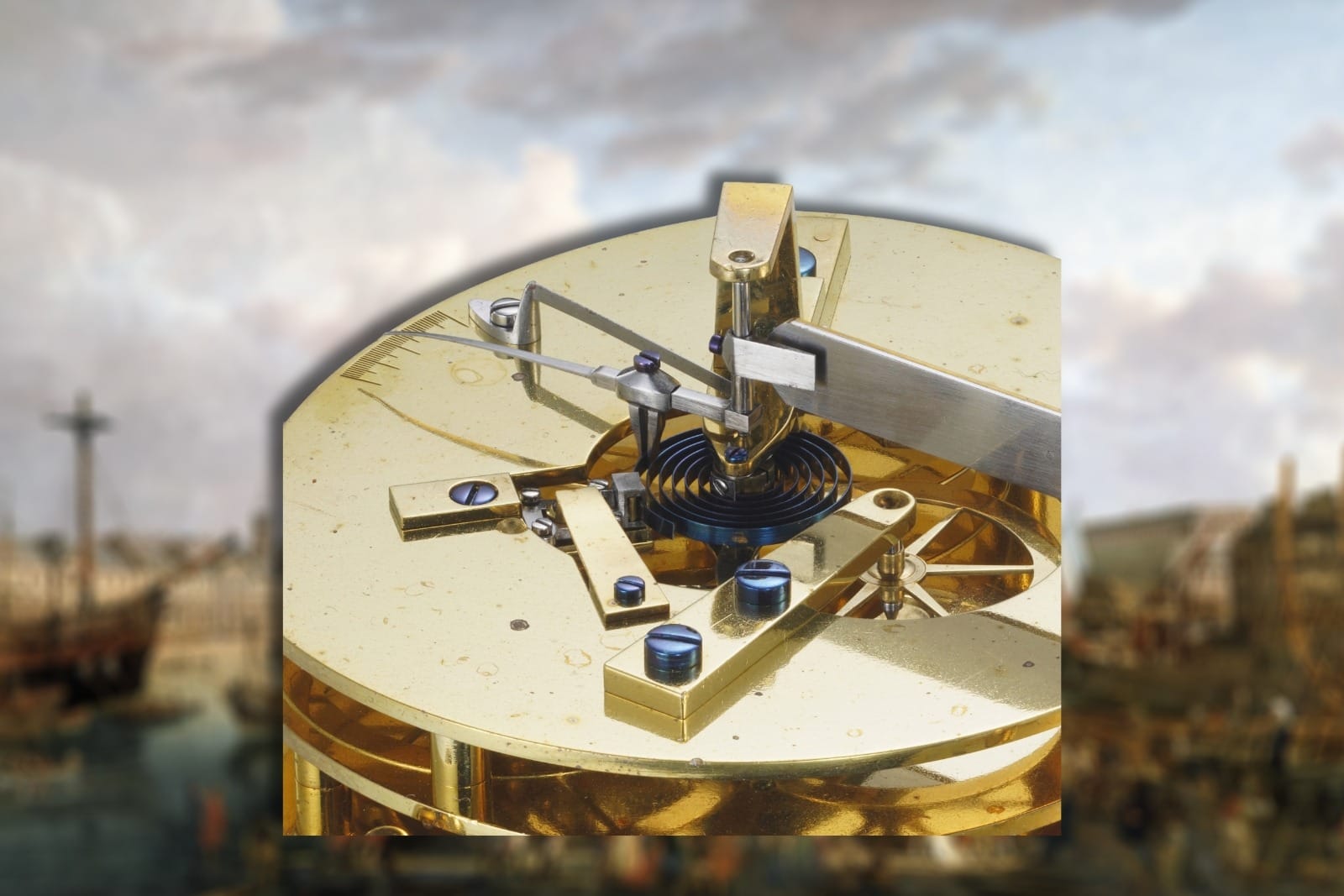
The blued spiral with the fork of the spiral stud on its outer turn, and the composed blade linked to the stud's arm. On No. 46 the blade the November trials acquitted, and the stud they convicted sit within a few millimetres of each other.
The graduated scale engraved at the edge of the top plate, with the long steel index of the spiral stud lying across it. The day after he traced the fault to the stud, Berthoud set down the rule that a stud in a watch of this kind must be as light as possible and must carry no index at all.
No. 46 carries such an index. A long, slender pointer runs across a row of fine strokes engraved at the edge of the top plate, and it is the index of the spiral stud itself: the arm that carries it ends in the jaw that pinches the end of the spiral. The catalogue of its 1988 sale called it a micrometric scale and compensation adjustment. The photographs of the watch now for sale show what it is, though not when it was fitted. If it was there in 1790, Berthoud wrote his rule against indexes with one in front of him. If it went on afterwards, someone later thought the watch needed what he had ruled out. After Berthoud's trials, they opened the watch and worked on it, and for 159 years since, nothing records where it was or who worked on it.
On 10 November, after tracing the fault to a part he had designed himself, he sat down and sorted out Martin's work. Two headings on one page, in his own hand.
deffaut du Plan. One item: the stud wants moving, because the chain touches it halfway through its travel.
deffaut d'exécution. Five on that page and at least seven by the turn of it. One of the rubies is loose in its setting, and the screw heads are sunk under the overhanging lips of the bridges, so it is very hard to put back together. The chain-guard spring is too strong. Two feet are missing from the compensation blade bridge. The collet spring « mal fait et de mauvaise figure », badly made and ill-shaped. And the movable foot of the roller is in the wrong place, against which Berthoud writes nine words: « mais Je ne l'avois pas tracé de cette Sorte. » But I had not drawn it that way. Over the page come a sixth and a seventh: the hook of the spiral-stud spring wants polishing, and in the large swings the spiral struck its own end where it stands out of the stud.
Below the list, under a rule of its own, he adds a note on the movement's height. The spiral stud bridge is too high and could be lowered by nearly two lignes; the blade should sit flush with the plate, so the watch could be nearly two lignes lower. The balance-cage pillars should be 1 3/4 lignes and are nearly 2. The design was drawn to keep the watch low, but it came out taller than needed. He files the note under neither heading.
He had printed the principle in 1773, in the Traité des horloges marines, and it reads now like a description of what was about to happen to No. 46:
« [...] les opérations dont nous avons traité sont de nature à être faites par un bon Ouvrier ordinaire, lorsqu'il sera dirigé par un Artiste; mais pour achever cette Horloge [...] c'est à l'Artiste même éclairé à opérer. Il faut pour ce qu'il reste à faire plus de lumiere encore que d'adresse. »
A good ordinary workman, directed by an artiste, can do the operations described so far. Finishing the clock is for the enlightened artiste himself, and what is left needs more light than skill of hand. Berthoud did not write where Martin sat on that scale. The dials were engraved in Paris that October. On 9 February 1791 he made the isochronism trials himself and found the spiral isochronous and at its point, with the balance down to 60 grains from the 80 that had come in from Brest. On 25 May, seven months after the watch arrived from Brest, he was still moving the compensation blades nearer the centre. Martin had sent a machine that still needed finishing, and the finishing was done in Paris.
The letter back
Martin wrote back. Three of his letters are known, and none has come to light. Berthoud copied what they said into his journal twice to record his disagreement.
The first came with a watch. N° 47 was another machine Martin built at Brest, and it reached Paris on 15 November 1791 with a letter from him. Berthoud wrote its figures into the journal under a rubric that credits them, « Dimensions selon la Lettre de M. Martin »: the mainspring pulling 13 gros over six and a half turns, the chain four turns less an eighth, the spiral of six turns and a fraction, the balance weighing 26 grains. Martin also reported the balance at 220 degrees.
On 8 December, he returned to that figure. He could not get the watch to show it, he wrote, and Martin had marked arcs of 215 to 220. The watch kept varying in a way that neither the steady temperature nor any shaking, since it stood upright, could account for. So he took the movement out of its box and found the upper roller running close enough to the balance pivot to drag on it. He moved it clear, and the balance swung about 300 degrees. Martin's figure was right about the machine as it stood then.
On 1 April 1792, at Groslay, Berthoud recorded that N° 47 had come back from Brest the previous Friday with a new spiral and balance, and that Martin's letter said he had made its oscillations isochronous « par le non Equilibre du Balancier », by deliberately putting the balance out of poise. He objected that the method could work only while the watch stood vertical, since, laid flat, the oscillations would stop being isochronous, and that the spiral gave far better isochronism. The tests on Martin's watches went on into 1793.
The third is from January 1793, over a small vertical clock, N° 49, which Berthoud records as executed by Martin at Brest on the pattern of No. 46. Berthoud sent for it, ran it for two days in both positions with a counterpoise of three onces hung on the balance to force the arcs apart, and concluded that its spiral was far from isochronous and that the small arcs ran slower than the large.
« N.ta que M. Martin dans sa lettre marque que les grands arcs sont plus lent que les petits il s'est fort trompé, ainsi que je l'avois d'abord jugé, en la faisant marcher Verticale & Horisontale : car elle avançoit verticalement et étoit reglee étant horisontale [...] »
He is much mistaken, and so was I at first, from running it upright and lying flat: it gained upright and kept time flat. Two days later Berthoud set down six numbered corrections in his own journal, written in the second person, the first of them a drop of tallow at the balance pivot bridge. The last tells him to take the index off the stud to make it lighter, and ends: « En un mot il faut donner la plus grande attention a la compensation [...] » He was telling Brest to take the index off the stud two years and two months after he had worked that out himself, on his own older machines. On 6 February 1793 he took the movement of N° 47 out of its case and removed its index himself.
Both men had the machines in their hands, and both of them measured. Only one of them is allowed to be right in writing. On the arcs of 1791, the man at Brest was right. On N° 49 in 1793, he writes down that Martin was much mistaken, and in the same sentence that he had made the same mistake himself.
Six lines, and four pages
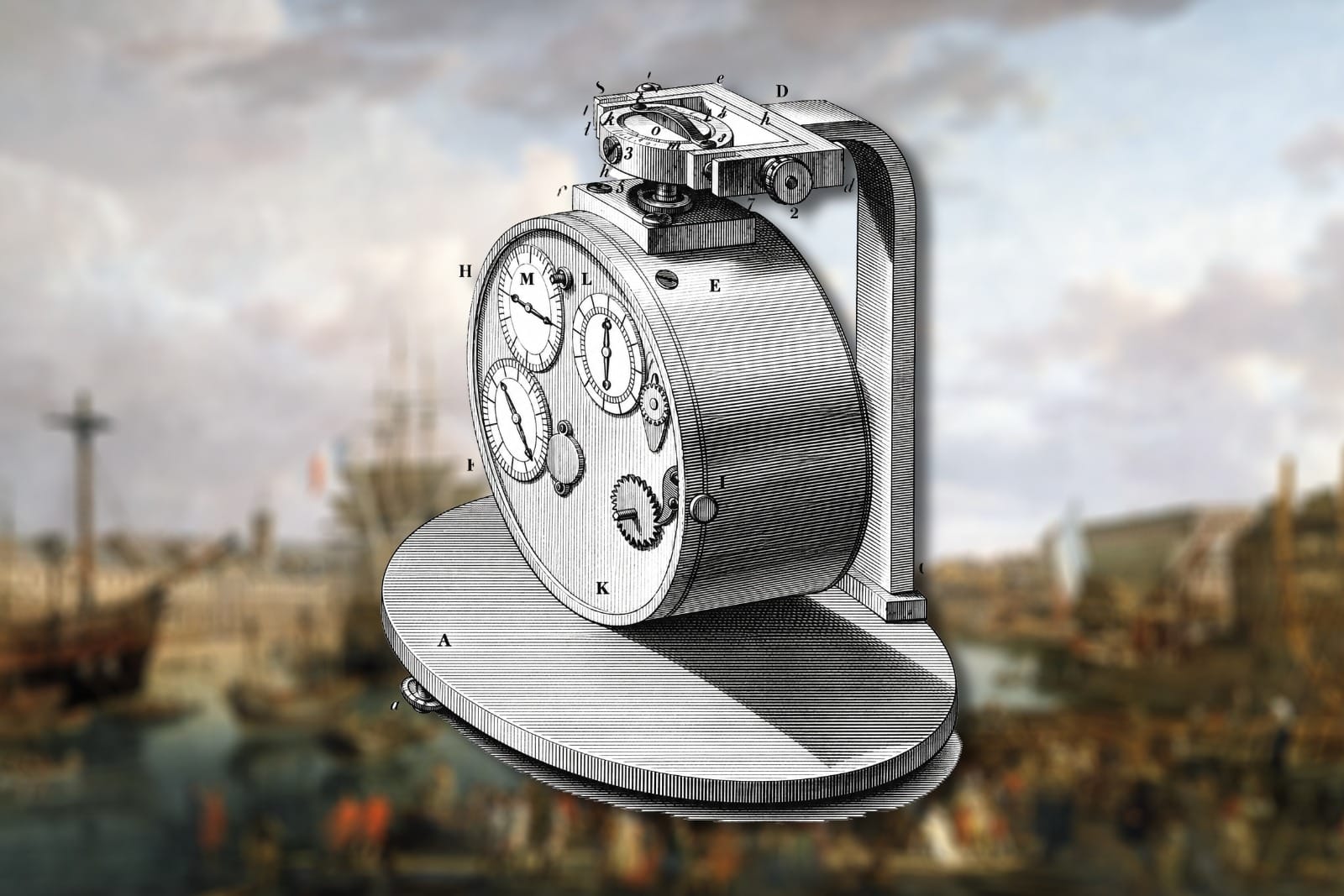
No. 46 as it appears in the Traité des montres à longitudes of 1792, Planche I figure 8: the whole machine on its suspension, the three eccentric dials, the wheelwork left open to view. Bibliothèque nationale de France, Gallica.
Ph.-D. Pierres printed the Traité des montres à longitudes in 1792 for Berthoud's pupils, and, by his own account, did not make it public until 1797. It opens on No. 46: 22 pages, titled Montre à Longitude verticale. N° 46.
At the foot of the first page, in small type, are six lines:
« J'ai fait exécuter cette Montre d'après mes plans descriptions & dimensions très-détaillés, par M. Vincent Martin mon Elève, Horloger du Roi & de la Marine, à Brest, & il a parfaitement rempli mes idées : j'ai fait aussi commencer une pareille Montre par M. Sanchez mon Elève, Pensionnaire de Sa Majesté Catholique ; il l'exécute en ce moment sous ma direction. »
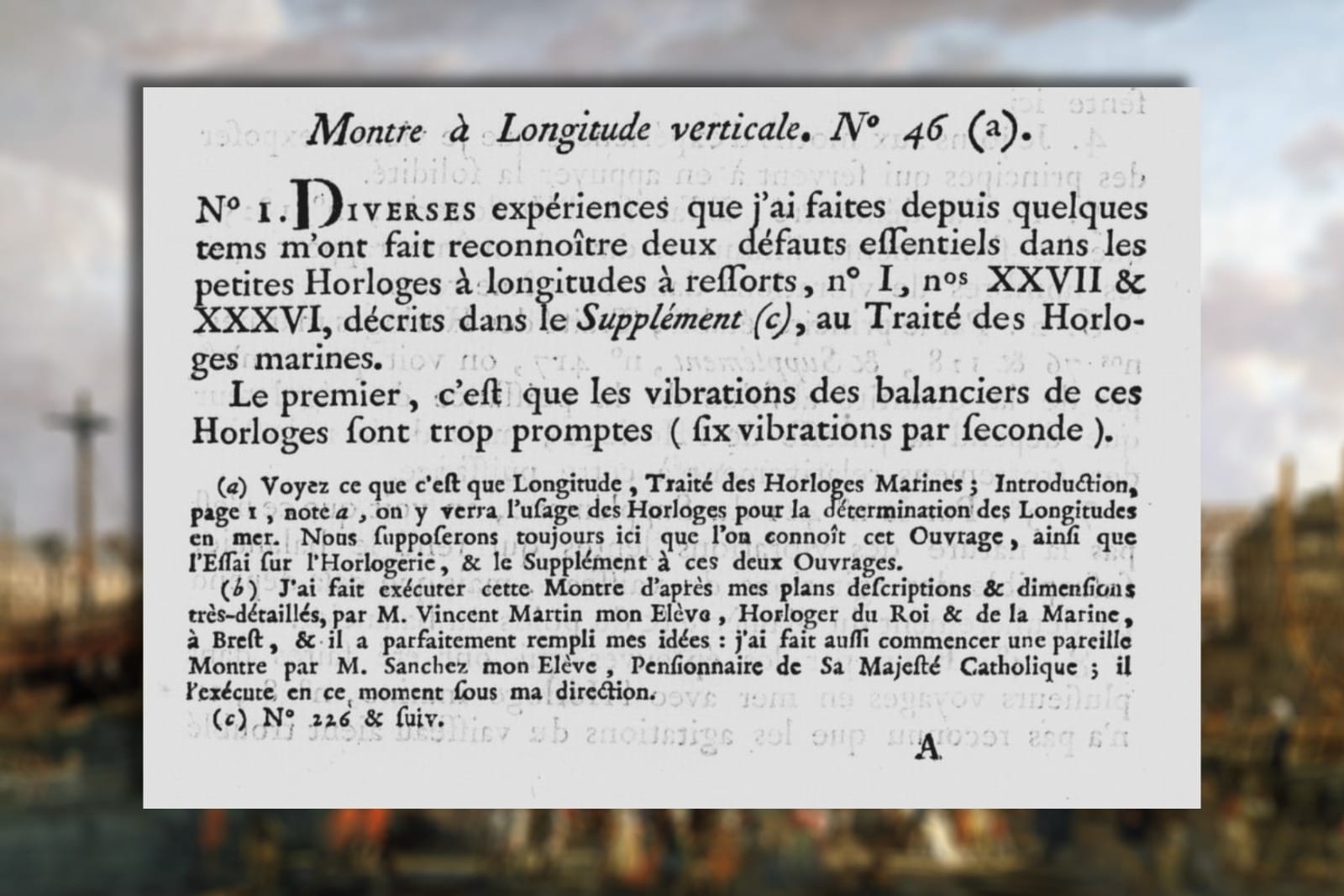
The foot of the first page of the Traité of 1792, note (b): the watch was executed « par M. Vincent Martin mon Elève, Horloger du Roi & de la Marine, à Brest, & il a parfaitement rempli mes idées ». Twenty-two pages describe the watch. This is the only place in the chapter where the man who made it appears. Bibliothèque nationale de France, Gallica.
I had this watch executed after my plans, descriptions and very detailed dimensions, by M. Vincent Martin, my pupil, clockmaker to the King and to the Marine, at Brest, and he has perfectly fulfilled my ideas. I have also had M. Sanchez, my pupil, pensioner of His Catholic Majesty, begin a similar watch; he is executing it at this moment under my direction. Both pupils in one note, the forename given in full, and the only printed verdict Berthoud ever passed on Martin's work on this watch. Six lines under 22 pages, and he is not mentioned again in the rest of the chapter.
He appears five more times in the book. Twice it prints what Berthoud sent him: nine pages of instruction for another watch, introduced with « je joins ici la copie de l'instruction que j'ai envoyée à M. Martin mon Elève à Brest », and the whole of Chapter VII, 59 paragraphs of it, whose opening note says the details had first been written « uniquement destinés pour servir de direction à M. Martin, mon Eléve, Horloger de la Marine à Brest, dans l'exécution de cette nouvelle Montre ». An entire chapter of a printed book, composed for one reader at an arsenal. The watch of Chapter VII is N° 50. They began its execution in 1792, the year Berthoud wrote to the Minister to keep Martin in his post, and finished it in 1793. The book says whom the chapter was written to direct; neither it nor the Supplément of 1807 says who finished the watch. Fifteen years later, Berthoud says which of his machines he wanted remembered. His last book opens on N° 50 and gives it the first chapter, presenting it to the artistes as the machine best fitted to find longitude at sea and on land. Of everything he had built since No. 46, he commended the one he had written a chapter for Vincent Martin to build. On the last page, the 1792 book ends with Martin: Berthoud will make N° 52 himself and have N° 51 made by « M. Martin, mon Élève, à Brest ».
Martin writes twice more, in an Addition to Chapter V.
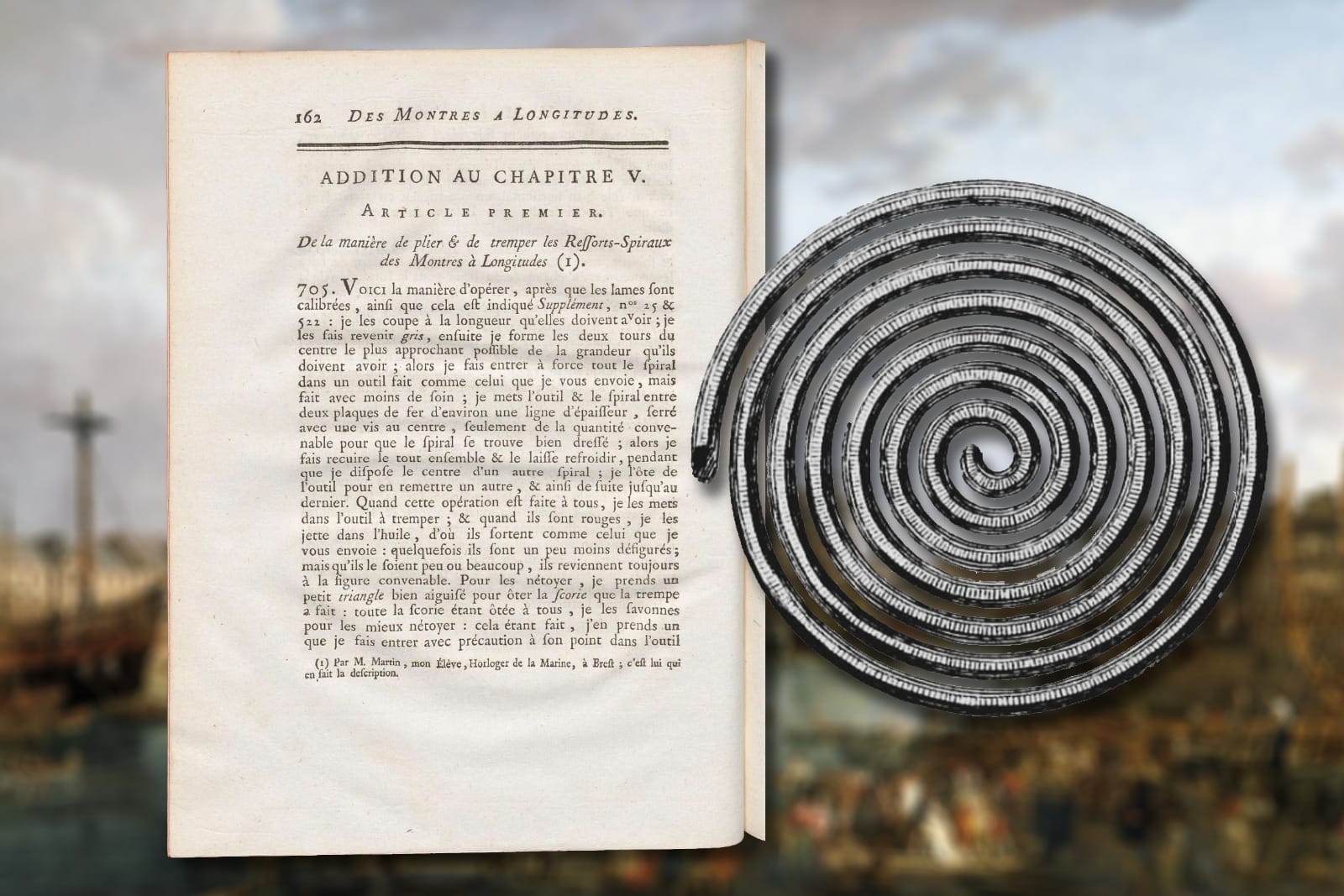
Left: Berthoud's note over the four pages on bending and tempering balance springs, « c'est lui qui en fait la description ». Right: the tool Martin describes, engraved on the volume's second plate. A flat spiral of spring steel wound on edge, with gaps between its turns forming the mould that shapes the spring. Left: e-rara, ETH-Bibliothek Zürich, Rar 4675. Right: Bibliothèque nationale de France, Gallica.
The article is on bending and tempering balance springs, set in guillemets throughout and in the first person, with Berthoud's note under the title: « Par M. Martin, mon Élève, Horloger de la Marine, à Brest ; c'est lui qui en fait la description. » A page on, a second note: « C'est M. Martin, mon Elève, qui continue ici la description de la méthode qu'il emploie. » It is one of the hardest operations in the trade, winding a spring to a true flat spiral and then hardening and tempering it without losing that figure, and the tool he uses for it is engraved on the volume's second plate: a flat spiral of some 14 turns of spring steel wound on edge, the gaps between its turns forming the mould the spring is shaped in.
A workman's own method, under his own name, with his own tool drawn for the plate, in a book written by the man he worked for. It runs to four pages, and it is the one place where Vincent Martin is an author rather than a pair of hands.
Naming a maker at all was almost as rare. I have gone through Berthoud's printed corpus, six volumes from 1773 to the 1807 Supplément. Over those 34 years, Berthoud named the man who made one of his machines in two volumes: Vincent Martin in 1792, and the gardener's son 15 years later. The 1787 volume describes at length the small clock N° 36, which Martin had made entirely before leaving for Brest and from which No. 46 was cut down. His name is nowhere in it.
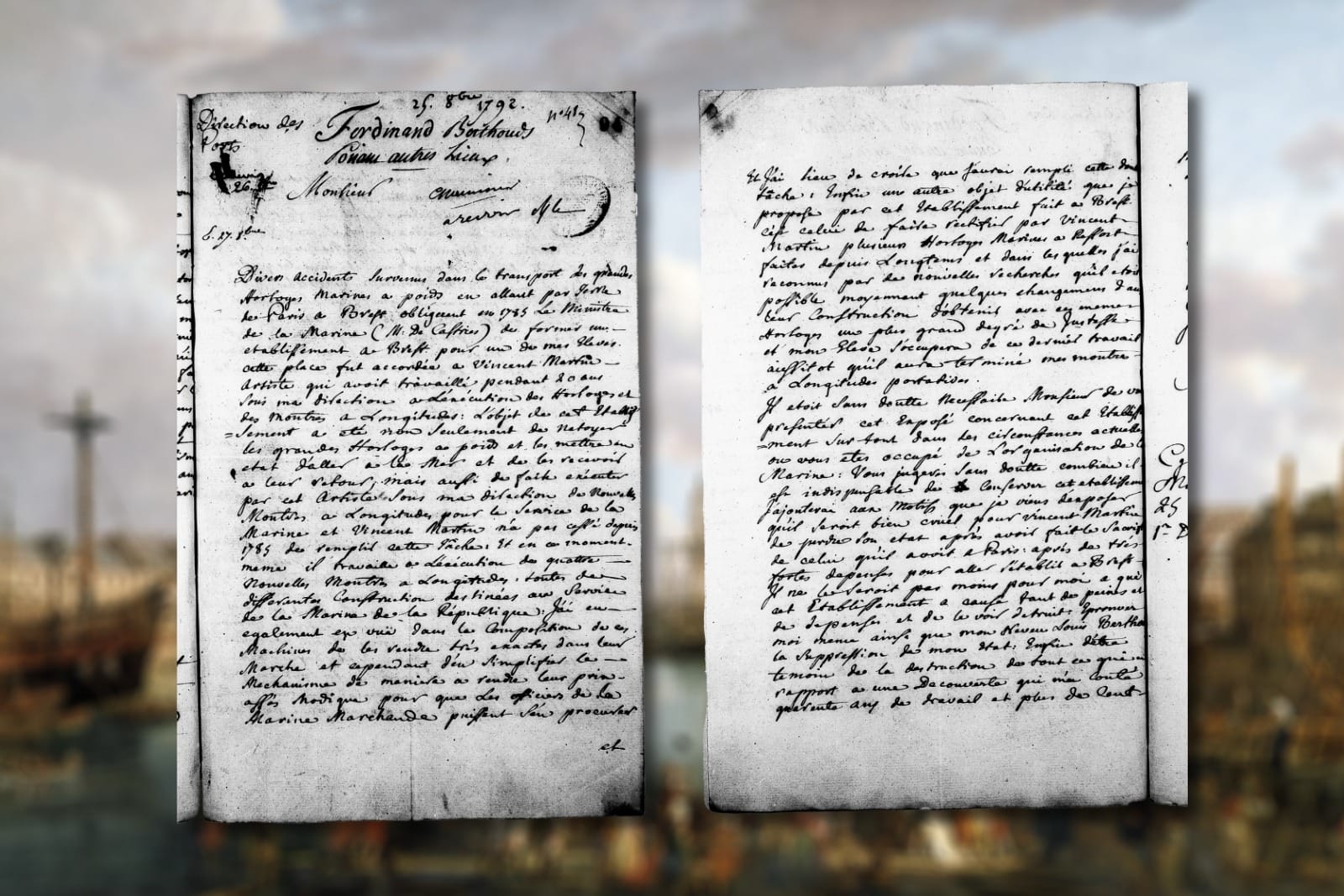
Groslay, 25 October 1792, Berthoud to the Minister of Marine, trying to keep Martin in his post. Recto: « cette place fut accordée a Vincent Martin Artiste qui avoit travaillé pendant 20 ans sous ma direction ». Verso: it would be cruel for Martin to lose his place after sacrificing the establishment he had in Paris and paying « de très fortes depenses » to settle at Brest. No printed source carries that second sentence. Archives nationales, France, MAR/G//97, fol. 94 recto and verso.
In print he gives Martin his offices, Horloger du Roi & de la Marine and Horloger de la Marine, and one word of standing, « mon Élève ». In October 1792, writing from Groslay to the Minister to keep him in his post at Brest, he uses another: « cette place fut accordée a Vincent Martin Artiste qui avoit travaillé pendant 20 ans sous ma direction a l'exécution des Horloges et des Montres a Longitudes [...] » An Artiste, who had worked 20 years under his direction before the place was granted. Artiste is his word for the man who directs the work, set in the 1773 passage above the good ordinary workman, though in 1781 he used it for the man he wanted at Brest to look after the clocks. « Mon Élève » is not a lower rung of that ladder, because it is not on it: it names a relation to himself rather than a standing in the trade. In one year he gave Martin the rank word in a letter to a ministry and the relation word in a book.
Twenty years before the 1786 order, the date lands on 1766, the year the goldsmith's son was bound to him. It is a round figure written six years after the event, so it proves nothing on its own. It agrees with Cardinal's identification, in Berthoud's own hand, which is more than the identification had before.
Two watches
One of them carries his name. In 1791, at Brest, he made a marine watch which has No. 46's architecture, and the plate carrying its dials is engraved « Cons.te par F.d Berthoud Exe.tée par Vincent Martin à Brest 1791 ». Constructed by Berthoud, executed by Vincent Martin at Brest. The dial is the part of that watch anyone can rely on.
It had been at the Musée de l'horlogerie et de l'émaillerie in Geneva, and records show that it was transferred in 1991 to the Musée d'histoire des sciences, a branch of the Musée d'art et d'histoire. I wrote to ask where it is now. Estelle Fallet, conservatrice of horology and jewellery at the Musée d'art et d'histoire, which holds its record, went looking and answered: the watch in its mahogany box, entered under three names: Ferdinand Berthoud, Jacques-Vincent Martin, a form of the name that confirms nothing on its own, and a Breguet with a question mark against him. Inside the cap, in thin, scratched script, it reads « N.° 1499 / Terminée par Breguet / 3 AVRIL 1821 ». Finished by Breguet, 30 years after Martin made it, which is why the engraved dial is the secure part, while the balance, the spiral, and the escapement are not. Condition: « excellent », and then the particulars. « Poussiéreux, mal emboîté, spiral de travers, mais fonctionnel. » Dusty, badly cased, the spiral out of true, but still going.
No. 46, the other watch, does not carry his name.
After
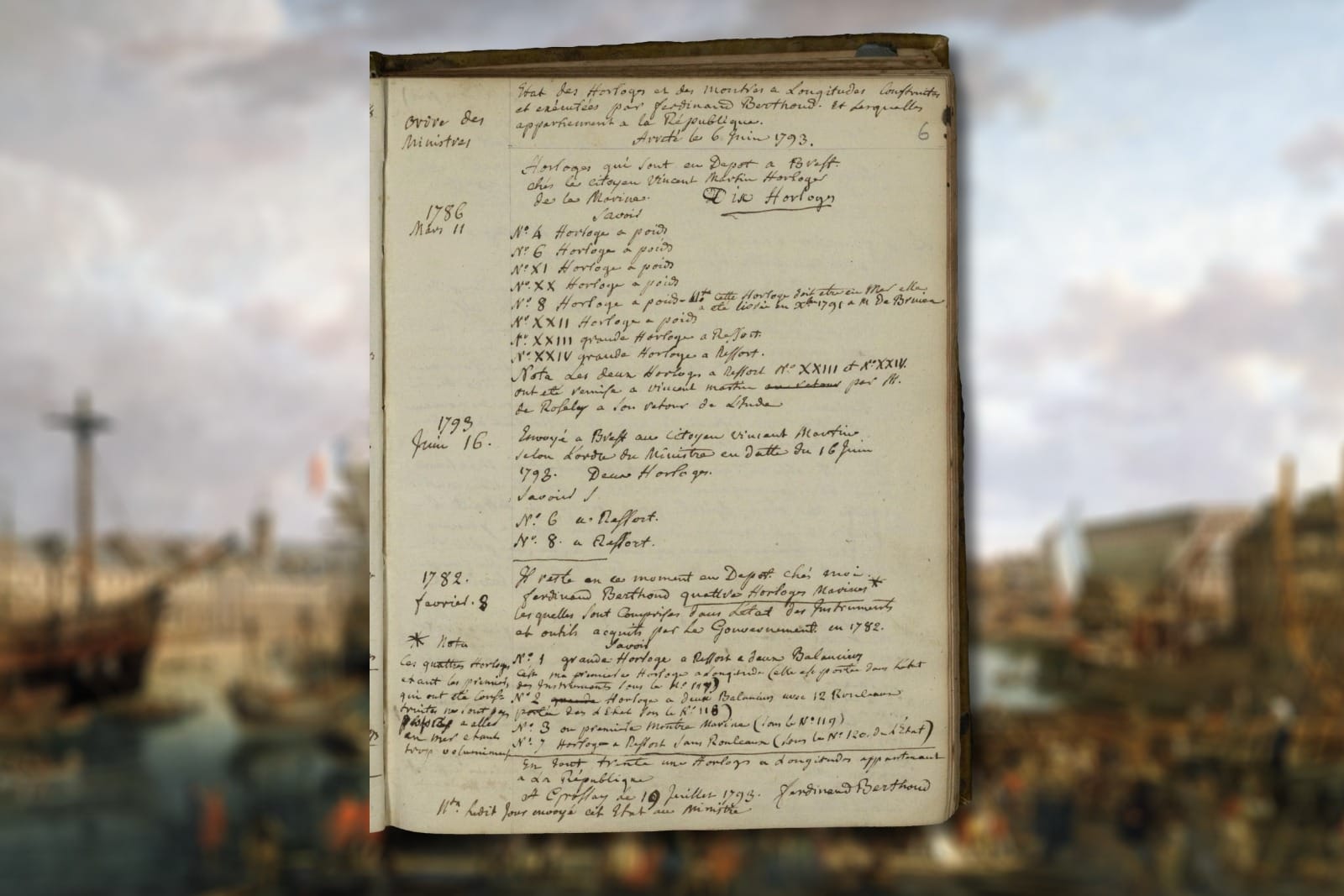
Berthoud's retained draft of the État of 19 July 1793: ten clocks in deposit at Brest with the citizen Martin, seven years after the King's order put the first eight into his hands. Conservatoire national des arts et métiers, Paris, Ms 73, p. 6. « Cnum - Conservatoire numérique des Arts et Métiers - https://cnum.cnam.fr »
1793 runs on normally for a while. In January, Berthoud writes up N° 49, « exécutée par Vincent Martin à Brest d'après N° 46 ». In May, young Jean Martin finishes his apprenticeship in Brest and is back by the 21st. In June the Minister orders two more clocks west, and on 2 July Berthoud puts them on the road, consigned « au Citoyen Vincent Martin Horloger de la Marine ». On 19 July Berthoud certifies the total: « Dix qui sont en Depot chés le Citoyen Martin a Brest. »
And then Martin goes quiet. He appears in print once more, in 1807, in a footnote about Jean Martin's apprenticeship. The analytical index at the back of that same volume runs through Berthoud's whole output from 1752 and gives No. 46 an entry of its own; Martin is not in it, and the only Brest in it is the Brest of 1764, where Berthoud's first marine clock was tried at sea. The last document that names him at all is dated 18 March 1808, when the Minister of the Interior writes to Molard at the Conservatoire des arts et métiers that « le ministre de la Marine consent à céder au Conservatoire des arts et métiers la collection des machines, outils et horloges mises à Brest sous la garde de Vincent Martin ». That June, the collection came to Paris. He was still the man it had been left with, 22 years after he signed for it.
His apprentice did better. Jean Martin's name went on the dials: a pocket chronometer of 1796 in the Louvre reads « Constᵉ par Ferdinand Berthoud / Execᵉ Par Jean Martin / 1796 », his name is on others of 1795, 1799 and 1806, and in 1807 Berthoud credited him in the body of a book rather than in a footnote, as « artiste habile ». Three years after Berthoud died in 1807, a hand in his journal wrote: « Fut terminé ce jour le N° 84 par Jean Martin, élève de Ferdinand Berthoud. [...] »
One caution belongs with all of that, and it is probably the most important qualification in this story. « Exécutée par » is Berthoud's own formula for naming the person who executed a machine, and it does not certify each operation: it neither promises that the pupil performed every one nor excludes the master's hands. For Sánchez's watch the papers record those hands directly, Berthoud having finished the movement and made the escapement himself. For No. 46 they record the plan, the eight pages of dimensions, the five clauses of July, the watch arriving assembled from Brest, and Berthoud's written verdict that Martin had perfectly fulfilled his ideas. For No. 46 and N° 47 alike, they contain no leaf in which Berthoud records working on the watch while it was on the bench at Brest. Once No. 46 reached Paris, he finished it, and he recorded it in his own hand in the journal. N° 47 went the other way. In December 1791 he had it in pieces in Paris, judged its escapement « fort bien exécuté », and sent it five hundred kilometres back to Brest « pour qu'il la finisse », for Martin to finish. The formula is the strongest thing print says about who made this watch, and a formula is not a signature.
Three things about Vincent Martin remain unknown: what became of him after 1808, when and where he died, and whether he ever signed an object he made himself, rather than being named by someone else's engraver.
The Spanish years
Berthoud had No. 46 in the stove for temperature trials in May 1791. By 1803 it was in Spain. No one recorded who owned it when it went, nor how it became available to a Spanish order. The Cádiz observatory's material was ordered in Paris in 1798, and 12 crates came out through Brest and reached the observatory in 1803 with 405 items in them, among them an unnumbered chronometer by Berthoud and three more by him, numbered 42, 46 and 49, along with lathes, a transit instrument, stoves for temperature trials and some copies of his printed works. In September 1804 an inventory at the Isla de León, now San Fernando, put Nos. 46 and 49 down together as arrived damaged and under repair.
A clock of Berthoud's numbered 49 therefore travelled in the same crates as No. 46 and was damaged with it. Whether that N° 49 is the small vertical clock Berthoud records Martin executing at Brest on the pattern of No. 46, and that the two men argued over in January 1793, is not established.
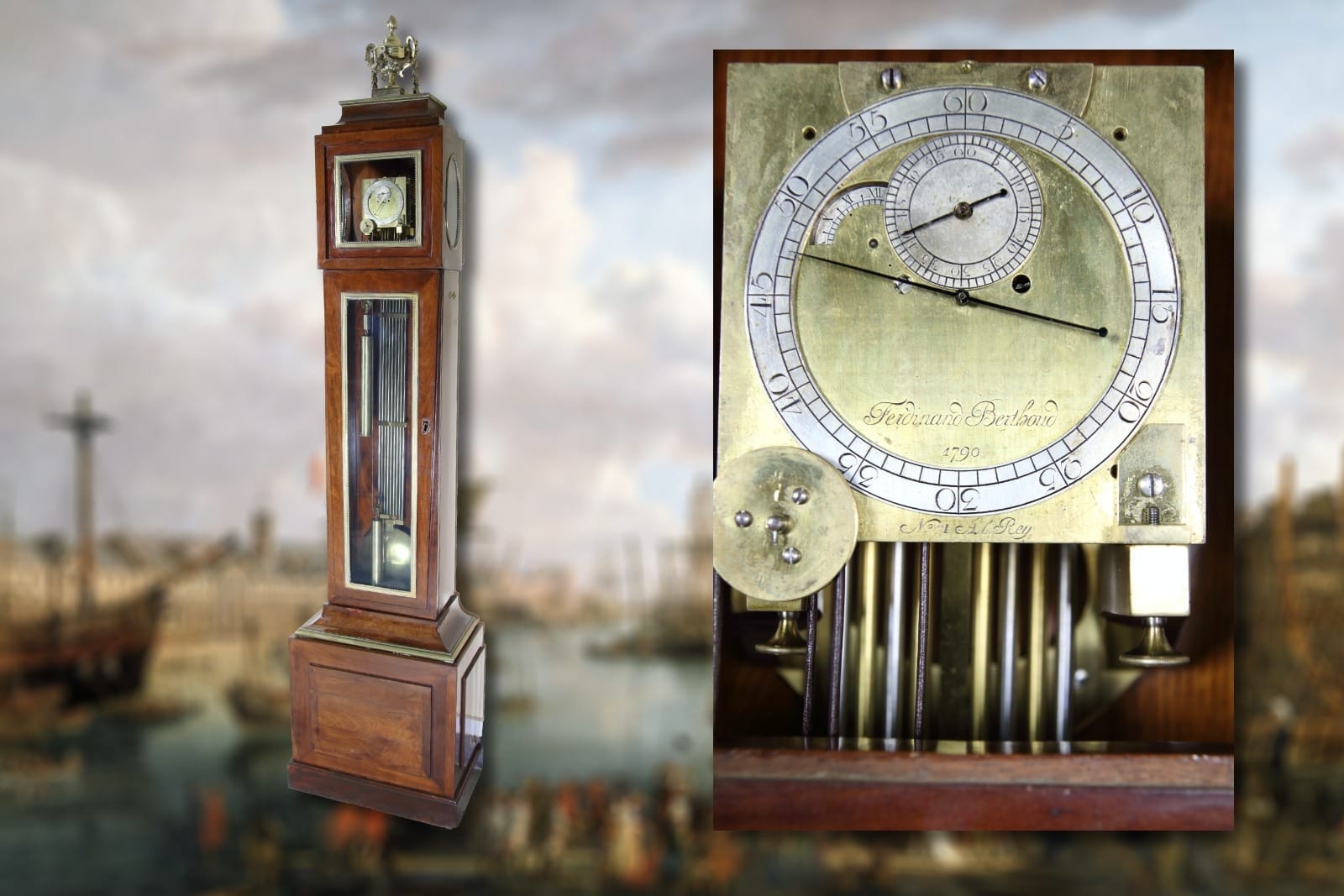
Ferdinand Berthoud's astronomical regulator of 1790, with the dial plate enlarged at the right. The engraving is in three parts and two positions: « Ferdinand Berthoud » and, below it, « 1790 » inside the silvered chapter ring, and « N.º 1 Al Rey » smaller and lighter, outside the ring at the foot of the plate. Beneath them, the gridiron, nine rods, four of brass and five of steel, counted by the observatory on the object. The observatory's records show it arrived from Brest in 1802, and it remains in working order. It is not the N° 1 of the stove, which was a portable machine in a drum. MINISTERIO DE DEFENSA. Colección Museográfica del Real Instituto y Observatorio de la Armada. N.º inventario: ROA-93. Fuente: Real Instituto y Observatorio de la Armada / Biblioteca Virtual de Defensa. CC BY 4.0.
Two Berthoud machines from that traffic remain at San Fernando, and the observatory's records show both arriving from Brest in 1802. One is an astronomical regulator by Louis Berthoud. The other is Ferdinand's, from 1790, with a silvered brass dial whose seconds are numbered in fives, a gridiron pendulum of nine rods, four of brass and five of steel, and one the observatory keeps in working order. It is inscribed « N.º 1 Al Rey », for the King, and stands two metres high. The consignment list names two pendulums, one by Louis and one by Ferdinand, and these are very probably those two, although the years in the two records differ by one.
In 1829, 25 years after that inventory, No. 46 was condemned. On 21 April that year José Sánchez Cerquero went through the 44 chronometers on the observatory's books at San Fernando, under a heading that reached back forty years, « Relación de la totalidad de los Instrumentos que tienen asiento en el Inventario general del Observatorio, desde fecha de 11 de febrero de 1789 », and set down twelve Berthouds as fit only for scrap. He gave eleven of the twelve by number, and 46 is among them. A royal order of 17 May ordered the useless instruments sold. Fifty years afterwards Fernández Duro wrote up the observatory's chronometry and recorded what became of them:
« Por Real orden de 17 de Mayo de 1829 se mandó que el Observatorio de San Fernando vendiera los instrumentos inútiles, y se enajenaron, en consecuencia, los cronómetros de Fernando y de Luis Berthoud, los de Arnold y los de Albino y Muñoz. Perdióse con esta medida imprevisora la ocasión de conservar un ejemplar tipo [...] á cambio del valor del metal [...] la pérdida es irreparable. »
They were sold. With that improvident measure, he wrote, the chance of keeping one example of the type was lost, for the price of the metal, and the loss is irreparable.
He was wrong about this one, and nothing I have read documents how it left Spain. In 1984, Cardinal and Sabrier, who had just published on the watch, didn't know where it was either, and Cardinal has since told me that, had they known, the notice would have said so, if only as « collection particulière ». Four years later, it came up for sale in Geneva on 16 October 1988 as the last lot of a Habsburg Feldman sale, 72 mm across and 115 mm high, overhauled, having been shown in Tokyo 12 days before. That catalogue had the attribution right: the timepiece, its footnote says, was produced by « Berthoud's pupil Vincent Martin, clockmaker to the French Navy in Brest, according to the master's specifications ». It came up again at Christie's in London on 5 December 1995, as lot 61. It came up a third time at Phillips, at the Hôtel President in Geneva, on 7 and 8 November 2026, as lot 91, estimated at 100,000 to 200,000 Swiss francs.
It includes a brass stand, which the catalogue states is a modern recreation, and leather-bound copies of two of Berthoud's books: the Traité of 1792 and the Histoire of 1802. In the photograph, the 1792 volume lies open to Chapitre premier. Montre à Longitude verticale. N.° 46, with the watch plate beneath it. At the foot of that page, in six lines of small type, the book names the man who made it.
Thanks
Seven people and one institution answered my letters while I was working on this story.
Anne Walther, at Chronométrie Ferdinand Berthoud, gave me the Groslay house and why Berthoud chose that particular village, shelfmarks in Neuchâtel, photographs of the Berthoud regulator at the Cádiz observatory, and her French transcription and translation of the published history of that observatory, from which the Cádiz documents here are taken.
Estelle Fallet, at the Musée d'art et d'histoire de Genève, sent back the record of the 1791 watch and the news that it still runs.
Corentin Durand, at the Archives nationales, sent scans of six leaves of MAR/G//97, including the letter Berthoud wrote from Groslay in October 1792 to try to save Martin's post, where the word artiste comes from.
Catherine Cardinal, professeure émérite, wrote the 1984 volume on which almost everything anyone thinks they know about Martin's birth and apprenticeship still rests. She answered my question about the identification by saying she has not looked at Berthoud's pupils since 1984, no longer holds the file, and that she and Sabrier did not know the watch's whereabouts when they wrote.
Hortense de Lestang Parade, of the Centre de documentation at the Musée des Arts et Métiers, answered a question about one of the clocks in that collection, and closed a divergence in my own notes with it.
Jean-Loup Caron, president of the AFAHA, answered in the society's own journal and said plainly what he could not help with.
Steven Rogers, Senior Editorial Manager for Watches at Phillips, which is selling the watch, sent ten photographs of it at a resolution that let me read the dial letter by letter.
The Real Instituto y Observatorio de la Armada, at San Fernando, answered a list of questions about what it holds. It named four Berthoud titles in its library, and sent the museum records of both its Berthoud regulators, which have them arriving from Brest in 1802. It also counted the rods in the 1790 clock's gridiron and measured the case, correcting my figures on all three axes.
My thanks to all of them.
The manuscript quotations above are from Ferdinand Berthoud's autograph journals at the Conservatoire national des arts et métiers, Paris (Ms 61, 68, 72 and 73), from the clerk's fair copy of the 1782 État at the same library, Ms 16 (1), in which the royal order of 11 March 1786 is bound, and from his correspondence with the Ministry of the Marine in the Archives nationales, MAR/G//97. The printed quotations are from the Traité des horloges marines of 1773, the Traité des montres à longitudes of 1792 and the Supplément of 1807. Berthoud's French is given as he wrote it, with his own spelling, accents and capitals. The French of the Geneva museum record is the museum's own. The English beside it is mine and reads for sense. I quote the baptism and the apprenticeship from Catherine Cardinal's 1984 volume, written with Jean-Claude Sabrier. The clause of the royal order requiring Martin's receipt is from Ms 16 (1), f. 12r, and is not in her published quotation, which ends at « huit horloges à poids ». The Cádiz inventories are in English, and the one Spanish heading among them reaches me in the same way, through Anne Walther's French transcription and translation of Lafuente and Sellés's published history of the observatory. Fernández Duro's 1879 account is quoted in his own Spanish, as printed, without the capitals my working file uses for emphasis. The March 1808 letter about the Brest collection is quoted from Catherine Cardinal's volume, which cites the Conservatoire archives. A fuller apparatus is in the research version.
Illustrations. The manuscript leaves are reproduced from the digitised volumes of the Conservatoire national des arts et métiers, Paris, « Cnum - Conservatoire numérique des Arts et Métiers - https://cnum.cnam.fr ». The letter from Groslay of October 1792 is Archives nationales, MAR/G//97, fol. 94. The engraved plates and the first page of 1792 are from the Bibliothèque nationale de France, Gallica, and from e-rara, ETH-Bibliothek Zürich, Rar 4675. The photographs of No. 46 are PHILLIPS IN ASSOCIATION WITH BACS & RUSSO. The astronomical regulator of 1790 is MINISTERIO DE DEFENSA, Colección Museográfica del Real Instituto y Observatorio de la Armada, N.º inventario ROA-93, reproduced from the Biblioteca Virtual de Defensa under CC BY 4.0. The background to the plates is Vue de l'intérieur du port de Brest by Jean-François Hue, 1794, Musée du Louvre, INV 5396, on deposit at the Musée national de la Marine, Paris, in the public domain via Wikimedia Commons.