The Watchmaker Who Signed Five Ways

Kelhoff a Manheim and the Sarcophagus Watch
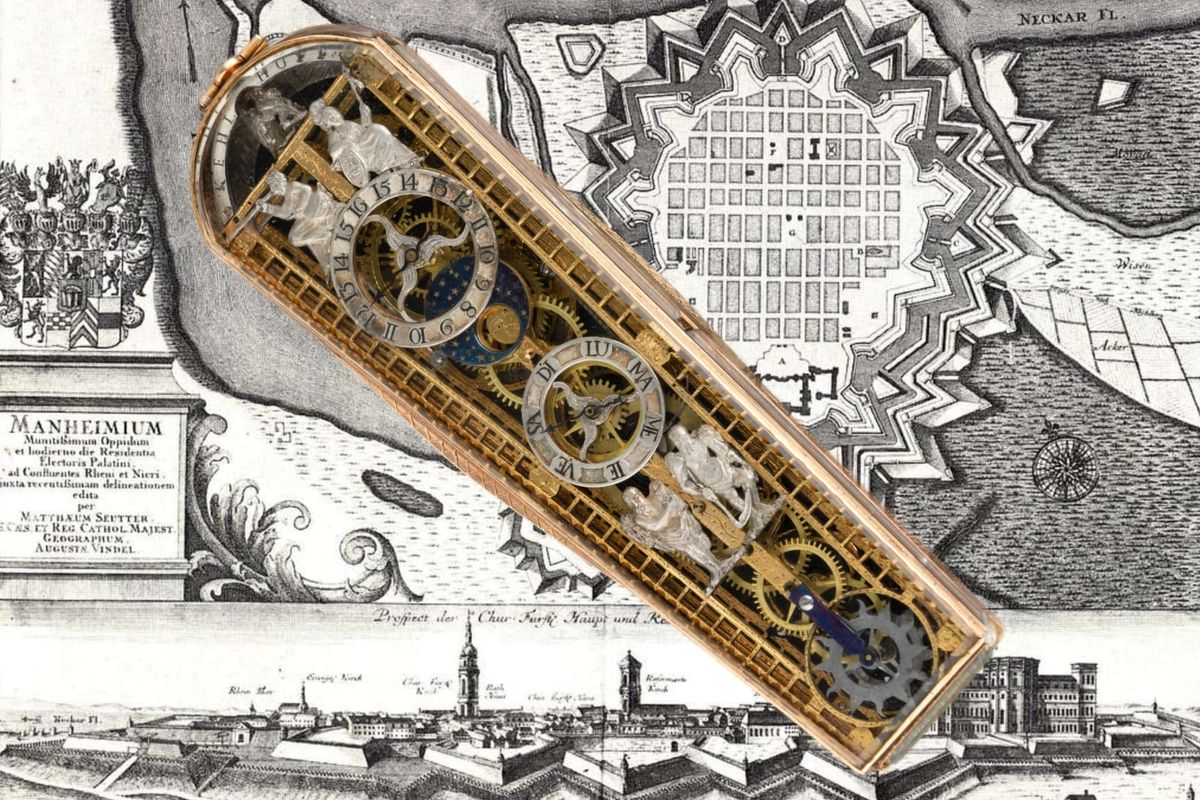
At 150 grams, the Kelhoff sarcophagus watch would sit in the palm with a density that immediately contradicts expectation — something closer to the concentrated heaviness of a reliquary, or a votive object, or a tool. The case is 135 millimetres from crown to foot, tapering toward the base in the manner of an Egyptian coffin, its gold flanks dressed in basketweave chasing, its faces sealed behind crystal. To turn it over is to discover that both sides are glazed, and that both sides are alive.
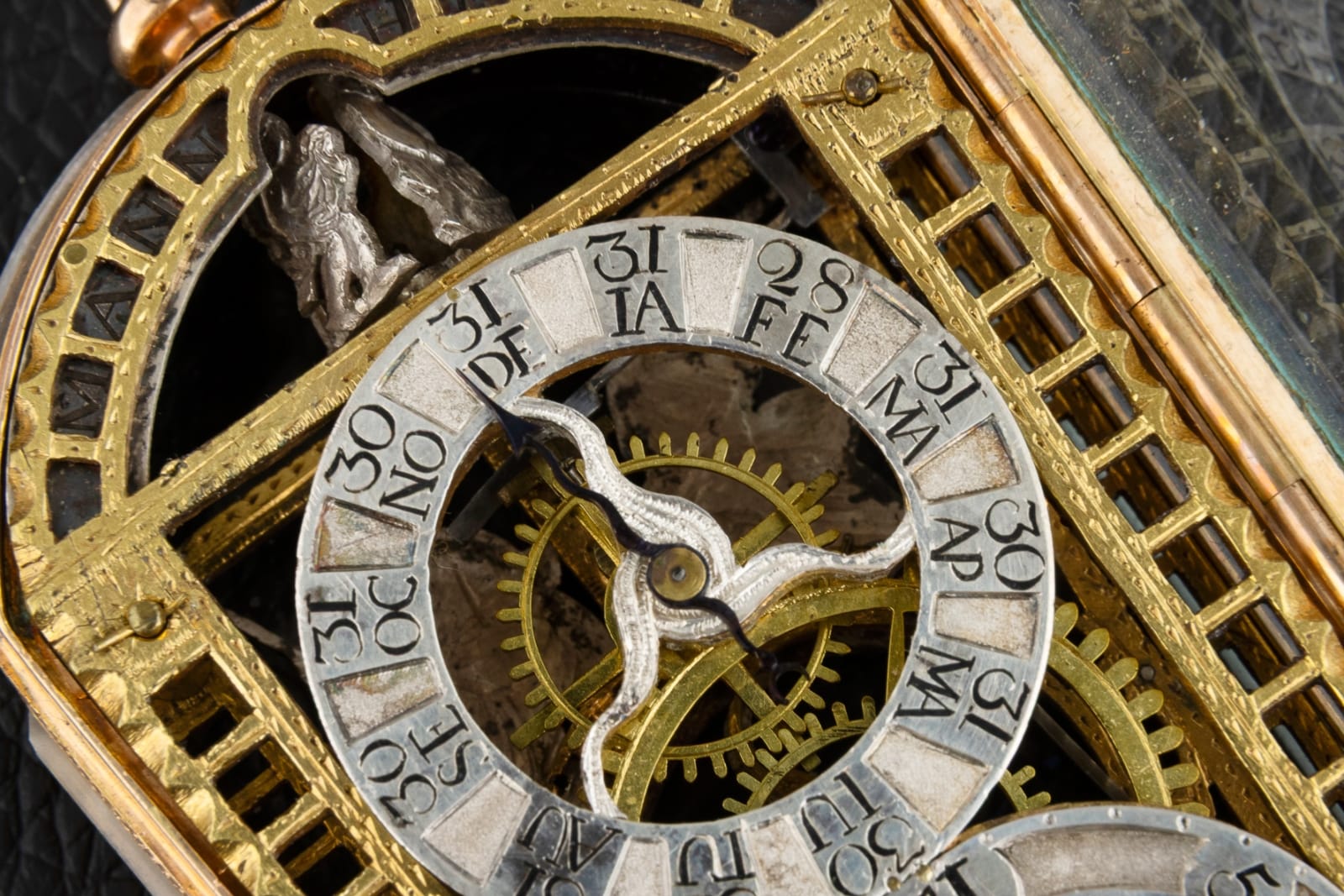
On one face, five chapter rings stack vertically down the length of the case like the floors of a building seen in section, seconds at the bottom, then minutes, then hours in Roman numerals, then the date, then the months, each ring larger than the one below it, each one skeletonised so that the wheel train behind it is fully visible, turning. At the apex, a small chased figure stands with a scythe. On the other face, a blue enamel disc carries a painted moon through its phases, surrounded by a ring numbered 8 to 16, the hours of daylight as they lengthen and contract across the year at the latitude of the Rhine. Above it, two silver figures flank the upper register: a woman with a celestial globe, another in martial dress. Below, a hand in blued steel points to the day of the week.
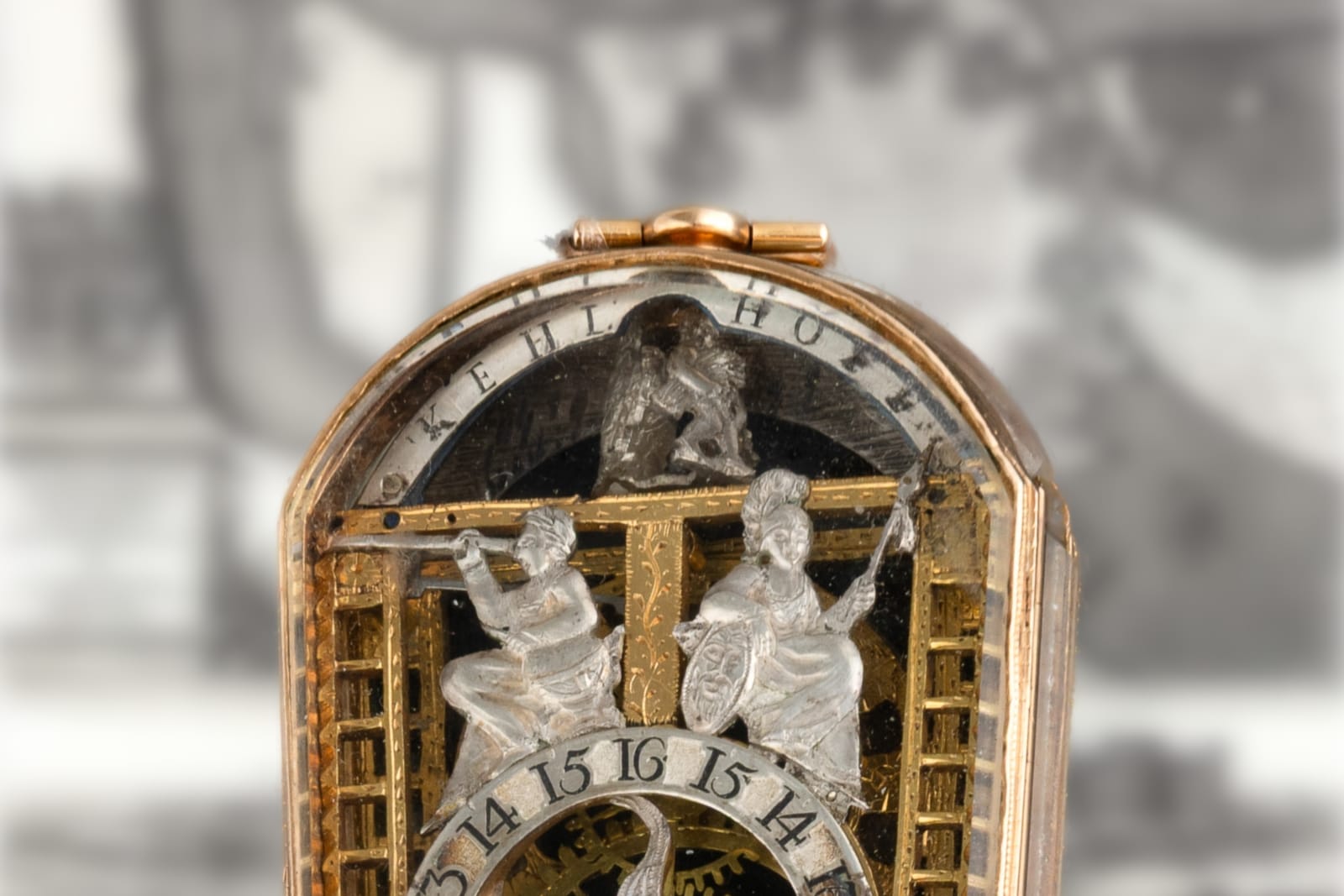
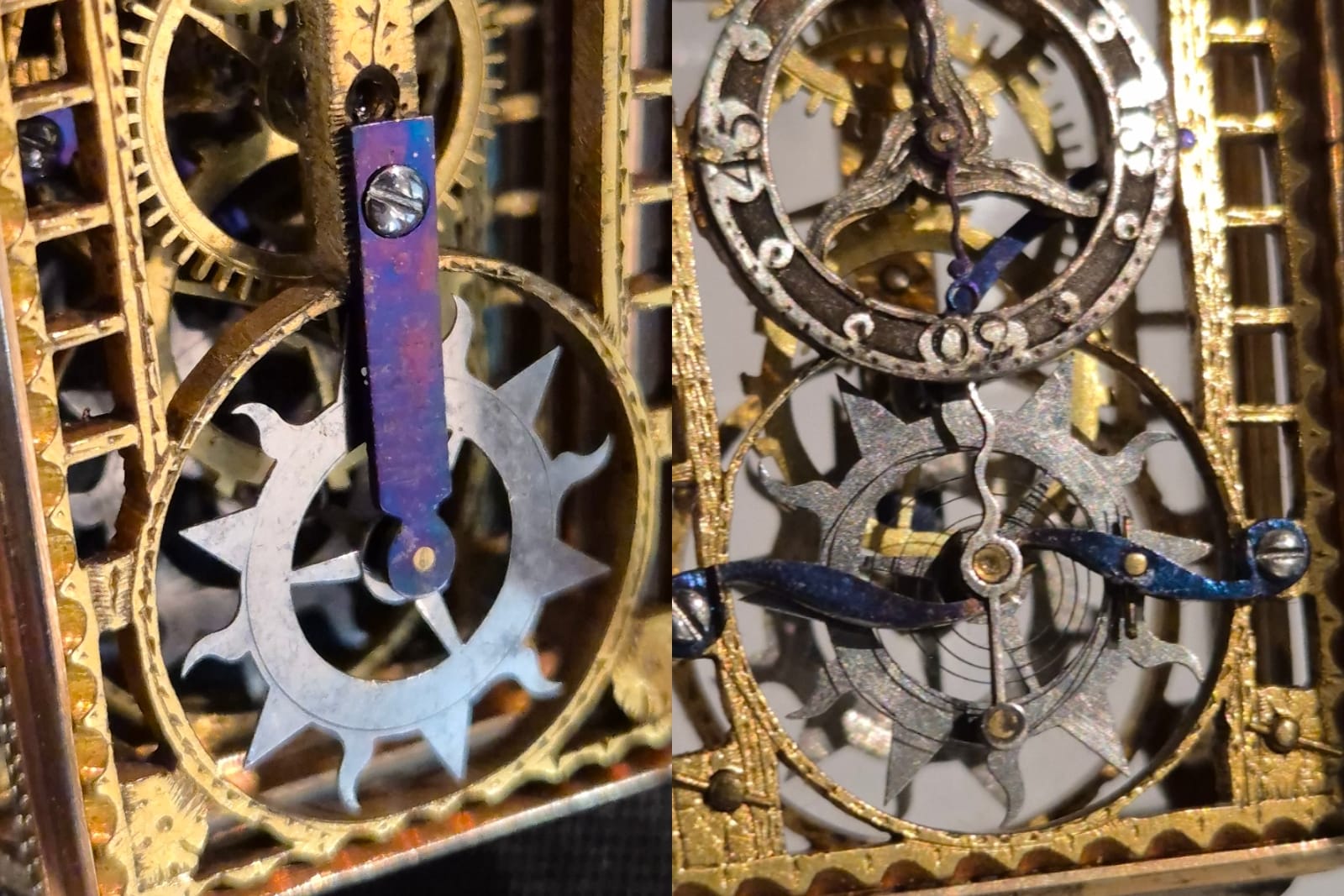
Somewhere inside all of this, on a balance staff shared between two steel wheels cut in the form of sunbursts, an escapement of a type that resists easy classification ticks, or rather, was ticking, until it stopped at some point in the last quarter century, and has remained still since. The watch is signed, on a silver arc at the top of the case, Kelhoff a Manheim. Specimens of his work reached the Ilbert Collection, now in the British Museum, and the Historisches Museum in Basel. The name is spelled differently in every document that records him.
The Name Problem
In the ledger of the house of Philippe Du Bois et Fils, kept sometime around 1771 and preserved in the pages of the Journal suisse d’horlogerie of December 1943, a watchmaker appears among a list of insolvent debtors: “Frédrich Kellhoff, horloger à Mannheim, mort insolvable.” The entry is four words of verdict on a man’s career. It is also, characteristically, wrong about his name, or rather, it renders it in one of the five orthographic variants that pursue Kelhoff across two and a half centuries of documentary record. Kelhoff, Kehloff, Kehlhoff, Kellhoff, Kelhof: five spellings across six independent sources, from a Swiss commercial ledger of 1771 to a Sotheby’s auction catalogue of 2019. The variation is consistent enough to suggest that the name was genuinely unstable and that even contemporaries who had commercial dealings with the man could not agree on how to write him down.
This matters more than it might appear. The watch trade of the eighteenth century ran on signature and reputation, on the legibility of a name engraved on a movement or painted on a dial. A maker whose name resisted standardisation across the three cities in which he worked — Mannheim, London, Vienna — was a maker whose reputation could not travel cleanly. Every misspelling was a small act of erasure, a degree of separation between the object and its author. The sarcophagus watch is signed Kehlhoff a Manheim on a silver arc. Baillie, in his Watchmakers and Clockmakers of the World, records a Friedrich Kelhoff. Abeler, in Meister der Uhrmacherkunst, writes Kehloff. The 1884 Revue chronométrique, reproducing a technical drawing of his patented remontoir mechanism from a watch then in the possession of M. P. Garnier, gives the signature as it appears on the movement itself: Frederic Kehlhoff London by his majestys Patent. Each source is working from a different physical object, a different signed artefact, and each produces a different name.
The earliest independent record is the Du Bois ledger entry, which places Friedrich in Mannheim at the end of his life and records his death as insolvent, a condition that, as will become clear, was neither the beginning nor the end of his financial difficulties. The next in chronological proximity to the man himself is the 1884 Revue chronométrique piece, published in Paris just over a century after his death, which reproduces the movement drawing and confirms the 1764 London patent for a pendant-winding remontoir incorporating a stackfreed. These two documents, a commercial bad-debt record and a French horological journal, constitute the primary layer of the biographical record. Everything else is compilation: Baillie drawing on British patent archives and the Ilbert collection catalogue; Abeler working from Austrian and German guild sources; the Sotheby’s and Antiquorum catalogue notes synthesising both, at one further remove, for the auction market.
The biographical record, imperfect and layered as it is, describes a career conducted across the major horological centres of Enlightenment Europe, technically brilliant, geographically restless, and financially ruinous. The name problem is not incidental to that career. It is certainly a symptom of it.
The Triangle
Mannheim in the middle decades of the eighteenth century was a city of deliberate grandeur. Rebuilt on a strict grid plan by the Electors Palatine, it was one of the few European cities whose rationalist ambitions were matched by genuine intellectual substance. Under Elector Carl Theodor, who assumed the Palatinate in 1743 and held it for four decades, Mannheim acquired a court orchestra of international reputation, an academy of sciences, and an observatory equipped for serious astronomical work. The demand for precision timekeeping in such an environment extended well beyond luxury — the Mannheim Observatory required instruments capable of supporting the calculations being conducted there, and the watchmakers who served the Elector’s court operated at the intersection of scientific instrument-making and decorative art. It was in this milieu that a watchmaker signing himself Kelhoff a Manheim developed the technical ambitions that the sarcophagus watch would eventually embody.
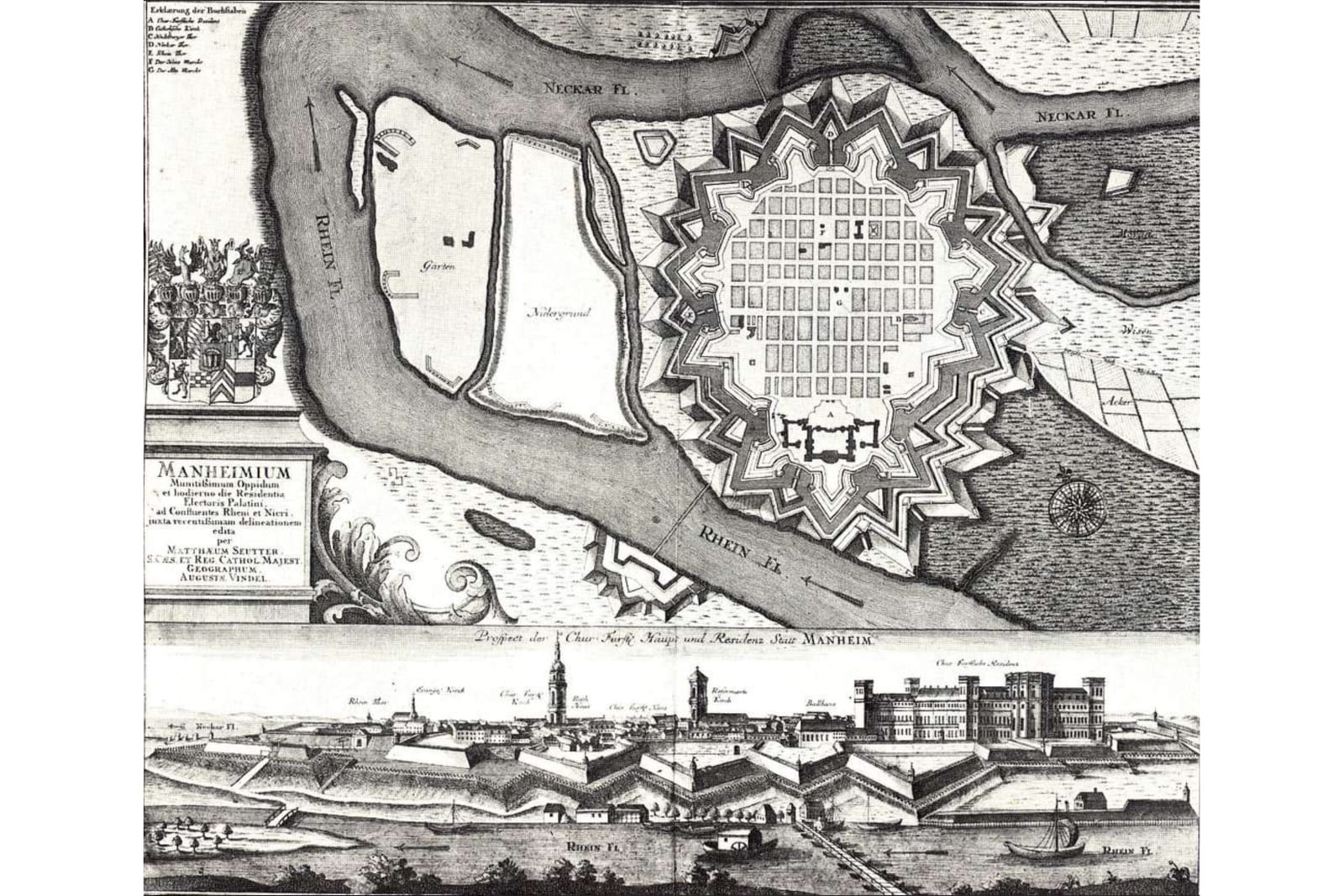
The precise dates of his Mannheim years remain unrecovered. The MARCHIVUM, the city’s central archive, holds council protocols, land registers, and address books from the period, but the absence of standardised civil registration before the nineteenth century means that tracing an individual requires granular searches across church records and guild documents. Searches complicated, in Kelhoff’s case, by the orthographic instability that makes even a simple name search an exercise in variant thinking. What the record does preserve is the fact of his presence: the sarcophagus watch, signed with the Mannheim attribution, is the most substantial evidence, but the Du Bois ledger entry of 1771 places him there at the end of his life, and Abeler’s entry in Meister der Uhrmacherkunst records a Kehloff working in Vienna in the late eighteenth century with a watch in the Historisches Museum in Basel, a provenance that suggests a maker with established connections across the Germanic and Swiss watch trade.
London came before Vienna, and London was where the ambition collided most visibly with financial reality. G. H. Baillie records a Friedrich Kelhoff active in the British capital and noted as insolvent in 1761, a fate that was common among innovative makers who invested heavily in research and development without the commercial infrastructure to sustain it. The London trade of the mid-eighteenth century was among the most competitive in the world, and an immigrant maker from the German states, however technically accomplished, faced structural disadvantages in a market organised around guild membership, established workshop networks, and the patronage of a clientele that already had its preferred suppliers. Insolvency in 1761 was a verdict, but it was not a terminal one. Three years later, in 1764, Friedrich Kelhoff secured a patent for a centre seconds watch incorporating a stackfreed remontoir, a mechanism documented in the 1884 Revue chronométrique, which reproduces a technical drawing of the device from a watch then in the possession of the Parisian collector M. P. Garnier, signed on the movement Frederic Kehlhoff London by his majestys Patent. The patent is the act of a man who, having failed commercially, retreated into the workshop and produced something worth protecting.
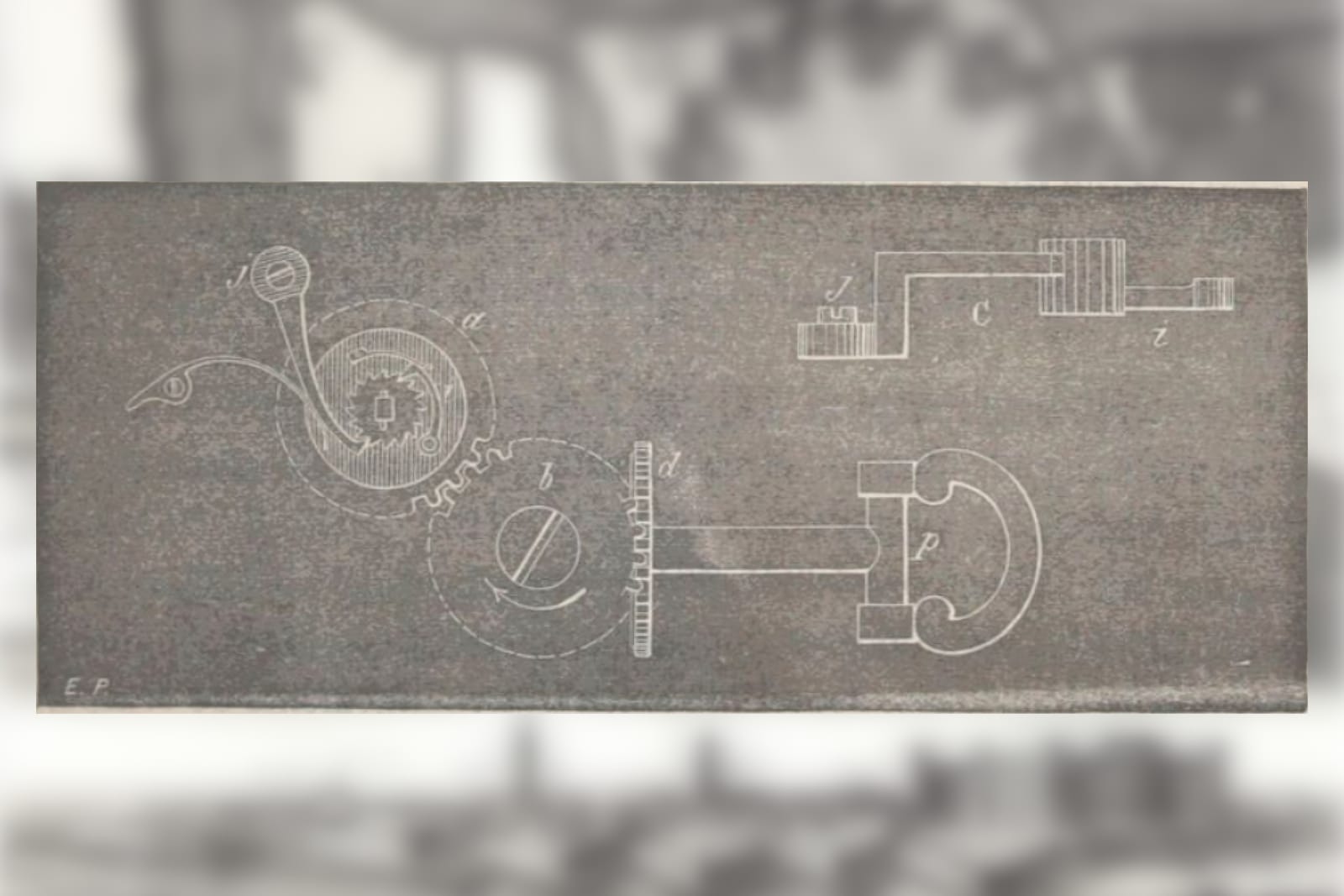
The stackfreed itself is a significant choice. By 1764, the fusee, a conical pulley and chain system that compensates for the diminishing force of the mainspring as it unwinds, had largely superseded the stackfreed across the major European centres. The stackfreed, a spring-loaded cam pressing against a snail-shaped wheel, was a German invention of the sixteenth century, considered by most of Kelhoff’s contemporaries an archaic solution to the torque compensation problem. Kelhoff’s decision to patent a refined version of it suggests a maker willing to look backward as well as forward, to find in a discarded mechanism an untapped potential that his more fashionable contemporaries had overlooked. For a centre seconds watch, where the additional gearing required to drive a central seconds hand creates significant drag, a finely tuned stackfreed may have offered a torque curve that Kelhoff found superior to the standard fusee for this specific application. The 1884 Revue chronométrique presents it without condescension, as a genuine technical curiosity deserving of documentation.
Baillie also credits Kelhoff with a watch featuring a type of pin-wheel escapement, a specimen of which was in the Ilbert Collection, which passed to the British Museum in 1958, though the piece does not appear in the museum’s current published catalogue. The pin-wheel escapement, a variation of the deadbeat in which the teeth of the escape wheel are replaced by pins projecting from the wheel’s face, was more common in French precision clockmaking of the period, associated particularly with Lepaute, and its appearance in a Kelhoff watch speaks to a maker conversant with contemporary mechanical theory across national schools. Taken with the stackfreed patent and the suspended cylinder escapement that would define his most significant surviving work, the pin-wheel watch establishes a pattern: Kelhoff was an experimenter, drawn to mechanisms at the margins of mainstream practice, willing to cross national and historical boundaries in search of solutions.
From London he moved, or returned, eastward. The Vienna connection is the least documented of the three cities, but the presence of a Kelhoff watch in the Historisches Museum in Basel, a city that served as a commercial gateway between the French and German-speaking horological worlds, suggests a maker participating in the export networks that moved high-quality German and Austrian work toward Swiss and French markets. Vienna in the last decades of the eighteenth century was the heart of the Holy Roman Empire, and its watchmakers worked under the patronage of the Habsburg court, producing pieces that competed directly with the best London and Paris had to offer. Whether Kelhoff achieved the imperial patronage he may have sought there is unrecorded. What the Du Bois ledger tells us is that by 1771 he was back in Mannheim, and that he died there insolvent, the same verdict London had returned a decade earlier, the same financial condition that seems to have accompanied him across the entire triangle of his career.
The sarcophagus watch was almost certainly made during this final Mannheim or Viennese period, in the 1780s or thereabouts. The Antiquorum catalogue of 1990 dates it to circa 1780, and the suspended cylinder escapement it contains connects it directly to the skeleton watches signed Kehlhoff in Mannheim that Antiquorum identified in the same sale. A maker who died insolvent in 1771 could not have made it. The watch therefore postdates its maker’s death, which raises a question the sources do not resolve: was there a workshop, a son, a successor who continued under the Kelhoff name? The 1878 Études sur l’Horlogerie of Paul Frédéric Dubois records an elderly watchmaker named Kelhoff still working in Geneva at the age of 85, capable of executing work of extreme delicacy, a detail cited in passing, as evidence that physical exercise preserves good eyesight, but suggestive of a family presence in the trade that extended well into the nineteenth century. The name, unstable as it was, survived the man.
The Object
The sarcophagus shape arrives before anything else. Before the complications, before the automata, before the question of who made it and where. The form itself demands an account. In the decorative vocabulary of late eighteenth-century Europe, the sarcophagus was a Neoclassical emblem with a specific and well-understood resonance: mortality, eternity, the passage of time made architectural. It had entered the European imagination through the antiquarian scholarship of the early century. Bernard de Montfaucon’s L’Antiquité expliquée, published between 1719 and 1724, had brought Egyptian and Roman funerary forms into serious circulation among architects, designers, and collectors, and by the 1770s and 1780s it was appearing in funerary monuments, interior furnishings, and the ornamental vocabulary of the early Neoclassical movement across France, the German states, and Britain. This is emphatically not the Egyptomania that Napoleon’s 1798 campaign would unleash on Europe, with its sphinxes and obelisks and the full apparatus of Empire-style decoration. The sarcophagus watch predates that wave by nearly two decades. It belongs instead to an earlier, more measured current of Egyptian interest, learned, antiquarian, filtered through Piranesi’s architectural fantasies and the symbolic language of Freemasonry, in which the Egyptian sarcophagus carried connotations of initiation, hidden knowledge, and the mystery of time itself.
For a watchmaker building an astronomical instrument, a machine whose explicit purpose is the measurement of celestial cycles, the tracking of the moon, the counting of the hours between sunrise and sunset, the sarcophagus form was a choice of extraordinary iconographic precision. The object that contains time also figures its end. The case that houses the mechanism for measuring the heavens is itself a coffin. Whether Kelhoff arrived at this conjunction through deliberate programme or through the intuition of a maker steeped in the visual culture of his moment is, like much else about him, unrecoverable. The object makes the argument regardless.
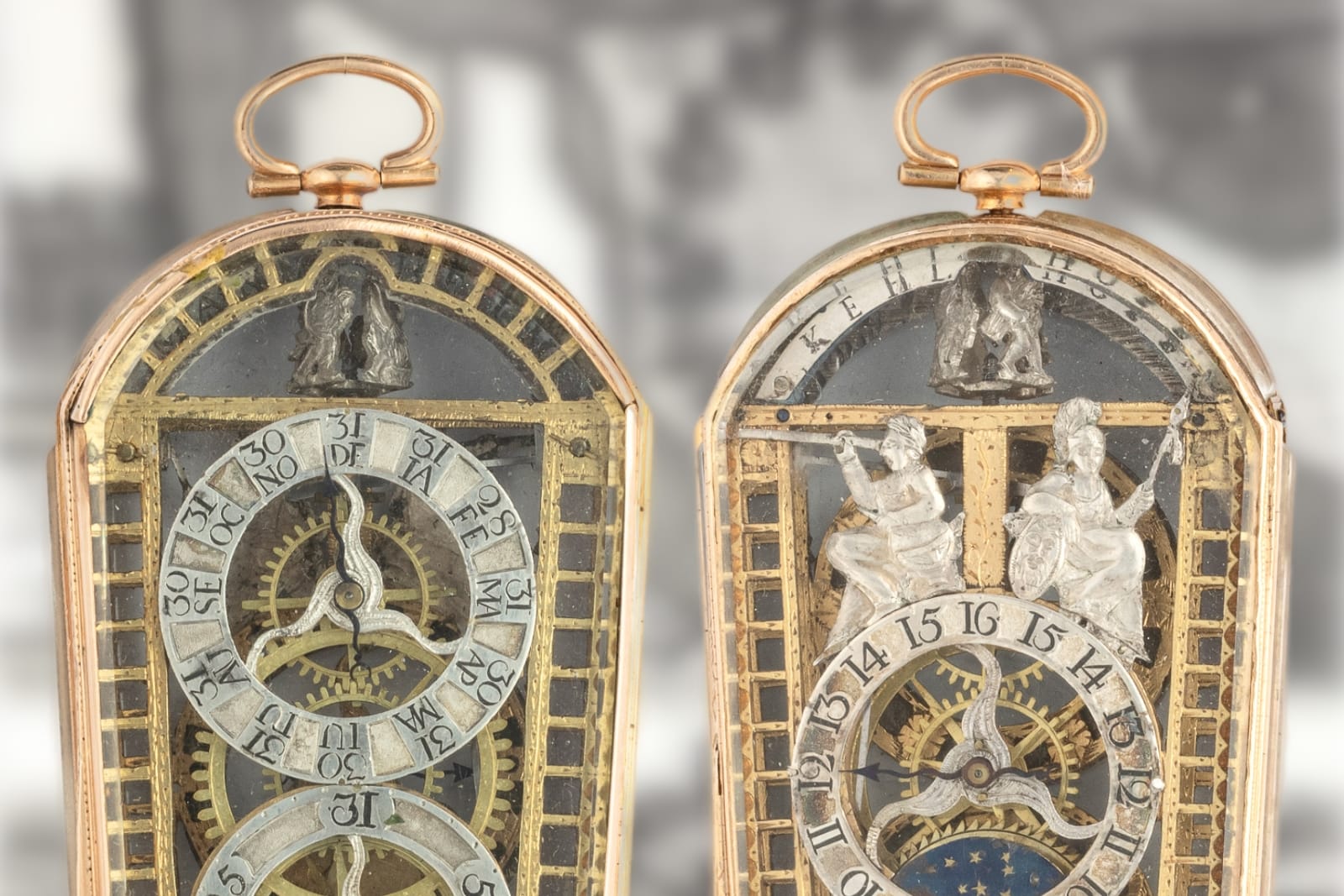
The first problem the sarcophagus form poses is architectural. A conventional pocket watch is round because the movement inside it is round — the circular plate, the concentric wheel train, the balance at the periphery: the form follows the mechanics with a directness that is almost tautological. To build a watch in a sarcophagus form is to abandon that logic entirely, to impose on the movement a shape that the movement has no natural reason to inhabit. The case is 135 millimetres long and 40 millimetres wide, tapering from the arched crown to the narrower foot, and every component of the wheel train inside it has been custom-designed to function within that irregular space. The bridges, the plate, the positioning of the barrel and the going train, all of it recalculated from first principles to fit a form that announces, from the outside, that the maker considered the mechanical challenge an invitation rather than a constraint.
The case itself is red gold, a gold-copper alloy that was a stylistic marker of Central European luxury production in the late eighteenth century, its warmer tone distinguishing it from the yellower gold of French work and providing a chromatic counterpoint to the silver and blued steel of the components visible through the crystal. The basketweave chasing on the flanks is fine and consistent, the kind of decorative work that requires a separate hand (a caser rather than a movement maker) and its quality suggests a commission of some ambition, a patron willing to spend on the exterior as well as the interior. At 150 grams, the piece carries the weight of its materials honestly. This is indeed not an object designed to be forgotten in a waistcoat pocket.
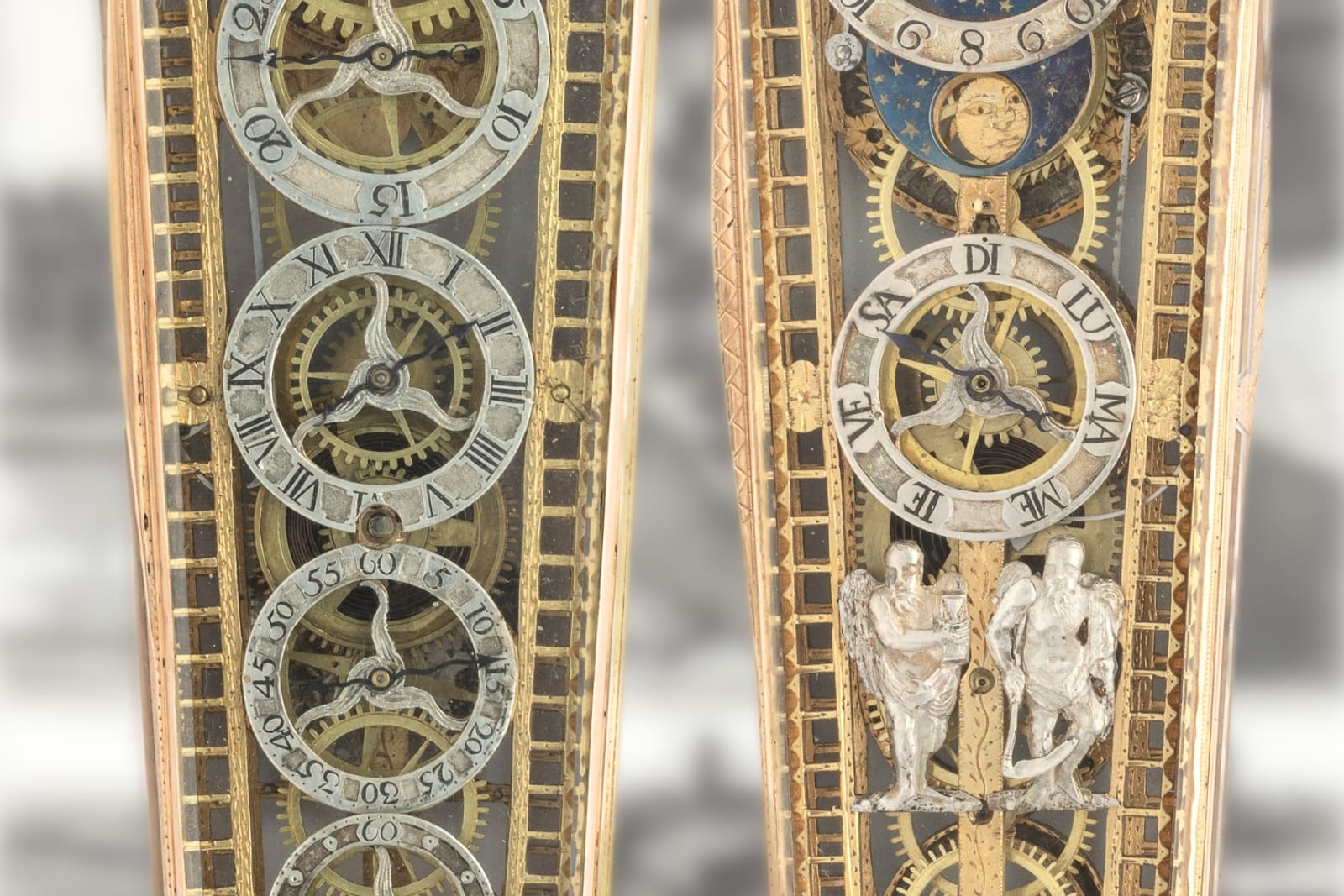
Both faces are fully glazed, and the glazing is structural to the object’s meaning. The sarcophagus watch is designed to be seen through, to make the mechanics visible rather than concealing them behind an opaque dial. On the timekeeping face, five chapter rings of increasing diameter are stacked vertically down the length of the case. The outermost ring of each carries the relevant scale — months at the top, then date, then hours in Roman numerals, then minutes, then seconds at the bottom — and each ring is skeletonised, its material reduced to the minimum necessary for structural integrity, so that the wheel train driving it is visible behind it, turning. The three-arm wheel carriers at the centre of each ring are polished to catch the light. The overall effect is less that of a dial than of a cross-section, a building seen with its facade removed, every floor exposed simultaneously.
At the apex of this face, the automaton figure of Chronos stands with his scythe. In the iconographic tradition of the eighteenth century, Chronos, Father Time, carried the scythe as an emblem of mortality, the instrument that cuts through all human endeavour regardless of its ambition or refinement. On the Kelhoff watch, the scythe is also functional: it marks the hours at the top of the chapter ring, integrating the memento mori into the primary time-telling mechanism with a precision that is either deeply considered or deeply fortunate, and in either case entirely characteristic of the period’s taste for allegory made mechanical.
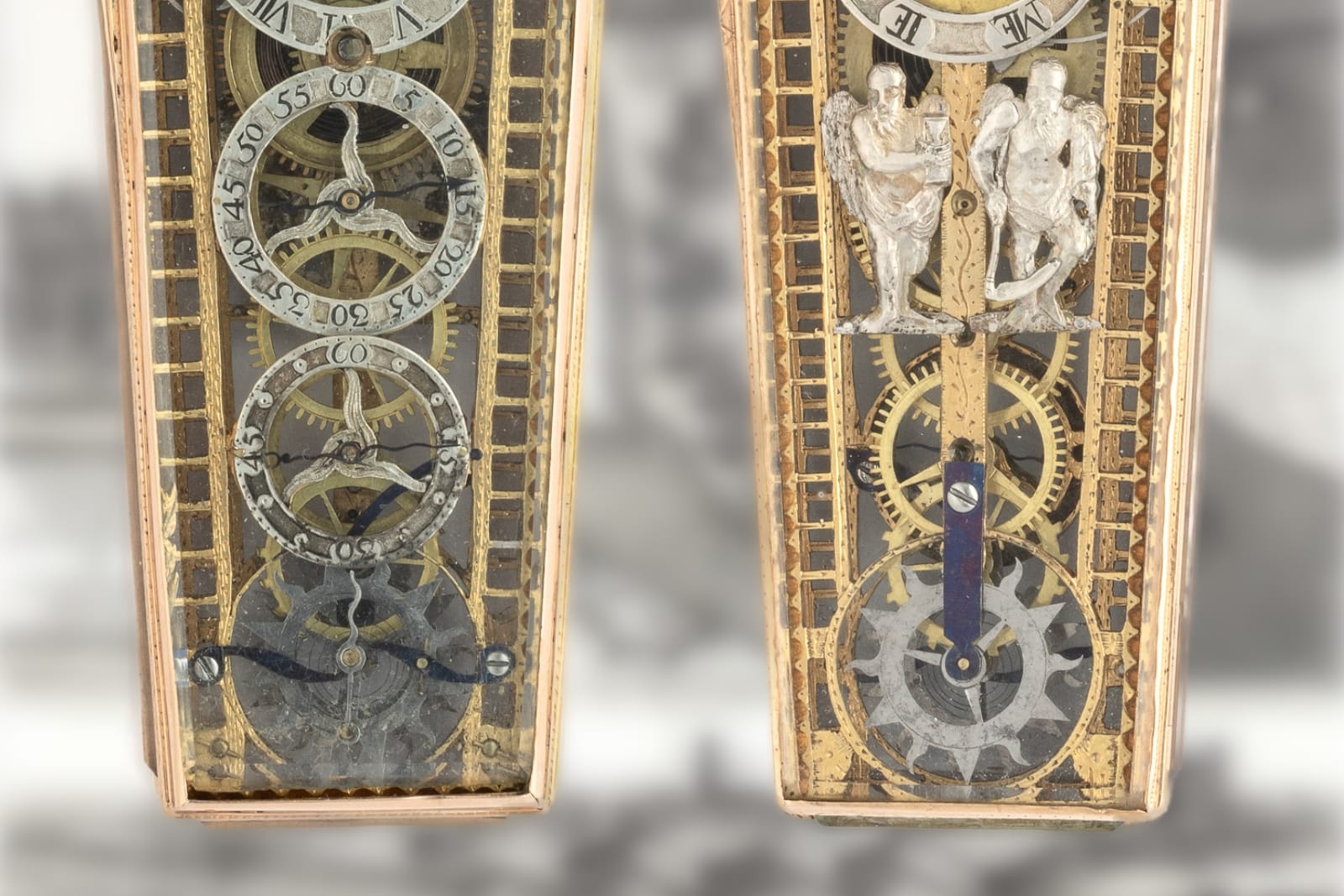
The reverse face is the astronomical one, and it is considerably more complex. The dominant element is a blue enamel disc carrying a painted moon, which rotates to display the lunar phases against a field of gold stars. Surrounding it is the sunrise and sunset ring, numbered 8 to 16, the range of daylight hours across the year at the latitude of Central Europe, calibrated specifically for the geography of the Rhine valley or thereabouts, which places the watch’s intended location of use with reasonable precision. Above the moon phase disc, two silver automaton figures flank the upper register: the figure carrying a celestial globe is Astronomy, the figure in martial dress is Minerva, goddess of wisdom and the patron deity of skilled craft. Below the moon disc, a ring carries the abbreviated names of the days of the week. Lower still, a hand in blued steel indicates one of the remaining functions. At the very bottom of this face, the large wheel of the going train is visible, its teeth meshing with the pinion of the next wheel in the train, the whole mechanism exposed to view in the manner of a demonstration piece or a scientific instrument.
Between the two faces, on a balance staff that runs through the centre of the movement, sit the two steel balance wheels of sunburst form that are Kelhoff’s most visually arresting technical signature. The sunburst design, with spokes radiating from the central staff, the rim cut into points, distributes the mass of the balance at a specific radius from the centre, controlling the moment of inertia and therefore the rate at which the balance oscillates. It also places a solar symbol at the heart of an astronomical instrument, a piece of iconographic consistency that extends from the figurative programme of the automata to the geometry of the regulating organ itself.
The revolving automaton with four putti emblematic of the seasons completes the iconographic programme. Driven by a slow-moving gear train connected to the calendar mechanism, it advances through the year as the months turn, each figure representing a season in the conventional allegorical manner of the period. The synchronisation required to coordinate the seasonal carousel with the lunar disc, the sunrise and sunset ring, the day and month indicators, and the primary time train, all running at vastly different speeds, from the rapid oscillation of the sunburst balances to the annual rotation of the seasonal figures, represents a feat of gear ratio calculation that is, in its own way, as demanding as the escapement design. There are makers who could build complications. There are fewer who could integrate them into a coherent mechanical and iconographic whole. The sarcophagus watch makes a case for Kelhoff belonging to the second category.
The Escapement
The catalogue entry for Lot 290 in the Antiquorum sale of October 1990 carries more authority than its format suggests. The principal expert writing Antiquorum’s catalogues at that time was Jean-Claude Sabrier, scholar, historian, and one of the most rigorous horological minds of the twentieth century, whose published work ranged from marine chronometry to the cylinder escapement tradition, and whose private collection centred on Breguet’s Souscription watches, the most commercially significant application of the ruby cylinder escapement that Breguet ever produced. Sabrier had joined Antiquorum in 1988 and would remain its principal cataloguing expert until 2000. He had also, in an earlier chapter of his career, served as a consultant to the Time Museum in Rockford, Illinois, the institution that held the Kelhoff sarcophagus watch as inventory number 3633. When the 1990 catalogue identifies a structural connection between a Kehlhoff skeleton watch and the Breguet ruby cylinder, it does so from the centre of Sabrier’s expertise, informed by his likely prior familiarity with the broader body of Kelhoff’s surviving work. This is far more than a generic cataloguer’s observation. It is a considered scholarly judgment made in the one format available to him at the time.
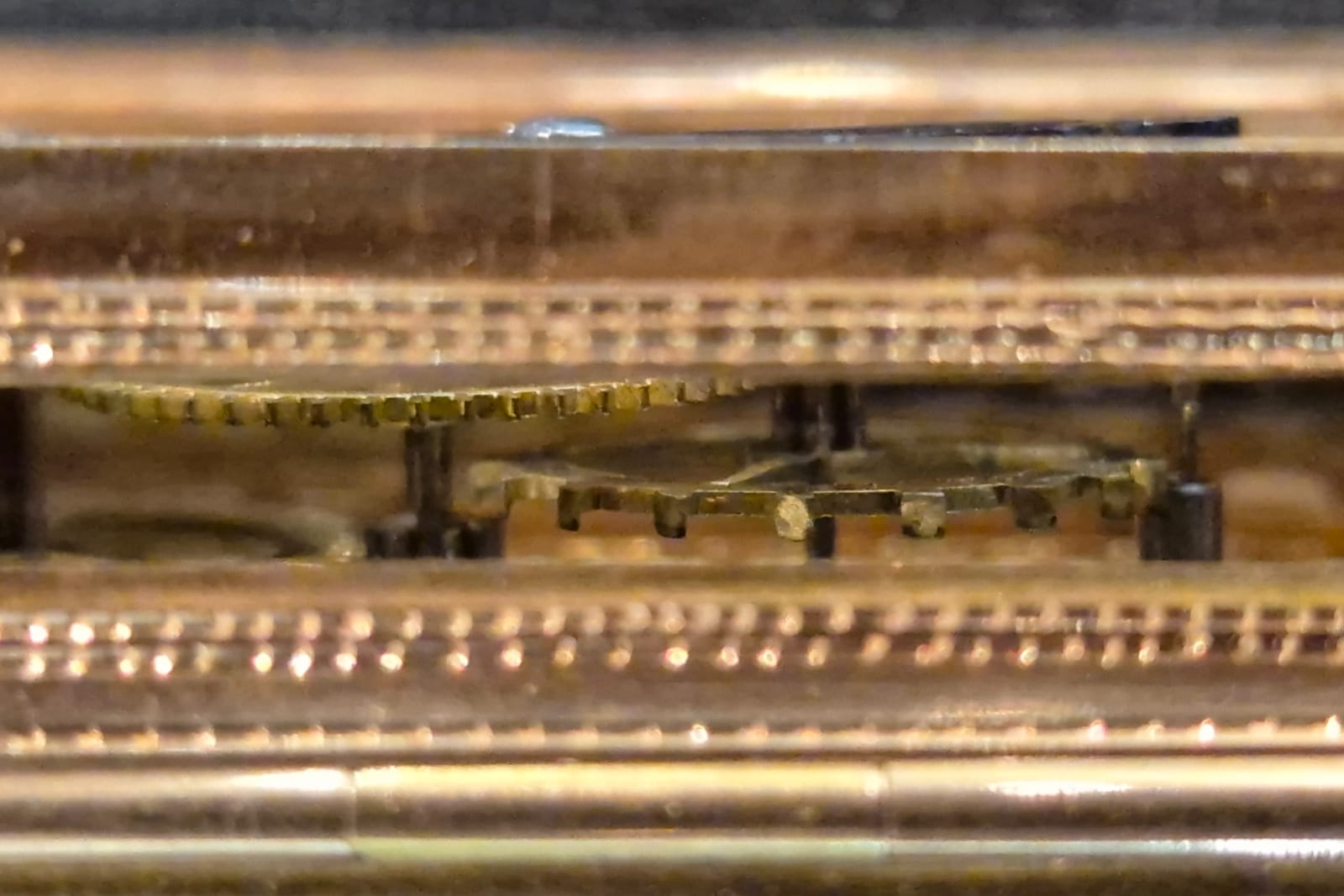
The watch in question, a fine 20-carat gold skeleton watch, double-glazed, signed Kehlhoff on the border of the back plate, diameter 40 millimetres, is described as possessing an interesting inverted cylinder escapement with a brass escape wheel, the half section of the steel cylinder in the form of a tile, completely isolated from the balance staff. The catalogue note then steps back from the object itself and makes a larger claim: that this escapement, found on at least two skeleton watches signed Kehlhoff in Mannheim and dating to the 1780s, foreshadows the Breguet ruby cylinder escapement whose ruby tile is shaped the same way and whose escape wheel is cut with teeth of the same form. Breguet, the note continues, used it first for his Souscription watches and subsequently adopted it for most of his watches for civilian use.
This is a significant assertion, made in an auction catalogue rather than a scholarly journal, and it deserves careful examination. The cylinder escapement in its standard form had been introduced to watchmaking by Thomas Tompion around 1695 and refined by George Graham into the dominant high-quality watch escapement of the eighteenth century. In Graham’s version, the cylinder, a hollow steel tube mounted on the balance staff, receives impulse from the teeth of the escape wheel as they pass through the opening in the cylinder wall, locking and releasing in a sequence that maintains the oscillation of the balance. The cylinder’s integration with the balance staff was a defining feature of the design: the two components shared an axis, the cylinder rotating with the balance as a single unit.
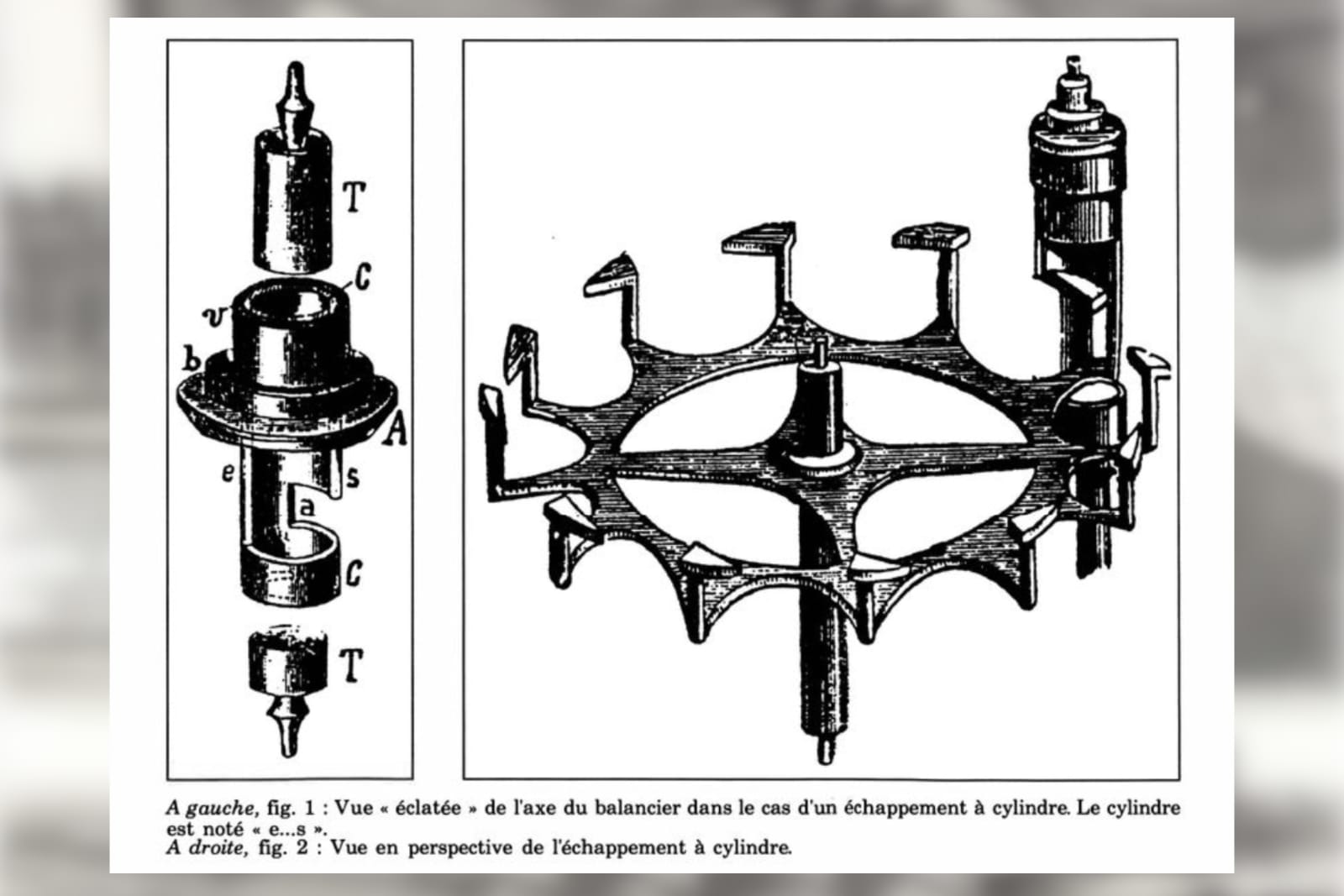
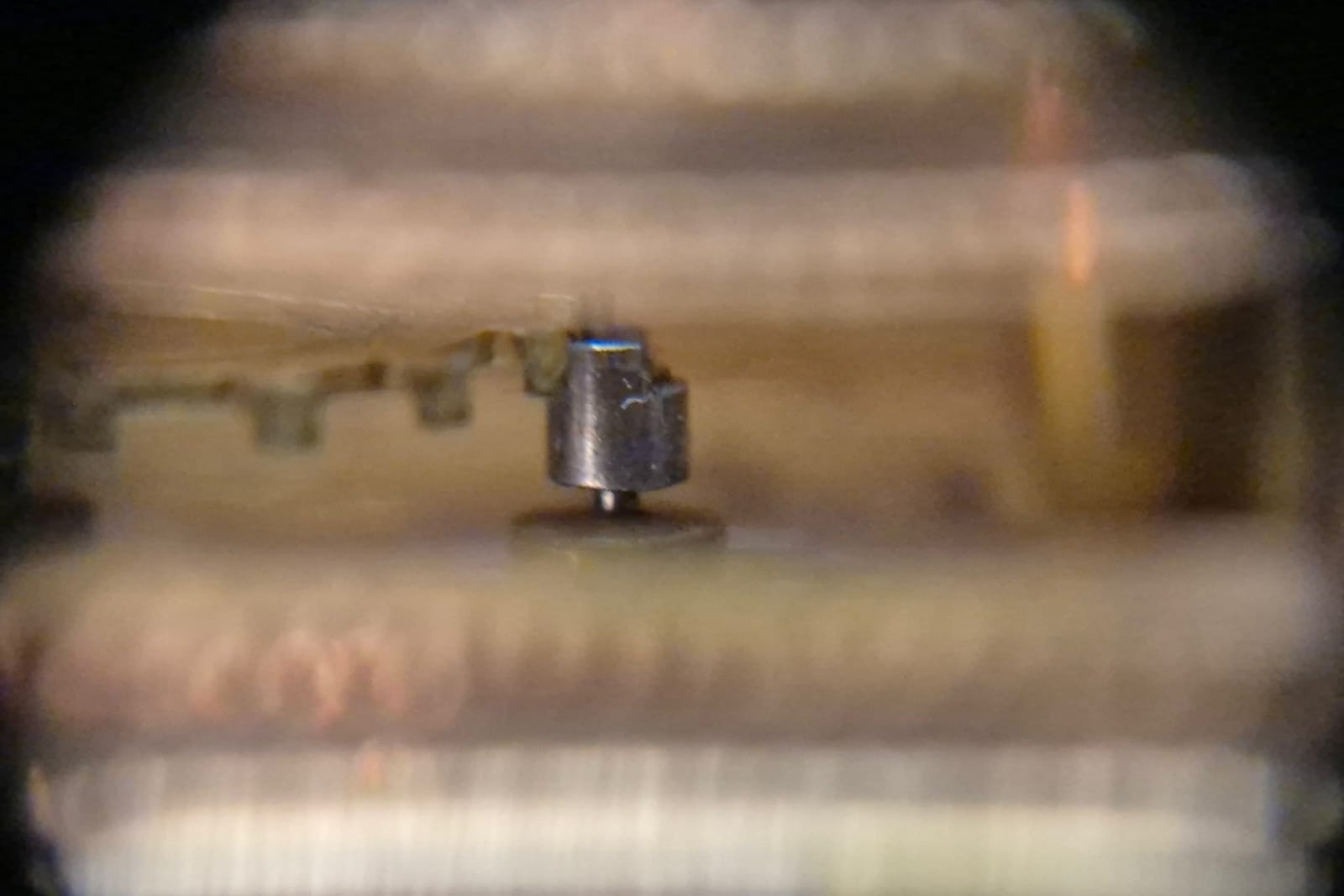
What Kelhoff did, and what Sabrier identifies in the Antiquorum catalogue as the critical innovation, was to suspend the cylinder independently of the balance staff, isolating the two components from each other. In Adolphe Chapiro’s 1996 study of the suspended cylinder escapement, published in the Bulletin of the ANCAHA, this configuration is described in precise mechanical terms: the half section of the steel cylinder acts like a tile, as in the Breguet construction, but is completely isolated from the balance staff, sitting in its own bearing and receiving impulse from the escape wheel independently of the balance’s rotational axis. Chapiro identifies the Antiquorum 1990 Kehlhoff watch as one of the earliest documented examples of this configuration, and draws a direct line from it to Breguet’s ruby cylinder, the escapement that would define the Souscription watch of 1798 and, through it, the most commercially successful line of watches Breguet ever produced.
The Souscription watch was Breguet’s response to the disruptions of the Revolutionary period — a simplified, robust, affordable precision watch designed for a broad civilian market, offered to subscribers at a fixed price before manufacture. Its escapement was the ruby cylinder, in which the steel tile of the earlier cylinder was replaced by a ruby, reducing friction and extending service intervals. It was, by any measure, the escapement that made precision timekeeping accessible beyond the aristocratic patronage market, and it remained central to Breguet’s production through the Consulate and Empire periods. The Antiquorum 2000 catalogue, describing a Martin Firstenfelder watch with a similar suspended cylinder configuration, restates the connection explicitly: Breguet used the escapement first for his Souscription watches and subsequently adopted it for most of his watches for civilian use, and refers the reader directly to the 1990 Kehlhoff lot as the comparative precedent.
The mechanism documented in the 1884 Revue chronométrique adds a further dimension. The pendant-winding remontoir reproduced there, from the watch signed Frederic Kehlhoff London by his majestys Patent, patented in 1764 and then in the collection of M. P. Garnier, is a different device from the suspended cylinder, but it belongs to the same intellectual project: the search for more consistent power delivery to the escapement, the reduction of the variables that cause a watch to gain or lose rate as the mainspring runs down. Taken together, the stackfreed remontoir, the suspended cylinder and the pin-wheel escapement in the Ilbert Collection describe a maker whose entire career was organised around the problem of escapement improvement, who approached that problem from multiple directions simultaneously, and who arrived, in at least one instance, at a solution that Breguet would independently reach, refine, and make famous.
Chapiro is careful about the word independently. He notes that the orthographic variant Kehlof appears in Tardy’s horological dictionary in connection with a maker who produced escapements for Abraham-Louis Breguet. It is a reference that, if accurate, would transform the relationship from parallel development to direct influence. The Tardy citation requires verification that the current state of the published record does not permit, and Chapiro flags it as suggestive rather than conclusive. It is included here on the same terms. If Kelhoff or a member of his family supplied escapement components to Breguet’s workshop, the filiation is not a matter of mechanical coincidence but of direct transmission, which would make the sarcophagus watch not merely a precedent but a source. That question remains open.
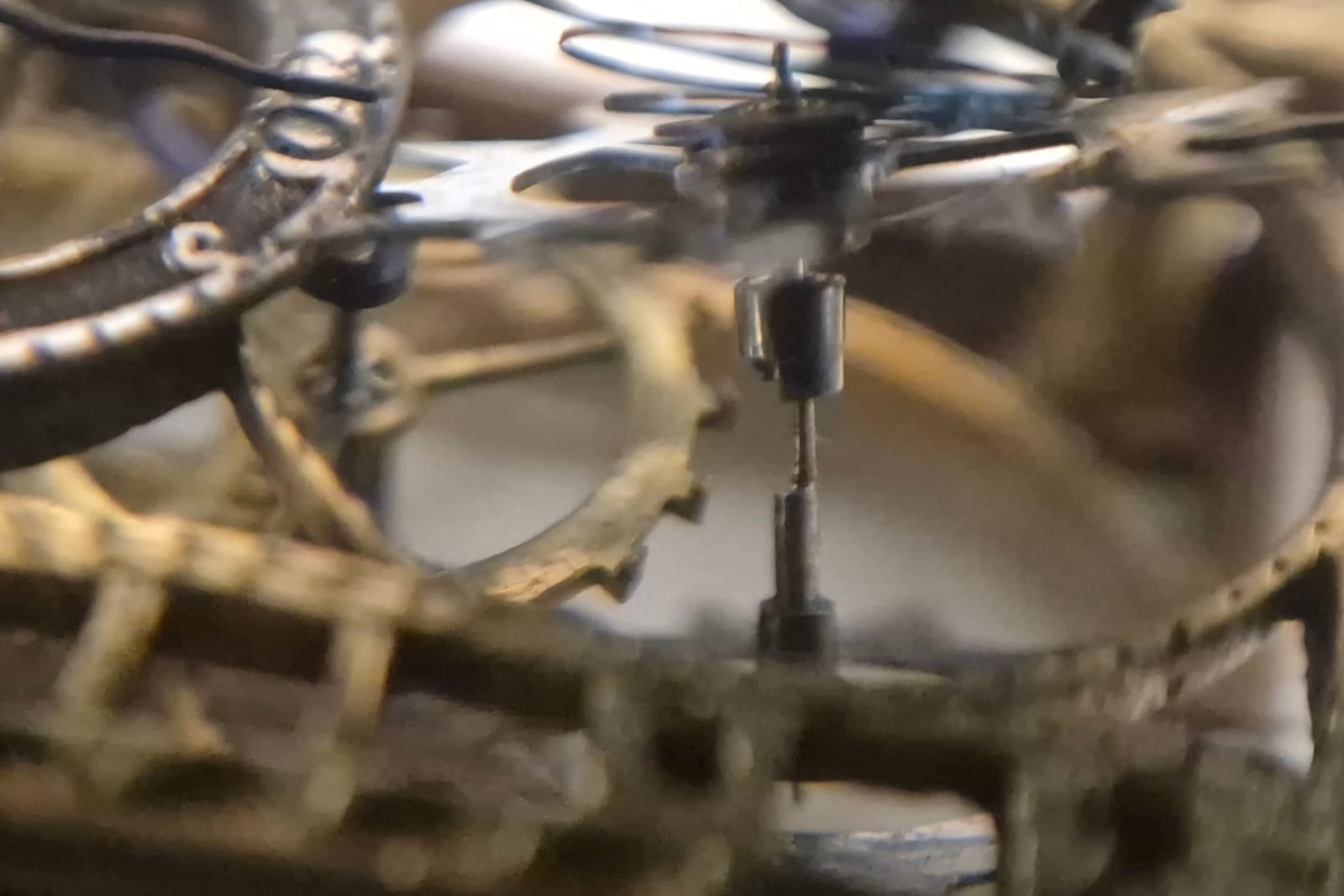
What the sources do establish, without equivocation, is that the suspended cylinder escapement found in the Kelhoff skeleton watches of the 1780s preceded the Breguet ruby cylinder by at least a decade, that the two mechanisms share a defining structural feature (the isolation of the cylinder from the balance staff) and that Jean-Claude Sabrier, working from the physical evidence of the watches themselves and almost certainly from prior knowledge of the sarcophagus watch in Rockford, considered the connection sufficiently robust to state it in print, and to restate it a decade later. For a maker who died insolvent in Mannheim in 1771, whose name was spelled differently by everyone who recorded it, and whose most significant surviving work has spent the last quarter century in a non-running state, that is a considerable posthumous claim.
The Provenance as Argument
In 1958, Courtenay Ilbert bequeathed to the British Museum one of the most comprehensive private collections of horology ever assembled: some 3,000 clocks, watches, and instruments spanning five centuries of European and Asian timekeeping. Among them, per Baillie’s record, was a watch with a type of pin-wheel escapement attributed to Kelhoff. The bequest was the act of a collector who understood that certain objects mattered to the history of the craft regardless of the fame of their makers, and the British Museum’s acceptance of it on those terms represented an institutional judgment about what horological significance looked like when stripped of commercial celebrity. The Kelhoff watch, if it entered the collection, entered it on merit.
The same logic governed the acquisitions of Seth Atwood, the Illinois industrialist who built the Time Museum in Rockford into what was widely regarded as the most important collection of time-measuring instruments in the world. Atwood collected across the full span of horological history, from ancient sundials to atomic clocks, with a consistent preference for objects that represented technical firsts or unique solutions to mechanical problems. What a later generation of collectors would call intellectual horology. The sarcophagus watch entered the Time Museum as inventory number 3633, its suspended cylinder escapement and astronomical complications placing it squarely within the collection’s institutional logic. In Rockford, it was among its kind.
The Time Museum closed in 1999, and its contents were dispersed through a series of Sotheby’s auctions that represented one of the most significant redistributions of horological material in the history of the market. The Kelhoff watch appeared in the second of these sales, Masterpieces from the Time Museum, Part Two, held in New York on 19 June 2002 as Lot 56, carrying an estimate of $20,000 to $40,000 and selling for $89,600, more than twice the high estimate. That result reflected both the quality of the object and the appetite of a collector market that had spent the preceding decade developing a serious interest in precisely the kind of technically anomalous, historically significant piece that the Time Museum had specialised in acquiring. In 2002, the Kelhoff watch found the room it deserved.
What happened next has been misreported. A subsequent research document on the watch states that it was acquired at the 2002 sale by George Daniels, the greatest horologist of the twentieth century, inventor of the co-axial escapement, and a collector of exceptional discernment whose personal holdings would have conferred on any piece an additional layer of validation. The claim is understandable as an inference: the watch reappeared in 2019 in a Sotheby’s London sale titled Masterworks of Time: George Daniels, Visionary, and the title invited exactly that misreading. In fact, the 2019 sale was the dispersal of the collection of Erivan Haub, the German billionaire and heir to the Tengelmann retail group, whose 800-piece accumulation of horological material Sotheby’s chose to frame under Daniels’s name as a curatorial and marketing device, honouring Daniels as the intellectual patron saint of serious pocket watch collecting rather than identifying him as the owner of the lots. The 2019 catalogue for Lot 66 states the provenance without ambiguity: Time Museum, Rockford Illinois, Inventory no. 3633; Sotheby’s New York, 19 June 2002, Lot 56. No intermediate owner is named. Daniels never owned the watch.
The 2019 sale result tells its own story. The estimate was £9,000 to £13,000 (a fraction of the 2002 hammer price, adjusted for currency and inflation a significant reduction in perceived value) and the watch sold at £9,375, just above the floor. The condition report for the lot noted that the movement was not running, though the balance wheel rotated freely. In a sale dominated by the George Daniels Space Traveller I, which sold for £3,615,000, and surrounded by material from one of the great private horological collections of the twentieth century, the Kelhoff watch was effectively invisible. It sold to a buyer whose identity is unrecorded, at a price that bore no relationship to its historical significance, in a room that was looking elsewhere.
The Wannenes catalogue for the forthcoming Milan sale of 19 May 2026, Auction 614, Lot 191, lists the piece at an estimate of €10,000 to €15,000. It notes that it requires service and that one side glass panel needs resetting. The provenance chain is stated correctly for the first time in a published catalogue, including all three auction appearances in sequence. The physical condition is unchanged from 2019. The balance wheel still rotates freely.
*
There is a particular kind of historical injustice that operates not through suppression or malice but through the ordinary friction of time: the misspelled name in a commercial ledger, the patent that generates no revenue, the workshop that continues after the maker’s death under a signature no one can agree how to spell. Kelhoff did not disappear from the record. He appears in it repeatedly, in six independent sources across two and a half centuries, in five different spellings, in three cities, in the collections of two museums. The problem is not absence, but the gap between what the sources collectively establish and what the market, and the literature, have been willing to conclude from them.
What the sources establish is this: a watchmaker of German origin, active in Mannheim, London, and Vienna in the middle and later decades of the eighteenth century, developed an escapement configuration that preceded Breguet’s most commercially significant design by at least a decade, possibly supplied escapement components to Breguet’s workshop directly, built at least two skeleton watches of extraordinary mechanical originality, patented a stackfreed remontoir in London in 1764 three years after being declared insolvent, and produced, at some point in the 1780s, a gold sarcophagus-form astronomical watch of a complexity and iconographic coherence that places it among the most ambitious portable instruments of its era. He died insolvent in Mannheim in 1771. The watch outlived him by at least a decade. The name survived him by at least a century.
The sarcophagus watch is coming up for sale in Milan on 19 May 2026. It requires service. One side glass panel needs resetting. The movement is not running. And yet the balance wheel rotates freely, which is the auction house saying, with professional care, that the escapement still moves. The steel sunburst wheels on their shared staff, the suspended cylinder in its independent bearing, the whole improbable mechanism that Sabrier identified in 1990 as the structural precursor to the most widely produced Breguet escapement of the nineteenth century: after two and a half centuries, it still has motion in it.
Someone should wind it up.
Acknowledgment
I am deeply grateful to horological expert Giacomo Cora of Wannenes Group for his exceptional generosity in providing exclusive photographic access to this watch prior to auction. Mr. Cora went to extraordinary lengths to document the movement's technical details, including extracting the balance wheel to photograph the suspended cylinder escapement, efforts that provided unprecedented visual documentation of this rare mechanism.